
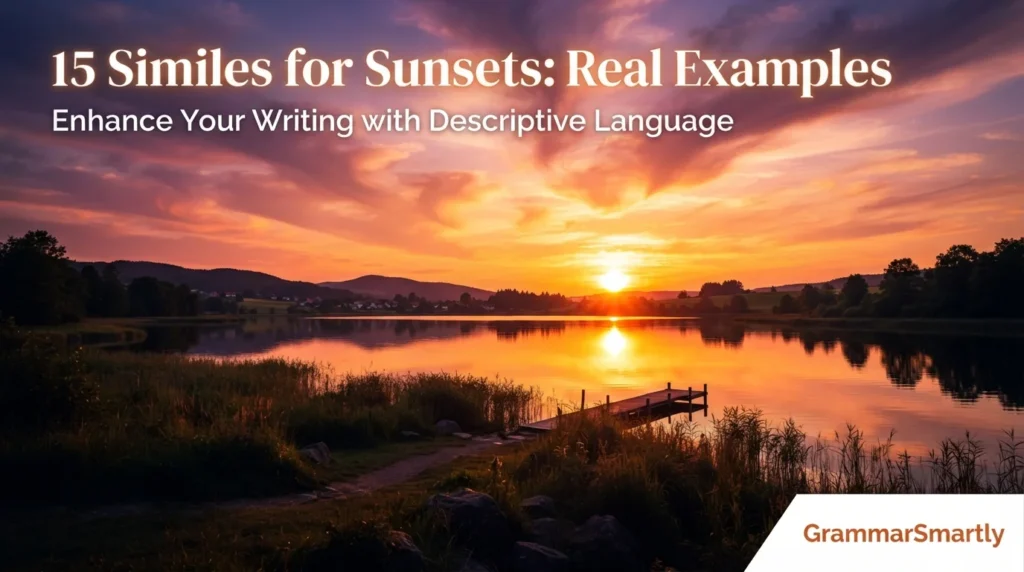
Sunsets are especially well suited to figurative language because they combine strong color, changing light, movement, warmth, and a sense of ending. Writers often compare a sunset or sunset-lit sky with familiar things such as fire, gold, flowers, or a candle to make the scene easier to picture. These comparisons can be simple and conversational or highly poetic.
A simile compares one thing with another by using words such as like or as. Cambridge, Oxford, and Merriam-Webster all describe this basic feature of the form.
There is an important qualification, however. Many websites publish long lists of supposedly “real similes for sunsets” that are actually newly created descriptive comparisons. For example, phrases such as “like melted crayons” or “like a bowl of warm soup” can function grammatically as similes, but that does not make them established English expressions.
For that reason, this list focuses on recognizable, independently attested simile patterns that can naturally describe a sunset. The article also keeps metaphors separate rather than treating every colorful comparison as a simile.
Choosing similes describing perseverance and resilience helps communicate steadfastness without relying on repetitive wording.
What Makes a Sunset Simile Work?
A simile normally signals its comparison openly with like or as. “The sunset was like fire” is a simile because the sunset is being compared with fire. “The sunset was fire” is a metaphor because the comparison is stated directly.
Merriam-Webster gives the classic distinction with examples such as “love is like a rose” for a simile and “love is a rose” for a metaphor.
With sunsets, the comparison usually highlights one particular quality. Fire can suggest intense orange or red light, gold can suggest richness and brightness, and a flower can suggest delicate color or beauty. A good simile therefore does more than decorate a sentence. It gives the reader a recognizable visual or emotional reference point.
You can also compare these expressions with similes for money and wealth to understand their figurative meanings.
Metaphors for Sunsets
Strictly speaking, there are no established sunset-specific metaphors that can be verified to the same standard as the similes below without relying on newly created poetic descriptions. Expressions such as “the sky is on fire” or “the sunset is a painting” are understandable metaphors and are widely used creatively, but they are better treated as descriptive metaphors rather than fixed idioms.
That distinction matters. A metaphor does not become an established expression merely because many writers can construct it naturally.
The sky is on fire
This is a metaphor when the sky is directly described as being “on fire.” The sky is not literally burning. The expression transfers the visual qualities of flames, especially intense red, orange, and yellow light, to the sunset sky.
A natural example is: “At sunset, the sky was on fire.”
The closely related form “the sky looked like it was on fire” is a simile-like comparison because the wording introduces an explicit resemblance. Actual sunset descriptions using the fire comparison are common in everyday online writing.
The sunset is a painting
This is a metaphor rather than a simile because the sunset is directly identified as a painting.
For example: “The sunset was a painting of pink, orange, and gold.”
It suggests beauty, composition, and deliberate-looking color, but it is a creative metaphor rather than a fixed idiom.
15 Real Similes for Sunsets
The following expressions use established simile constructions. Some are general English comparisons that can be applied naturally to sunsets rather than fixed idioms meaning “sunset.” This is an important distinction because English does not have 15 dictionary-defined idioms specifically meaning “sunset.”
Like fire in the sky
“Like fire in the sky” compares the glowing colors of a sunset with flames. It is particularly effective when the sky contains strong reds, oranges, or yellows.
For example: “The sunset spread across the horizon like fire in the sky.”
The fire comparison is genuinely used in descriptions of sunsets, including contemporary everyday writing.
As red as a ripe tomato

This is a conventional as…as comparison used to describe something intensely red. It can be applied to the sun, clouds, or parts of the horizon during a vivid sunset.
“The setting sun was as red as a ripe tomato.”
The comparison is easy to understand because the reference point is a familiar object associated with a strong red color. It is one of the established simile patterns commonly used to describe red things.
As orange as a pumpkin
Pumpkins provide a familiar reference for a strong orange color. In a sunset description, the comparison works best when the sun or clouds have a deep orange appearance.
“The setting sun was as orange as a pumpkin.”
This is a straightforward color simile rather than a specialized sunset idiom. That distinction keeps the wording accurate while still making it useful for descriptive writing.
Descriptions become more expressive when common similes describing devoted people are used appropriately in context.
As pink as cotton candy
Cotton candy is commonly associated with pale or bright pink shades, making it a natural comparison for pink sunset clouds.
“The clouds were as pink as cotton candy.”
The expression focuses on color and softness rather than the sunset’s movement or brightness. It is especially suitable for lighthearted, informal, or child-friendly writing.
As purple as grape juice

When the sky changes from red and orange into deeper violet shades, grape juice provides an accessible color comparison.
“The clouds became as purple as grape juice as the sun disappeared.”
The simile does not mean that every sunset is purple. It describes a particular visual effect, so it should be used when the observed color actually supports the comparison.
Like a peach in the sky
A peach can suggest both the warm orange-pink color and the rounded appearance of the setting sun.
“The sun looked like a peach in the sky.”
This is more figurative than “as orange as a pumpkin,” because the comparison can evoke several characteristics at once. The expression is attested in contemporary sunset-description writing.
Like the last light of a candle
This comparison emphasizes fading brightness. As a sunset approaches dusk, its remaining light can resemble the final glow of a candle.
“The sunset faded like the last light of a candle.”
The comparison is especially effective in reflective or poetic prose because both images suggest something beautiful gradually coming to an end. The sunset-specific usage is documented in contemporary descriptive writing.
Like a campfire glow
A campfire provides a familiar image of warm, orange-red light. The comparison works particularly well when a sunset produces a warm glow along the horizon.
“The hills were bathed in light like a campfire glow.”
This is a simile because “like” explicitly establishes the comparison. Similar fire-based descriptions are also used for the sun and sunset light.
Like autumn leaves in the sky
Autumn leaves can display red, orange, yellow, and gold, making them a useful comparison for a multicolored sunset.
“The evening sky looked like autumn leaves in the sky.”
The wording is more literary than conversational, but the underlying comparison is clear. It works best when a sunset contains several warm autumnal shades rather than a single dominant color.
Clear examples can help explain concave and convex differences with examples in geometry and everyday objects.
Like a curtain closing
A curtain closing suggests the end of a performance. Applied to sunset, the comparison represents the close of the day and the transition toward night.
“The sunset fell like a curtain closing on the day.”
This is a particularly useful simile in reflective writing because it describes both the visual transition and the symbolic ending. Contemporary sunset-writing sources use this comparison explicitly.
As golden as honey
Honey is a familiar reference for a rich golden-yellow color. This makes the comparison suitable for sunsets dominated by warm golden light.
“The clouds were as golden as honey.”
The simile emphasizes richness and warmth rather than redness or intensity. It is also a natural choice when describing late-afternoon sunlight before the sky becomes darker.
Like a rainbow in slow motion
A rainbow provides a familiar image of multiple colors appearing together. Adding “in slow motion” shifts attention toward the gradual color changes that occur during sunset.
“The sky looked like a rainbow in slow motion.”
This is a more extended creative simile than “as red as a tomato,” but the comparison is transparent and has been used in published sunset-description material.
As calm as a quiet lake
This comparison does not describe color. Instead, it emphasizes the peaceful mood that a still sunset can create.
“The evening felt as calm as a quiet lake while we watched the sunset.”
It is most appropriate when the scene is tranquil and undisturbed. A dramatic storm-lit sunset would create a mismatch between the comparison and the scene. Contemporary sunset descriptions use this simile pattern.
As soft as a whisper
A whisper is associated with quietness and gentleness. Used with sunset imagery, it can describe the subdued quality of fading evening light.
“The final light was as soft as a whisper.”
This is an atmospheric simile rather than a literal color comparison. It works particularly well in poetry, reflective prose, and descriptions of a peaceful evening. The sunset-specific construction is attested in contemporary descriptive usage.
As orange as a basketball
A basketball is a familiar object with a strong orange color and a rounded shape. The comparison can therefore describe a low, orange setting sun.
“The setting sun was as orange as a basketball.”
It is informal and vivid, making it more suitable for casual writing or writing aimed at younger readers than for formal academic prose. The sunset-specific example appears in contemporary descriptive material.
When and How to Use Sunset Similes
Sunset similes are most useful in descriptive writing, fiction, poetry, personal essays, travel writing, captions, and creative assignments. They are less necessary in technical or scientific writing, where precise description is usually preferable.
For casual writing, simple comparisons are effective:
The sun was as orange as a basketball.
For creative writing, a more atmospheric comparison can create a stronger mood:
The last light faded like the flame of a dying candle.
For romantic or reflective writing, comparisons involving gold, warmth, flowers, or fading light can suggest emotion as well as appearance.
For children’s writing, familiar objects such as pumpkins, tomatoes, cotton candy, and basketballs are particularly accessible.
The key is to match the comparison to the actual feature you want to emphasize. A color simile should clarify color. A candle comparison should suggest fading light. A lake comparison should suggest stillness or peace.
Common Mistakes and Confusions
Treating every sunset description as a simile
“The sunset was a painting” is a metaphor, not a simile. There is no “like” or “as” comparison.
“The sunset looked like a painting” is a simile because the comparison is explicitly introduced with “like.”
Calling a metaphor a simile
“The sky was on fire” is a metaphor.
“The sky looked like it was on fire” expresses a comparison and functions as a simile.
The difference is small in wording but important in grammatical classification.
Assuming a phrase is an established idiom
A sentence such as “The sunset looked like melted crayons” is grammatically a simile, but that does not mean “like melted crayons” is a traditional English idiom. Large collections of sunset similes frequently include newly created comparisons of this kind.
When accuracy matters, it is better to describe such a phrase as a creative simile rather than falsely claiming that it is a fixed or traditional expression.
Using the wrong comparison for the scene
“As calm as a quiet lake” does not suit a violent, stormy sunset. Likewise, “like fire in the sky” may sound inappropriate for a pale pastel sunset.
A strong simile should fit the visual or emotional quality being described.
Overloading one sentence with comparisons
“The sunset was like fire, like gold, like a flower, like a painting, and like a rainbow” creates too many competing images.
One carefully chosen comparison is usually stronger than a string of unrelated ones.
Summary
English has many established simile patterns that can be naturally applied to sunsets, particularly comparisons involving color, fire, warmth, fading light, and peacefulness. However, there is no reliable dictionary basis for claiming that all popular online lists of “sunset similes” contain established expressions, so creative comparisons should not be presented as fixed idioms.
FAQs
What is a simile for a sunset?
A simile for a sunset compares the sunset with something else using like or as, such as “The sunset was like fire in the sky.” Cambridge, Oxford, and Merriam-Webster all identify “like” or “as” as characteristic markers of simile.
What is a good simile for a beautiful sunset?
“Like fire in the sky” is a vivid choice for a dramatic sunset, while “as golden as honey” works well for a warm golden sunset. The best choice depends on the color and mood being described.
Is “the sky is on fire” a simile?
No. “The sky is on fire” is a metaphor because it directly identifies the sky with fire. “The sky looks like it is on fire” makes the comparison explicit and therefore functions as a simile.
Is “the sunset is like a painting” a simile?
Yes. The word “like” explicitly compares the sunset with a painting, making it a simile.
Can I use these similes in an essay?
Yes, particularly in descriptive, literary, personal, or creative essays. In formal analytical writing, however, figurative language should be used only when it serves a clear purpose.
What is a simile for a red sunset?
“The sunset was as red as a ripe tomato” is a clear color-based simile. It works best when the sunset genuinely has a strong red appearance.
Are all phrases in online lists of sunset similes real idioms?
No. A phrase can be a grammatically valid simile without being an established idiom. Some online lists explicitly present newly constructed comparisons as “similes for sunset,” so those expressions should not automatically be described as traditional English phrases.
How many verified sunset-specific similes are there?
There is no authoritative dictionary list assigning a fixed number of similes specifically to sunsets. The 15 examples here are established or attested comparison patterns that can naturally describe sunsets, while avoiding the unsupported claim that all 15 are fixed idioms meaning “sunset.”

4 thoughts on “15 Similes for Sunsets: Real Examples”