
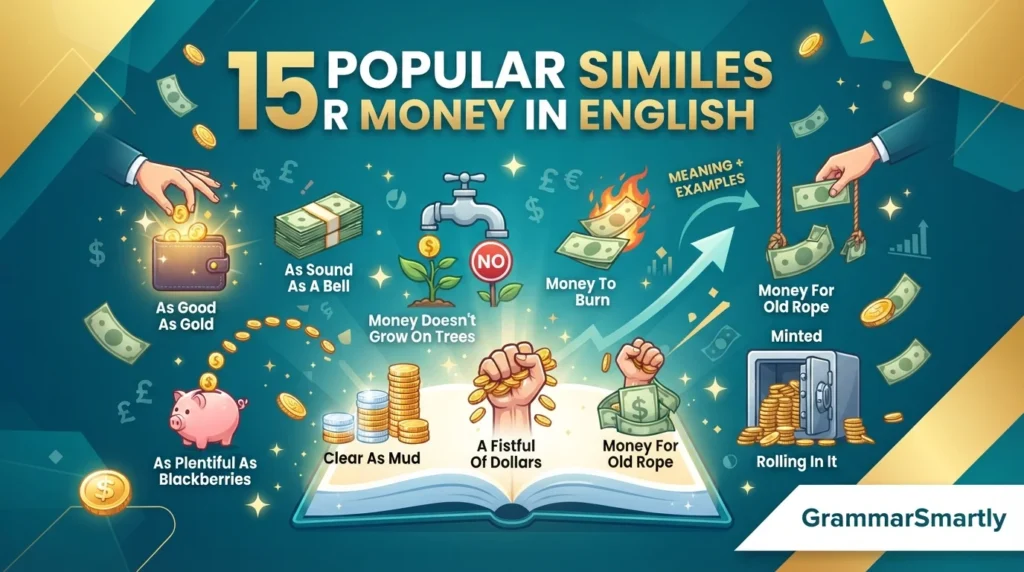
Money shows up everywhere in English figurative language, and similes are one of the most natural ways speakers reach for it. When someone says a person spends money like water or is as poor as a church mouse, they are not inventing a fresh image on the spot. They are pulling from a stock of comparisons that English speakers have used for generations, some dating back centuries, others still evolving in everyday speech.
This article focuses specifically on similes, expressions that compare money, spending, wealth, or poverty to something else using the words “like” or “as.” That is a narrower category than metaphors, which state that something simply is the thing it is being compared to (he is money in the bank, not he is like money in the bank). Keeping that line clean matters if you want to use these expressions correctly, especially in writing where precision counts.
Every entry below was checked against idiom dictionaries such as The Free Dictionary’s idioms database, Cambridge, and other established references, and where an origin story exists, it is noted honestly, including cases where sources disagree or the trail runs cold. Fifteen genuine similes made the cut. Where an expression’s meaning is disputed or shifting, that is flagged rather than smoothed over.
For students and writers seeking expressive language, Real Similes About Friendship offer clear examples of comparing meaningful friendships.
What Makes a Simile Work
A simile draws a direct, signaled comparison. The signal word, either “like” or “as,” tells the listener that two unlike things are being placed side by side on purpose. “He’s tight as a tick” is a simile because it compares a person’s spending habits to a blood-swollen insect using “as.” Without that comparison word, the same idea stated as “he’s a tightwad” becomes something else entirely, a label rather than a comparison. Money similes tend to lean on a small set of source images again and again: water, sand, mice, biblical figures, and cheap goods. That repetition is not laziness on the language’s part. It is what makes an expression recognizable enough to survive for two or three hundred years.
Similes About Spending Money
Spend Money Like Water

This is one of the most widely recognized money similes in English, appearing in idiom dictionaries with a consistent meaning: to spend money freely and carelessly, often on a scale that suggests little concern for how much is left. Water is a fitting comparison because it flows continuously and cannot be held onto by hand. Someone who spends money like water tends to run through savings quickly, often on things that bring short term pleasure rather than lasting value. The phrase works equally well in casual conversation and in writing about personal finance, though its tone always carries a note of mild disapproval.
Spend Money Like A Drunken Sailor
This simile is more colorful and more informal than “like water,” and it carries a specific implied backstory. The idea traces to the old image of sailors who, after long stretches at sea with no chance to spend anything, would blow through their wages fast once they hit port, often on drink and entertainment. Idiom references note this connection explicitly. The expression is used today for anyone, sailor or not, who spends without restraint or planning. It reads as more vivid and slightly more humorous than “like water,” so it fits casual or narrative writing better than formal financial advice.
Spend Money Like There’s No Tomorrow
Here the comparison shifts from an object (water) to an entire scenario (a world with no future). The implied logic is that if tomorrow truly did not exist, saving would be pointless, so why hold back today. This simile is common in everyday speech and works well for describing short bursts of spending, a shopping spree, a vacation splurge, rather than a chronic habit. It sits alongside close variants like “spend money like it’s going out of style,” both of which describe the same reckless urgency using a different comparison.
Similes About Financial Security
Like Money In The Bank
Unlike the previous three entries, this simile is not really about spending at all. It describes something regarded as certain, safe, or guaranteed to pay off, the way money already deposited in a bank is considered secure compared to cash you’re still carrying around. Dictionary sources trace a documented use back to 1939, and the phrase has since broadened well past literal finance. A reliable teammate, a foolproof plan, or a dependable friend can all be described as like money in the bank. The comparison works because banked money represents safety, not just wealth.
As Sound As A Dollar (As Sound As A Pound)
This pairing shows a simile adapting itself across two varieties of English. American speakers say “sound as a dollar,” while British speakers historically said “sound as a pound,” both meaning very stable, dependable, and trustworthy. The comparison leans on currency’s reputation for reliability, though idiom sources point out this reliability is a bit ironic given how much currencies actually fluctuate in value. It can describe a person’s character, an investment, or even a physical structure that is well built and sturdy.
Money Is Like Muck
This one comes with an unusually well documented history. The phrase traces to Francis Bacon’s 1625 essay “Of Seditions and Troubles,” where he wrote that money is like muck, not good except it be spread, a line he credited to a barrister named Mr. Bettenham who compared piled up riches to a stinking heap of manure that only becomes useful once spread across a field. The comparison argues that hoarded wealth does no one any good, while circulated money benefits everyone, much like manure only fertilizes soil when it is spread rather than left in a pile. Variations of this simile have appeared in speeches and business writing for centuries since, including a modern paraphrase sometimes attributed to entrepreneur Richard Branson.
Similes About Wealth
As Rich As Croesus

Croesus was a real historical king of Lydia in the sixth century BC, famed even in his own time for extraordinary wealth. Idiom references date the simile’s first recorded English use to 1577, and it has stayed in steady use ever since, often in slightly formal or literary contexts. It sits in direct opposition to another entry on this list, as poor as a church mouse, and the two are frequently cited together as opposite ends of the same scale.
Students learning figurative language can benefit from Similes for Students With Meanings that explain comparisons clearly.
As Rich As Midas
This simile draws on the Greek myth of King Midas, granted a wish that everything he touched would turn to gold, a gift that famously turned into a curse. The comparison signals extreme wealth, sometimes with a faint undertone borrowed from the myth itself, wealth so extreme it becomes almost absurd or even a burden. It is less ancient in documented English use than “rich as Croesus” but is common in modern writing and speech, often alongside the related expression “the Midas touch,” which describes someone whose every venture seems to succeed financially.
Similes About Poverty
As Poor As A Church Mouse
Few money similes are as instantly recognizable as this one. Its origin is genuinely uncertain, and idiom dictionaries are upfront about that rather than inventing a tidy backstory. The most common explanation offered is that churches historically had no food stores, so any mouse living there would have nothing to eat, though this remains speculation rather than confirmed fact. What is documented is the phrase’s age: a version appears in James Howell’s 1659 proverb collection as “hungry as a churchmouse,” and the poverty-specific version has been traced to the late 1600s. It replaced several older, now mostly forgotten comparisons for extreme poverty, including “poor as Job.”
As Poor As Job’s Turkey
This is a more folksy, distinctly American cousin of “poor as a church mouse,” rooted in the biblical figure Job, who lost all his possessions as a test of faith. According to a story attributed to nineteenth century humorist Thomas Chandler Haliburton’s character Sam Slick, the joke was that Job’s turkey was so destitute it had only a single feather left in its tail and had to lean against a fence just to gobble. The phrase carries a Southern and Appalachian flavor and tends to sound more folksy and humorous than its church mouse counterpart, even though both describe the same extreme poverty.
Similes About Cost And Value
Cheap As Chips
Primarily a British expression, this simile describes something remarkably inexpensive, often with a note of pleasant surprise at the low price. Chips, meaning fried potato chips or fries in British English, were historically a cheap, everyday food, which grounds the comparison in something ordinary and low cost. It functions as a friendlier, more casual alternative to describing something as merely “cheap,” which can carry connotations of poor quality that “cheap as chips” mostly avoids.
Cheap As Dirt
This simile leans on dirt as the ultimate example of something worthless and freely available, since soil itself has no price tag in ordinary life. It describes goods or services priced remarkably low, sometimes suspiciously low. Unlike “cheap as chips,” which tends to carry a positive, bargain-hunting tone, “cheap as dirt” can lean either way depending on context, sometimes praising a good deal, sometimes hinting that the low price reflects low quality.
Similes About Money Habits And Honesty
As Tight As A Tick
This one requires an honest caveat rather than a clean definition. Idiom sources disagree on its primary meaning. Historically and in many current references, “tight as a tick” most commonly means extremely drunk, drawing on the image of a blood engorged tick swollen to bursting. Some dictionaries and regional usage guides also list a secondary, less dominant meaning tied to money, describing someone who is unwilling to spend, essentially stingy or miserly. Because usage varies by region and even by speaker, this expression should be used with some caution in writing about money specifically, since a reader might just as easily assume you mean drunk.
Poems and personal narratives can become more expressive through Similes to Describe Feeling Lonely in natural language.
As Phony As A Three-Dollar Bill
Since United States currency has never issued a three dollar bill, anything compared to one is automatically identified as fake or fraudulent. This simile describes a person, claim, or object that seems dishonest, counterfeit, or simply too good to be true. It ties into money not through spending or wealth but through the idea of counterfeit currency, using an absurd, nonexistent denomination to make the point unmistakable.
Money Slips Through Fingers Like Sand
This comparison deserves an honest note before its explanation: it functions more as a flexible, widely used poetic image than as a single fixed idiom recorded with one exact wording in major idiom dictionaries. The core image, something slipping through fingers the way sand does, is well documented and old, used for time, opportunities, and money alike. Applied to money specifically, it describes cash that disappears quickly despite one’s best efforts to hold onto it, often through many small, hard to track purchases rather than one big expense. Because it is more of a living, adaptable image than a locked phrase, you will see it worded slightly differently from one source to the next, and that variability is worth knowing before treating it as a fixed idiom.
When And How To Use These Similes
Most of these expressions sit comfortably in informal to moderately formal writing and speech. Phrases like spend money like water, cheap as chips, and as poor as a church mouse work well in conversation, blog posts, personal essays, and dialogue, but they read as too casual for a formal financial report, a legal document, or academic writing. Older, more literary comparisons such as as rich as Croesus or money is like muck can carry a slightly elevated, storytelling tone, useful in narrative nonfiction or speeches aiming for a touch of gravity. As tight as a tick and as phony as a three-dollar bill lean distinctly colloquial and regional, so they suit dialogue or informal blog writing more than professional correspondence. As a general rule, if the writing calls for warmth, humor, or personality, these similes add flavor. If it calls for precision and neutrality, plain language usually serves better.
Common Mistakes And Confusions
The most frequent error is treating a metaphor as a simile or the reverse. Saying someone “is money in the bank” states an identity, a metaphor, while “he’s like money in the bank” makes the comparison explicit, a simile. Dropping the “like” or “as” changes the grammatical category even when the meaning stays close. A second common mix-up involves regional variants: sound as a dollar versus sound as a pound, or cheap as chips, which barely registers in American English but is everyday language in Britain. Using the wrong regional variant will not usually cause confusion, but it can sound slightly out of place. Finally, as tight as a tick genuinely trips people up because its dominant meaning, drunk, differs from the secondary, less common meaning tied to stinginess. Context alone often will not resolve the ambiguity, so it is worth choosing a clearer alternative when precision matters.
Summary
These fifteen similes cover the emotional range money tends to inspire in language: recklessness, security, wealth, poverty, bargains, and suspicion. Each one earns its place through genuine, traceable usage rather than a forced fit to the theme, and a few, like as tight as a tick and money slips through fingers like sand, come with honest caveats about how fixed or ambiguous they really are. Used thoughtfully, they give writing about money a texture that plain description rarely achieves on its own.
FAQs
What is the difference between a simile and a metaphor about money?
A simile signals its comparison directly using “like” or “as,” as in spend money like water. A metaphor states the comparison as fact without a signal word, as in he’s a money pit. Both describe money figuratively, but grammatically they work differently.
Is “as poor as a church mouse” still commonly used today?
Yes, it remains one of the most recognized poverty similes in English, though its exact origin is uncertain even according to major idiom dictionaries, which openly note that the reasoning behind it is speculative rather than confirmed.
Where does “money is like muck” come from?
It traces to Francis Bacon’s 1625 essay “Of Seditions and Troubles,” where he credited the comparison to a barrister named Mr. Bettenham, who compared piled up wealth to a stinking heap of manure that only becomes useful once spread out.
Does “tight as a tick” always refer to money?
No. Its more common and older meaning is extremely drunk. A secondary, regionally inconsistent meaning describes someone unwilling to spend money. Because usage varies, context is essential when using this phrase.
What’s the difference between “cheap as chips” and “cheap as dirt”?
“Cheap as chips” is primarily British and usually carries a positive, bargain-hunting tone. “Cheap as dirt” can go either way, sometimes praising a low price and sometimes hinting the low cost reflects low quality.
Is “spend money like there’s no tomorrow” the same as “spend money like it’s going out of style”?
They express the same reckless urgency but use different comparisons: one imagines a world without a future, the other imagines an item about to disappear from availability. Both are genuine, commonly used similes.
Why isn’t “worth its weight in gold” included as a simile here?
That expression does not use “like” or “as,” the defining structural markers of a simile, so it does not meet the strict grammatical test applied throughout this article, even though it functions as a comparison in a looser sense.
Are all fifteen of these similes still in everyday use?
Most are, though usage varies by region and formality. Expressions like spend money like water and as poor as a church mouse are broadly current, while as poor as Job’s turkey and as tight as a tick skew more regional or old fashioned depending on the speaker’s background.









1 thought on “15 Popular Similes for Money in English (Meaning + Examples)”