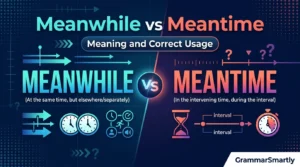
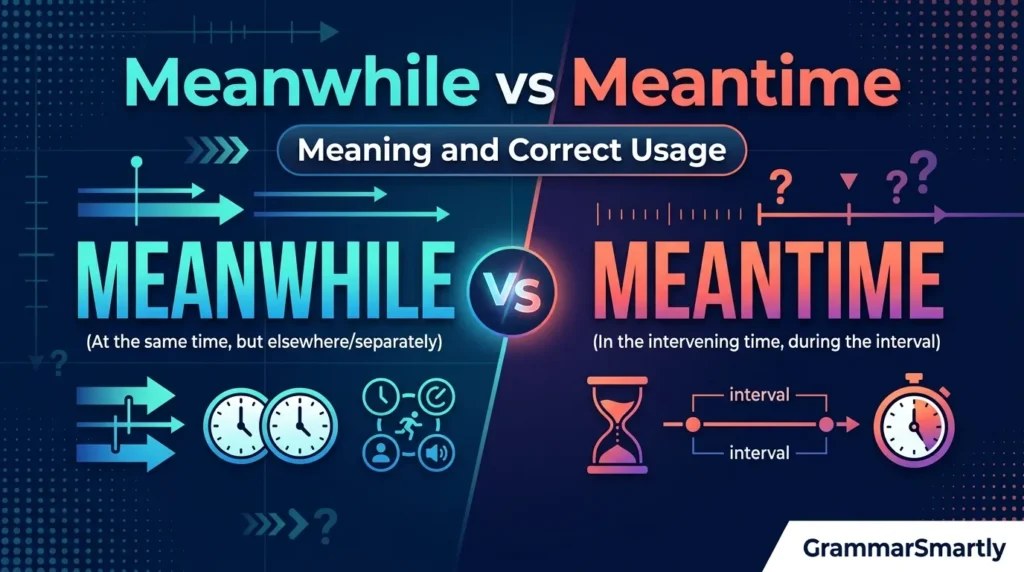
“Meanwhile” and “meantime” are both correct English words that refer to a period during which something else happens or to events occurring while another activity is underway. The difference between meanwhile vs meantime is mainly grammatical and contextual, not a matter of correct versus incorrect spelling.
“Meanwhile” commonly introduces a separate event happening at the same time as another event. “Meantime” usually refers to the intervening period before something expected or planned happens, particularly in the expression “in the meantime.” Although the two words sometimes overlap in meaning, they are not always interchangeable in a sentence.
This guide explains their meanings, grammatical patterns, pronunciation, origins, and practical differences. You will also find original examples, memory tricks, common mistakes, and answers to frequently asked questions to help you choose the right word confidently in academic, professional, and everyday writing.
Quick Facts: Meanwhile vs Meantime
| Feature | Meanwhile | Meantime |
| Standard form | Meanwhile | Meantime |
| Spelling status | Correct | Correct |
| Word type | Adverb; also used as a noun in some contexts | Noun; also used adverbially in some contexts |
| Main meaning | During the same period; at the same time | The intervening period between events |
| Common expression | Meanwhile, … | In the meantime, … |
| Pronunciation | /ˈmiːn.waɪl/ | /ˈmiːn.taɪm/ |
| Main difference | Often connects simultaneous events | Often emphasizes the period of waiting |
| Usage status | Standard modern English | Standard modern English |
| Common error | Using it when the sentence needs a noun phrase | Omitting “the” from the usual expression “in the meantime” |
What Does “Meanwhile vs Meantime” Mean?
The phrase “meanwhile vs meantime” asks how two related English words differ in meaning and usage. Both can connect events that occur within the same general period, but each has a different grammatical emphasis.
Writers can avoid confusion by learning the difference between inter and intra with examples in academic, professional, and everyday contexts.
What Does Meanwhile Mean?

Meanwhile is primarily an adverb that means during the same period or at the same time as something else.
It is particularly useful when describing two activities, events, or situations that happen concurrently.
Examples:
- Maya prepared dinner. Meanwhile, her brother set the table.
- The engineers repaired the bridge. Meanwhile, traffic was redirected through nearby streets.
- The application is being reviewed. Meanwhile, you can prepare the required documents.
In each example, “meanwhile” introduces another event that takes place during the period already being discussed.
What Does Meantime Mean?
Meantime refers to the intervening period between two events, especially the time before an anticipated event takes place.
It frequently appears in the expression “in the meantime.”
Examples:
- The replacement laptop will arrive on Friday. In the meantime, use the office computer.
- Our appointment is next week. In the meantime, please complete the paperwork.
- The final decision is pending. In the meantime, the existing arrangements will remain in place.
Here, “in the meantime” directs attention to what happens during the waiting period before the expected event.
The Main Difference in Simple Terms
- Meanwhile: Focuses on another event happening at the same time.
- Meantime: Focuses on the period between now and a later event, especially when waiting for something to happen.
- In the meantime: A common expression meaning during that intervening period.
Compare these sentences:
The chef prepared the dessert. Meanwhile, the guests enjoyed their coffee.
The dessert will be ready shortly. In the meantime, the guests can enjoy their coffee.
The first sentence presents two activities happening concurrently. The second emphasizes what the guests can do while waiting for the dessert.
Are Both “Meanwhile” and “Meantime” Correct?
Yes. Both are established words in modern English, and neither is a misspelling of the other.
The distinction is primarily grammatical:
- Meanwhile is most commonly used as an adverb to connect events or describe what is happening during an interval.
- Meantime is most commonly used as a noun in the expression “in the meantime.”
- Both can function adverbially, so “Meantime, …” is also possible, although “Meanwhile, …” is often the more familiar choice in ordinary writing.
- Both words can refer to an intervening period, which explains why their meanings sometimes overlap.
For example, “Meanwhile, the team continued working” and “Meantime, the team continued working” are both possible. The second is a less typical choice for many readers, but it is not automatically incorrect.
What Is the Correct Spelling?
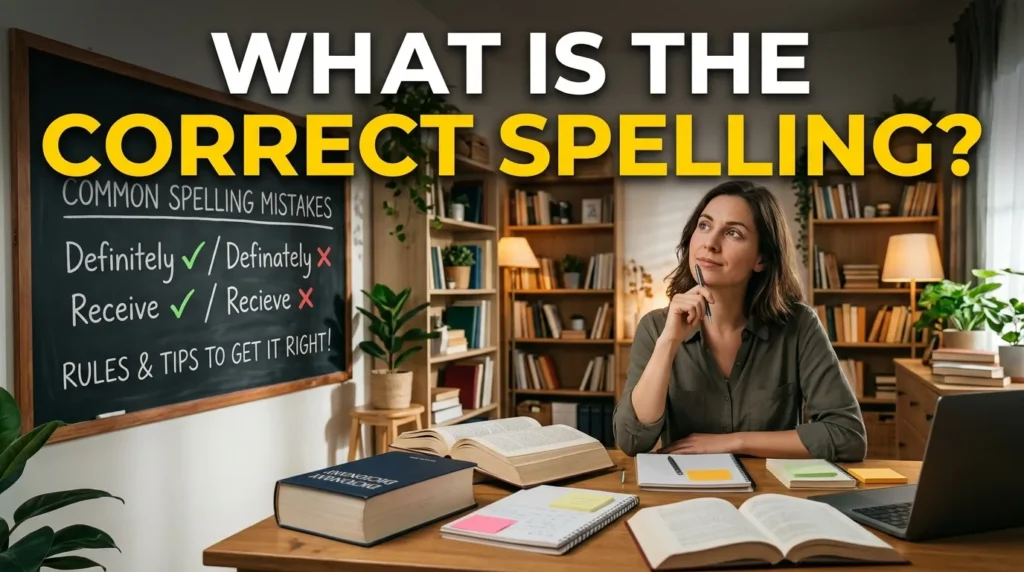
The correct spellings are meanwhile and meantime.
Both words are written as single words, without a space between their parts.
Spelling Structure of Meanwhile
The word meanwhile combines the elements mean and while.
- Correct: meanwhile
- Incorrect for the intended word: mean while
The two-word expression “mean while” is not the standard spelling of the adverb meanwhile. However, separate words may occur together legitimately in other grammatical constructions.
Spelling Structure of Meantime
The word meantime combines mean and time.
- Correct: meantime
- Incorrect for the intended word: mean time
When referring to the intervening period, write “in the meantime,” not “in the mean time.”
A separate phrase such as “the mean time of the measurements” could be grammatical in a technical context if mean means an average. That is a different use of the words.
Common Spelling Error
The most important spelling lesson is not to replace one word with the other merely because they sound similar or share part of their meaning. The choice depends on the intended sentence, not on which spelling is supposedly correct.
Difference Between Meanwhile and Meantime
| Feature | Meanwhile | Meantime |
| Status | Standard English | Standard English |
| Primary grammatical role | Adverb | Noun |
| Other grammatical role | Noun in some contexts | Adverb, particularly in informal usage |
| Meaning | During the same period; at the same time | The interval between events |
| Typical pattern | Meanwhile, another event happens. | In the meantime, an activity continues. |
| Sentence position | Beginning, middle, or end, depending on construction | Often follows “in the” |
| Pronunciation | /ˈmiːnwaɪl/ | /ˈmiːn.taɪm/ |
| Modern usage | Common in narrative and explanatory writing | Especially familiar in “in the meantime” |
The Most Important Distinction
Consider the following examples:
Meanwhile
The train was delayed. Meanwhile, passengers bought refreshments.
This connects two developments that occurred during the same period.
In the meantime
The train will arrive in twenty minutes. In the meantime, passengers can wait in the lounge.
This emphasizes the interval before the train arrives.
The distinction is a useful guideline rather than an absolute rule. Either word can refer to events during an interval, and context determines which expression sounds most natural.
Meaning of Meanwhile
Meaning in Time-Related Contexts
The main meaning of meanwhile is during the same period as something else.
It helps writers move from one activity or situation to another without suggesting that the first event has necessarily finished.
Examples:
- The students worked on their presentations. Meanwhile, the teacher checked their research.
- The shop was being renovated. Meanwhile, customers used the temporary entrance.
- A storm approached the coast. Meanwhile, rescue crews prepared their equipment.
Meaning When Comparing Situations
“Meanwhile” can also introduce a contrasting or complementary situation.
For example:
The northern region received heavy rainfall. Meanwhile, the southern region experienced unusually dry weather.
Here, the word connects developments in two different places. The events occur during the same general period, but the emphasis is also on their contrast.
Learning about the alligator and crocodile snout shapes and teeth reveals important clues for recognizing each reptile.
Common Contexts for Meanwhile
Use meanwhile when:
- Describing simultaneous activities.
- Switching between two storylines.
- Explaining what happens while a process continues.
- Comparing developments in different locations.
- Connecting two related observations in an article or report.
Meaning of Meantime
The Intervening Period
As a noun, meantime refers to the period between two events or points in time.
It is particularly useful when the reader knows that something is expected to happen later.
Examples:
- The new building will open in June. In the meantime, staff will work remotely.
- The application is awaiting approval. In the meantime, the applicant can gather supporting documents.
- The package has not arrived. In the meantime, we can use the spare supplies.
The Expression “In the Meantime”
The phrase “in the meantime” is the most useful pattern to learn.
Its structure is:
in + the + meantime
The phrase can appear at the beginning or later in a sentence.
- In the meantime, please keep your receipt.
- We can review the draft in the meantime.
- The technician will arrive tomorrow. In the meantime, leave the equipment switched off.
The expression does not require the intervening period to be long. It can refer to a few minutes, several days, or a much longer interval.
The Expression “For the Meantime”
“For the meantime” is also used, particularly to describe a temporary arrangement.
Example:
We will use the smaller office for the meantime.
However, “for now” and “for the time being” may sound more natural in many sentences. Choose the expression that fits your intended meaning and audience.
Pronunciation
IPA Pronunciation
The following are standard pronunciation guides. Individual accents may vary.
| Word | IPA | Simple guide |
| Meanwhile | /ˈmiːnwaɪl/ | MEEN-wyle |
| Meantime | /ˈmiːn.taɪm/ | MEEN-time |
In American English, the vowel in the first syllable may be represented as /i/ rather than /iː/, depending on the transcription system used.
Syllable Breakdown
Both words have two syllables:
- Meanwhile: mean + while
- Meantime: mean + time
Pronunciation Tips
The first part of each word sounds similar. The difference comes at the end:
- Meanwhile ends with the sound in while.
- Meantime ends with the sound in time.
Practise saying each word aloud, then use it in a complete sentence. This helps you connect the pronunciation with its grammatical role.
Why Do People Confuse Meanwhile and Meantime?
The confusion is understandable because the words share several characteristics.
Similar Meanings
Both words can describe what happens during an interval. As a result, a sentence may remain understandable even when the writer chooses the less natural option.
Similar Word Structure
Both begin with mean and contain a time-related element. Their parallel structure makes them easy to associate with each other.
Overlapping Grammatical Uses
Although meanwhile is primarily an adverb and meantime is primarily a noun, both have adverbial uses. This overlap means that a simple rule such as “one is always an adverb and the other is always a noun” would be misleading.
The Influence of Familiar Expressions
Many learners encounter “in the meantime” as a complete phrase rather than learning meantime as an independent noun. They may therefore be uncertain about using it in other constructions.
The best solution is to learn each word in context instead of memorizing a rigid distinction.
Origin and Etymology
Both words developed from older English expressions built around the idea of an intermediate period.
- Meanwhile developed from mean and while.
- Meantime developed from mean and time.
In these compounds, mean carries the older sense associated with something intermediate or in the middle, rather than its familiar modern sense of intending or signifying.
Both forms have a long history in English. Their related origins help explain why their meanings overlap, but their historical development does not mean that they must be used identically in every modern sentence.
How to Remember the Difference
A practical memory strategy is to associate each word with the expression or function in which you most often need it.
Quick Memory Trick
Remember these two patterns:
- Meanwhile = another event happening.
- In the meantime = the waiting period.
For example:
The mechanic is repairing the car. Meanwhile, I am answering emails.
The car will be ready at noon. In the meantime, I am answering emails.
Both sentences describe activities occurring during an interval, but the second explicitly identifies a period before a future event.
Word-Structure Connection
Connect the final element of each word to its role:
- While in meanwhile helps you associate the word with concurrent activity.
- Time in meantime helps you associate the word with an interval.
This is a learning aid, not a strict grammatical rule. The actual sentence still determines which word fits best.
Word-Family Connection
Remember meantime through the common phrase “in the meantime.” Once that phrase becomes familiar, you can recognize the noun pattern in your own writing.
For meanwhile, practise using it to shift attention from one person, place, or activity to another.
Examples of Meanwhile and Meantime in Sentences
The following examples show how both words work in everyday communication, storytelling, academic writing, and professional situations.
| Meanwhile Example | Meantime Example |
| 1. Lena watered the garden. Meanwhile, her father trimmed the hedges. | 1. The gardener will return tomorrow. In the meantime, water the seedlings. |
| 2. The manager interviewed one applicant. Meanwhile, the receptionist welcomed another. | 2. The manager will make a decision next week. In the meantime, applicants should check their email. |
| 3. The soup simmered on the stove. Meanwhile, Omar sliced the bread. | 3. The soup needs another ten minutes. In the meantime, set out the bowls. |
| 4. The first team tested the software. Meanwhile, the second team documented the results. | 4. The software update is scheduled for Monday. In the meantime, continue using the current version. |
| 5. A reporter spoke to witnesses. Meanwhile, photographers documented the scene. | 5. The report is being prepared. In the meantime, the editor is reviewing the photographs. |
| 6. The children played outside. Meanwhile, their parents organized the picnic. | 6. Lunch will be served shortly. In the meantime, the children can play in the garden. |
| 7. The company expanded its online services. Meanwhile, its local branches continued serving customers. | 7. The new branch opens next month. In the meantime, customers can visit the existing location. |
| 8. The pilot checked the controls. Meanwhile, the ground crew inspected the aircraft. | 8. Boarding begins in thirty minutes. In the meantime, passengers can relax in the waiting area. |
| 9. Nina researched the topic. Meanwhile, her partner prepared the presentation slides. | 9. The presentation is due tomorrow. In the meantime, the team can rehearse its introduction. |
| 10. The river rose overnight. Meanwhile, emergency workers moved equipment to higher ground. | 10. The evacuation order remains in effect. In the meantime, residents should follow official safety instructions. |
| 11. The actor changed costumes. Meanwhile, the stage crew adjusted the lighting. | 11. The performance starts at seven. In the meantime, audience members can find their seats. |
| 12. The scientist examined the samples. Meanwhile, an assistant recorded the measurements. | 12. The laboratory results are not ready. In the meantime, the research team can organize its notes. |
| 13. The bus crossed the city center. Meanwhile, traffic continued moving slowly on the highway. | 13. The next bus arrives in fifteen minutes. In the meantime, check the departure board. |
| 14. The author revised the opening chapter. Meanwhile, the illustrator worked on the cover. | 14. The publisher will respond soon. In the meantime, the author can revise another chapter. |
| 15. The committee discussed the budget. Meanwhile, the secretary prepared the meeting minutes. | 15. The budget vote is scheduled for Friday. In the meantime, members can review the revised figures. |
Notice that many examples use meanwhile to move between parallel activities and in the meantime to describe what can happen before an expected event. These are common patterns, not an absolute restriction on either word.
Common Mistakes to Avoid
- Treating one word as a misspelling of the other: Both are standard English words.
- Using “in the meantime” when the sentence needs a different connection: The phrase emphasizes an interval, so check whether that emphasis suits your meaning.
- Assuming “meanwhile” only describes events in different places: It can also connect activities occurring in the same location.
- Assuming “meantime” cannot be an adverb: It can be used adverbially, although this use is less typical in many contexts.
- Writing “mean while” or “mean time” as the intended compound: Use the one-word spellings when referring to meanwhile or meantime.
- Forgetting punctuation: When meanwhile introduces an independent sentence, a comma often follows it. A semicolon can also connect two closely related independent clauses.
- Confusing “in the meantime” with “for the time being”: These expressions overlap, but “for the time being” emphasizes a temporary state or arrangement, while “in the meantime” highlights an intervening period.
Similar Commonly Confused Words
The following comparisons are useful because they involve overlapping meanings, similar word structures, or differences between compounds and separate expressions.
| Common Confusion | Correct Forms | Reason for Confusion |
| Sometime / some time | Both forms are correct | Sometime usually refers to an unspecified point in time; some time refers to a period or duration. |
| Everyday / every day | Both forms are correct | Everyday is an adjective meaning ordinary or routine; every day is a phrase referring to each day. |
| Awhile / a while | Both forms are correct | Awhile is an adverb; a while is a noun phrase that commonly follows a preposition. |
| Already / all ready | Both forms are correct | Already refers to something that has happened by a particular time; all ready means completely prepared. |
| In time / on time | Both forms are correct | In time can mean early enough; on time means at the scheduled time. |
| Sometimes / some times | Both forms are correct | Sometimes means occasionally; some times refers to particular instances or occasions. |
| Any time / anytime | Both forms are correct | Any time is a noun phrase; anytime is an adverb in standard usage, with some variation in style preferences. |
These are not all spelling errors. In each pair, the correct choice depends on grammar and meaning, just as it does with meanwhile and meantime.
Related Words
Synonyms
Several expressions can replace meanwhile or meantime in suitable contexts, but the alternatives are not always interchangeable.
- During that time: Emphasizes the period in which something happens.
- At the same time: Highlights simultaneous events.
- In the interim: A more formal expression for the intervening period.
- For now: Emphasizes a temporary arrangement or current situation.
- For the time being: Refers to a temporary condition that may change later.
- While waiting: Emphasizes an activity performed during a wait.
- Concurrently: A more formal word for things happening at the same time.
For example, “The office is being renovated. In the interim, employees will work remotely” is suitable in a formal announcement. In casual conversation, “In the meantime, employees will work remotely” may sound more natural.
Antonyms
Neither meanwhile nor meantime has one universal antonym. Their meanings concern time and the relationship between events, so an opposite depends on the intended contrast.
Possible contrasting expressions include:
- Beforehand: Before a particular event.
- Afterward: After an event has happened.
- Subsequently: At a later point in time.
These expressions describe different temporal relationships rather than serving as exact opposites in every sentence.
Related Forms
The words are related in structure but do not have a large family of everyday grammatical derivatives.
- Mean: Can be a verb, adjective, or noun, depending on context.
- While: Can function as a conjunction, noun, or verb.
- Time: Can function as a noun or verb.
- Meantimes: The plural form of the noun meantime, although it is uncommon in ordinary usage.
- Meanwhile: Usually remains unchanged when used adverbially.
Avoid inventing forms such as meanwhiles for ordinary use unless a specific context supports them.
Grammar Tips
Use Meanwhile as an Adverb
“Meanwhile” can appear at different points in a sentence.
- Beginning: Meanwhile, the audience waited patiently.
- Middle: The audience, meanwhile, waited patiently.
- End: The audience waited patiently meanwhile.
The final-position example is possible, but a different construction may sound more natural depending on the context.
Use Meantime as a Noun
When meantime functions as a noun, it commonly appears in a prepositional phrase:
- In the meantime, we will continue working.
- The children can read in the meantime.
- We will use the temporary arrangement for the meantime.
The phrase “in the meantime” is particularly useful because it clearly identifies the period between the current situation and a later event.
Punctuate Connecting Words Correctly
When meanwhile begins a new independent sentence, a comma is generally appropriate:
The first presentation ended. Meanwhile, the judges discussed their scores.
When connecting two independent clauses, use suitable punctuation:
The first presentation ended; meanwhile, the judges discussed their scores.
Do not join two complete sentences with only a comma. That creates a comma splice.
Keep the Intended Time Relationship Clear
Use the word that communicates the relationship you want readers to understand. If two events are occurring concurrently, meanwhile may be a natural choice. If the focus is on what happens before an anticipated event, in the meantime is often more precise.
Writing Tips
Choosing between meanwhile and meantime is easier when you consider the purpose of the sentence and the expectations of your reader.
In Essays and Academic Writing
Use meanwhile to connect parallel developments, compare situations, or transition between related points.
Example:
The first study examined short-term effects. Meanwhile, the second investigated long-term outcomes.
Use in the meantime when discussing interim arrangements or actions that occur before a later stage of a project.
In Professional Emails
Both words are useful for explaining ongoing work and next steps.
Example:
We expect to receive the revised contract tomorrow. In the meantime, please review the attached proposal.
This clearly identifies what the recipient should do before the next development.
In Exams and English Tests
When choosing between the two, examine the sentence structure.
Ask yourself:
- Is the sentence introducing another event happening at the same time?
- Is it referring to the interval before an expected event?
- Does the sentence require an adverb or a noun phrase?
- Would “in the meantime” fit naturally?
Do not choose an answer simply because one word seems more formal. Both are standard English.
During Proofreading
Search for both words when editing a long document. Check that each one fits its context and that the sentence communicates the intended relationship between events.
Also look for accidental spacing errors, especially mean while and mean time when the intended meaning calls for the compounds.
Quick Spelling Checklist
| Check | Correct Form or Rule |
| Standard spelling | Meanwhile and meantime |
| Common misspelling | Neither target word is inherently misspelled |
| Meaning | Simultaneous events or an intervening period |
| Pronunciation | MEEN-wyle versus MEEN-time |
| Word type | Meanwhile is primarily an adverb; meantime is primarily a noun |
| Key spelling pattern | Write each compound as one word |
| Common usage | “Meanwhile, …” and “in the meantime, …” |
| Final proofreading check | Confirm that the word matches the sentence’s meaning and grammar |
Key Takeaways
- Both meanwhile and meantime are correct English words.
- Meanwhile is primarily an adverb that connects events or describes what happens during an interval.
- Meantime is primarily a noun referring to the period between events.
- “In the meantime” is a particularly common and useful expression.
- Both words can have overlapping adverbial uses.
- Their shared structure and related meanings explain why writers sometimes confuse them.
- Choose according to the intended meaning and grammatical construction, not spelling preference alone.
Conclusion
Understanding meanwhile vs meantime requires more than memorizing two definitions. Both words are correct, and both can describe events occurring during an interval. The most useful distinction is that meanwhile commonly introduces another event or shifts attention to a parallel situation, whereas meantime most often names the intervening period, especially in the expression “in the meantime.”
A simple way to remember the difference is to associate meanwhile with what is happening alongside another event and in the meantime with what happens while waiting for something expected. This distinction will help you write clearer sentences in essays, reports, emails, and everyday conversations.
Remember that the distinction is a practical guide rather than an inflexible rule. Since the words have overlapping meanings and grammatical uses, always consider the complete sentence. With practice, you can select the more natural expression and communicate the relationship between events accurately.
Frequently Asked Questions
Are “Meanwhile” and “Meantime” Both Correct?
Yes. Both are standard English words with related meanings. Meanwhile is most commonly used as an adverb, while meantime is most commonly used as a noun. Both can also be used adverbially, so context and sentence structure determine which choice sounds most natural.
What Is the Main Difference Between Meanwhile and Meantime?
Meanwhile commonly introduces another event happening during the same period. Meantime usually refers to the interval between two events, particularly in the phrase “in the meantime.” Their meanings overlap, but their typical grammatical patterns differ.
Is “In the Meantime” Grammatically Correct?
Yes. “In the meantime” is a standard English expression referring to the period before an expected event or while another process continues. For example, “The technician will arrive tomorrow. In the meantime, please restart the computer.” The expression is suitable for formal and informal writing.
Can I Use “Meanwhile” and “Meantime” Interchangeably?
Sometimes. Both can describe what happens during an interval, so certain sentences allow either word. However, “meanwhile” is generally more natural when introducing a parallel event, while “in the meantime” is particularly useful for describing activities during a waiting period.
Is “Meantime” a Noun or an Adverb?
Meantime is primarily a noun, as in “in the meantime.” It can also function as an adverb, particularly in constructions such as “Meantime, the investigation continued.” The noun use is especially familiar to English learners because it appears in a common fixed expression.
Is “Meanwhile” an Adverb?
Yes. Meanwhile is primarily an adverb. It can connect events, indicate that something is happening during another activity, or introduce a related comparison. For example, “The researchers collected samples. Meanwhile, their colleagues analyzed the earlier results.”
Should I Write “Mean Time” or “Meantime”?
Use meantime as one word when referring to the intervening period between events. For example, write “In the meantime, we will wait.” The separate words mean time may be appropriate in a different context, such as a technical discussion involving an average time measurement.
Is “In the Meanwhile” Correct?
“In the meanwhile” is an established expression and is grammatically possible. However, “in the meantime” is a more familiar choice for many readers. You can also use meanwhile by itself, as in “Meanwhile, the team continued working.”
What Is Another Word for Meanwhile or Meantime?
Suitable alternatives depend on the sentence. At the same time emphasizes simultaneous events, while during that period highlights an interval. In the interim is another option, especially in formal writing. None of these alternatives fits every context, so choose one that preserves the intended time relationship.
How Can I Remember When to Use Meanwhile or Meantime?
Associate meanwhile with another event happening alongside the first. Associate meantime with the period before a planned event, especially in “in the meantime.” Practising these two sentence patterns is more reliable than memorizing a rule that treats the words as completely interchangeable or entirely different.
Which Word Is Better for Formal Writing?
Both words are appropriate in formal writing when used correctly. Meanwhile works well in reports and essays when connecting developments, while “in the meantime” is useful for explaining interim actions or arrangements. Clarity, grammatical structure, and context matter more than choosing one word simply because it appears more formal.