Stars are among the easiest subjects to describe beautifully, but finding a comparison that feels natural is harder than simply putting like or as into a sentence. A strong simile connects the appearance, brightness, movement, number, or emotional effect of stars with something readers already recognize.
A simile makes an explicit comparison, commonly using like or as. Both Cambridge and Oxford dictionaries define the device in essentially these terms. For example, “stars like diamonds” compares the visual sparkle of stars with diamonds without saying that stars actually are diamonds.
For this article, the expressions below were checked against published or established examples rather than being generated simply because they sound poetic. The list includes literary, educational, scientific, and cultural attestations. Some are common poetic comparisons, while others are more specialized. They are not all fixed idioms, and that distinction matters.
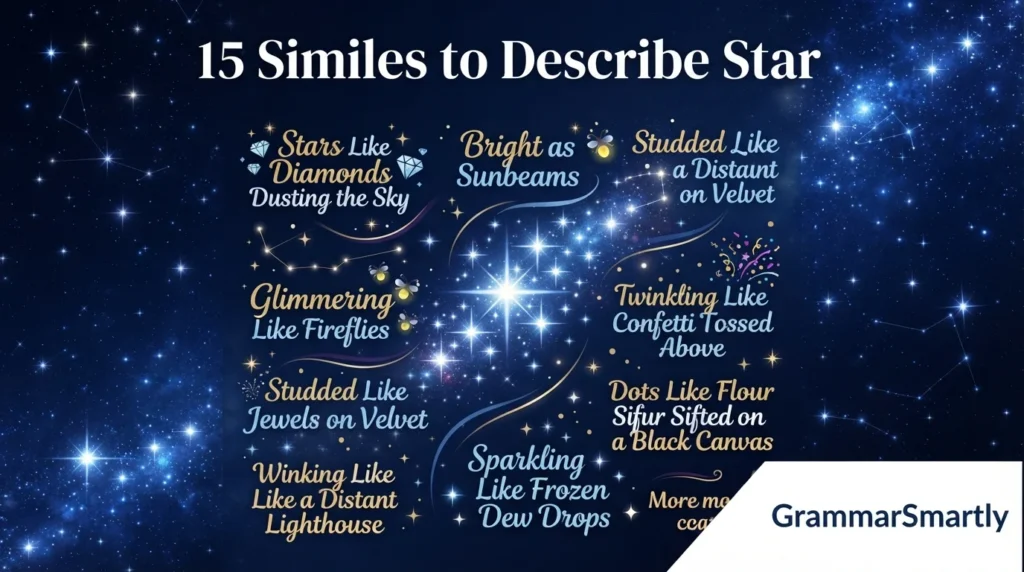
There are 15 verified similes in the main list. They describe stars as diamonds, jewels, pearls, fireflies, pinholes, sequins, snowflakes, sparks, candles, beads, grains of sand, grains of sugar, silver points, eyes, and crystals. Writers can describe complete quiet more vividly with Similes For Silent in descriptive passages.
Writers often use sunset simile examples for creative writing to capture changing colors, light, mood, and atmosphere naturally.
What Makes a Simile for Stars Work?
A star simile usually works because the comparison emphasizes one recognizable quality. Diamonds and jewels suggest brilliance and beauty. Fireflies and candles suggest small, flickering points of light. Snowflakes and grains of sand emphasize number and distribution. Eyes can suggest that stars appear to watch from above.
The comparison does not have to mean that stars resemble the other object in every respect. A simile normally focuses attention on one or a few shared characteristics. That is why “stars like fireflies” can work even though stars and fireflies are physically unrelated.
The grammatical test is straightforward. If the comparison explicitly says that stars are like something or as something, it can function as a simile. If it directly identifies the stars with something else, it becomes a metaphor. Merriam-Webster makes the same distinction, explaining that metaphor equates or identifies things, whereas simile makes an explicit comparison.
Metaphors
This article is specifically about similes, so metaphors are not counted among the 15. Keeping them separate prevents a common mistake in figurative-language lists.
“The stars are diamonds”
This is a metaphor, not a simile, because it directly identifies stars with diamonds instead of saying that they are like diamonds. The construction is attested in poetry and educational material.
Compare the two forms:
- Metaphor: “The stars are diamonds.”
- Simile: “The stars are like diamonds.”
The second version belongs in the simile section because the comparison is explicit.
Similes to Describe Stars
Stars like diamonds

“Stars like diamonds” is one of the most familiar poetic comparisons for a starry sky. It emphasizes sparkle, brilliance, beauty, and the impression that individual stars are tiny precious objects scattered through darkness.
The comparison is well attested in poetry. PoetrySoup contains multiple examples of “stars like diamonds,” including poems describing stars as diamond-like points against the night sky.
You could write:
The stars shone like diamonds across the clear night sky.
This works especially well in romantic writing, poetry, descriptive prose, and children’s writing.
Stars like jewels
Jewels suggest something bright, beautiful, precious, and carefully displayed. When stars are compared with jewels, the sky becomes visually similar to a dark setting covered with small points of light.
The comparison occurs in published poetry, including examples using “stars like jewels” to describe a glittering sky.
Example:
The stars appeared like jewels scattered across the velvet darkness.
This is a flexible choice when you want the description to emphasize beauty rather than simply brightness.
Stars like pearls
Pearls provide a softer comparison than diamonds. They can suggest rounded, pale, luminous objects distributed across a dark background.
The phrase “stars like pearls” is attested in poetry, including a poem describing stars as pearls “strung” across the sky.
Example:
The stars looked like pearls strung across the deep blue sky.
This simile suits gentle, peaceful, romantic, or reflective descriptions.
Writers can strengthen motivational passages with perseverance simile examples for writing that make persistence easier to visualize.
Stars like fireflies

Fireflies are especially effective as a comparison because both stars and fireflies can appear as scattered points of light against darkness. The image also suggests flickering and liveliness.
Rabindranath Tagore uses the comparison in Stray Birds, writing that the stars can appear “like fireflies.” Another published poem by Peycho Kanev similarly describes stars as fireflies dotting a dark landscape.
Example:
The stars flickered like fireflies above the sleeping forest.
Use this when you want the stars to feel animated, delicate, or gently sparkling.
Stars like pinholes
This comparison focuses on size and appearance. From a distance, stars can look like tiny holes or points cut into a dark surface, with light seeming to come through them.
The image appears in published prose. The Irish Times, for example, describes stars as pinholes pricked into dark cloth. Merriam-Webster also gives an example involving stars and pinholes when illustrating the word pinhole.
Example:
The stars looked like pinholes in the black curtain of night.
This is particularly effective when the sky is extremely dark and the stars appear small and sharply defined.
Humorous descriptions of foolish behavior become more vivid with Similes For Dumb used naturally.
Stars like sequins
Sequins are small, shiny pieces used to decorate fabric. Comparing stars with sequins emphasizes their number, sparkle, and appearance as tiny bright objects scattered over a dark surface.
The comparison appears in published poetry. Andrea Dietrich’s “Night, a Pantoum Lullaby” describes stars as sequins sparkling across the sky. A published book description from Hachette also uses stars and sequins together in a figurative comparison.
Example:
The stars glittered like sequins sewn into a midnight-blue cloth.
This has a distinctly decorative quality, making it useful for lyrical and imaginative writing.
Stars like snowflakes
Snowflakes are numerous, individually small, and scattered across a large surface. That makes them a useful comparison for a sky filled with countless stars.
The British Council’s LearnEnglish Kids includes the line “Stars like snowflakes in the sky” in a seasonal poem by Gillian Craig. Edmund Blunden also uses a comparison between dim stars and snowflakes in his poem “The Blind Lead the Blind.”
Example:
The stars spread across the heavens like snowflakes in a winter storm.
This simile is particularly suitable when you want to emphasize abundance and scattered distribution.
Stars like sparks
Sparks suggest tiny, bright points that stand out against darkness. The comparison can make a starry sky seem energetic, glowing, and almost fiery.
A published collection of poems contains the phrase “Stars like sparks” in a description of the night sky.
Example:
The stars glittered like sparks from a distant fire.
This works well when the stars appear especially bright or when you want a warmer, more energetic image.
Stars like candles
Candles provide a warmer and more intimate image than diamonds or jewels. The comparison emphasizes individual lights shining against darkness.
The image appears in poetry attributed to Rumi, where the stars are described as candles behind blue veils. The comparison also occurs in translated poetry from the Poetry Translation Centre.
Example:
The stars glowed like candles behind a veil of darkness.
This is a good choice for calm nighttime scenes, spiritual writing, reflective prose, and gentle poetry.
Stars like beads
Beads suggest small, separate objects arranged or scattered in a recognizable pattern. The comparison can therefore emphasize the individual points that make up a larger starry display.
Sarojini Naidu uses the phrase “counting like beads” in relation to blazing stars in “The Broken Wing.” Another published poem compares counting stars with counting beads of rosaries.
Example:
We counted the stars like beads on an endless string.
This comparison can be especially effective when writing about someone slowly observing one star after another.
Stars like grains of sand
This simile emphasizes enormous number rather than sparkle. Stars in a dense region of the sky can appear as countless as grains scattered across a beach.
The comparison has been used in scientific and astronomical writing as well as religious and literary contexts. Nature described the aesthetic impression of stars as “like grains of sand,” while the Educational Portal for the University of California and other astronomy resources have used similar imagery. An astronomy publication from USRA also describes a Milky Way field in which the myriad stars resemble grains of sand.
Example:
The distant stars seemed like grains of sand scattered across an endless shore.
This is one of the strongest choices when the main idea is vastness or an overwhelming number of stars.
Stars like grains of sugar
Sugar grains are smaller and finer than grains of sand, making this comparison useful when the stars appear extremely numerous and tiny.
The phrase has a documented scientific use in an astronomy demonstration published in the Journal of the Washington Academy of Sciences. The article uses “Stars like Grains of Sugar” to help communicate the enormous number of stars in the Milky Way.
Example:
The Milky Way looked as though stars had been scattered like grains of sugar across the darkness.
This is more specialized than “stars like grains of sand,” but it is a genuine documented comparison.
Stars like silver points of light
This comparison focuses on the visual appearance of stars as tiny, bright points against darkness. The word “silver” also adds a cool, pale quality to the image.
A contemporary poem describing the night sky uses the phrase “stars, like silver points of light.”
Example:
The stars shone like silver points of light above the quiet hills.
This works particularly well for descriptions where the stars appear cool, distant, and sharply defined rather than warm or golden.
Students looking to improve their descriptive skills can benefit from Similes For Students in everyday writing.
Stars like eyes
Stars have long been compared with eyes because they appear as bright points set against the darkness of the sky. The comparison can suggest watching, mystery, awareness, or simply visual similarity.
Robert Frost uses an extended comparison between stars and Minerva’s marble eyes in his poem “Stars.” A modern published novel also describes a sky with “stars like eyes.” A scholarly translation of Saʿdī’s poetry similarly contains the image of a dark night dotted with stars like eyes.
Example:
The stars watched over the valley like countless silent eyes.
This is more atmospheric than the diamond comparison and can create a mysterious or slightly haunting mood.
Stars like crystals
Crystals suggest clarity, brightness, and a hard, sparkling appearance. The comparison is less conventional than “stars like diamonds,” but it is an attested poetic description.
A published poem, “Moonlight Rhymes,” uses “stars like crystals in the sky” as part of its description of a beautiful night.
Example:
The stars glittered like crystals against the midnight sky.
This can work well when you want to emphasize crispness and sparkle without using the more familiar diamond image.
Stars like flowers
Flowers create a very different visual effect. Instead of emphasizing hardness or sparkle, this comparison makes stars seem delicate, scattered, and naturally beautiful.
The comparison has a long enough documented presence to appear in published verse. A historical children’s poetry collection includes “twinkling Stars like flowers bloom,” while other published poetry also uses stars compared with flowers.
Example:
The stars opened like flowers across the dark sky.
This is especially suitable for children’s writing, fantasy, romantic poetry, and descriptions that emphasize delicacy.
When and How to Use These Similes
The best simile depends on the particular quality of the stars you want to highlight.
For brightness and sparkle, “stars like diamonds,” “stars like jewels,” “stars like crystals,” and “stars like sequins” are strong choices.
For soft or flickering light, try “stars like fireflies,” “stars like candles,” or “stars like sparks.”
For large numbers, “stars like snowflakes,” “stars like grains of sand,” “stars like grains of sugar,” and “stars like beads” are more appropriate.
For mystery or watchfulness, “stars like eyes” creates a stronger emotional effect.
For a delicate natural image, “stars like flowers” can be more original and gentle.
Register also matters. Most of these expressions are literary or descriptive rather than formal everyday English. They are perfectly natural in poetry, fiction, creative essays, storytelling, captions, and descriptive writing, but they may sound unnecessarily decorative in technical astronomy.
For example, an astronomer writing a scientific report would normally say that a field contains many faint point sources, not that the stars look like jewels. A novelist, poet, or travel writer has much more reason to use the figurative comparison.
Common Mistakes or Confusions
Confusing a metaphor with a simile
“The stars are diamonds” is a metaphor. “The stars are like diamonds” is a simile. The difference is small in wording but important in grammatical classification.
Treating every comparison as an established idiom
A phrase can be a genuine simile without being a fixed idiom. “Stars like diamonds” is a recurring poetic comparison, but it is not an idiom in the same sense as an expression such as “break the ice.”
This distinction is useful because many online lists label every imaginative comparison an “idiom.” That is not accurate.
Assuming every star simile means the same thing
“Stars like diamonds” focuses on sparkle and value. “Stars like grains of sand” focuses on number. “Stars like eyes” can suggest observation or mystery. Choosing the comparison according to its intended effect makes the writing stronger.
Using “as” without completing the comparison
A phrase such as “the stars were as bright” is incomplete as a simile. You need a comparison, such as “the stars were as bright as diamonds.”
Overusing familiar comparisons
“Stars like diamonds” is effective, but it is also very familiar. If a piece of writing already contains several common celestial images, a comparison such as “stars like silver points of light” or “stars like beads” can provide a fresher effect.
Summary
The 15 verified similes in this article compare stars with diamonds, jewels, pearls, fireflies, pinholes, sequins, snowflakes, sparks, candles, beads, grains of sand, grains of sugar, silver points, eyes, and crystals or flowers. The strongest choice depends on whether you want to emphasize brilliance, number, delicacy, movement, or mystery.
FAQs
What is a simile for stars?
A simile for stars is an explicit comparison between stars and another thing, usually using like or as. “The stars shone like diamonds” is a clear example.
What is the most common simile for stars?
“Stars like diamonds” is one of the most familiar poetic comparisons for stars. It emphasizes their brightness, sparkle, and beauty, and the expression is widely attested in poetry.
Are “stars are diamonds” and “stars are like diamonds” the same?
No. “The stars are diamonds” is a metaphor because it directly identifies the stars with diamonds. “The stars are like diamonds” is a simile because it explicitly compares them.
What is a simile for stars that emphasizes brightness?
“Stars like diamonds,” “stars like jewels,” “stars like crystals,” and “stars like silver points of light” all emphasize brightness or sparkle.
What is a simile for many stars?
“Stars like grains of sand” is particularly useful when you want to emphasize the enormous number of stars. “Stars like snowflakes” and “stars like beads” can also emphasize abundance and distribution.
Can stars be described as “like fireflies”?
Yes. “Stars like fireflies” is an attested literary comparison. Tagore uses the image in Stray Birds, and other published poetry uses the same comparison.
Is “stars like eyes” a simile?
Yes. Because the expression compares stars with eyes using “like,” it is a simile. Robert Frost provides a notable literary example in his poem “Stars.”
Are these expressions suitable for formal writing?
Most are better suited to creative or descriptive writing than formal academic prose. They can be effective in literature, personal essays, storytelling, poetry, and descriptive passages, but scientific writing normally favors literal descriptions.


2 thoughts on “15 Similes to Describe Stars: Beautiful English Examples”