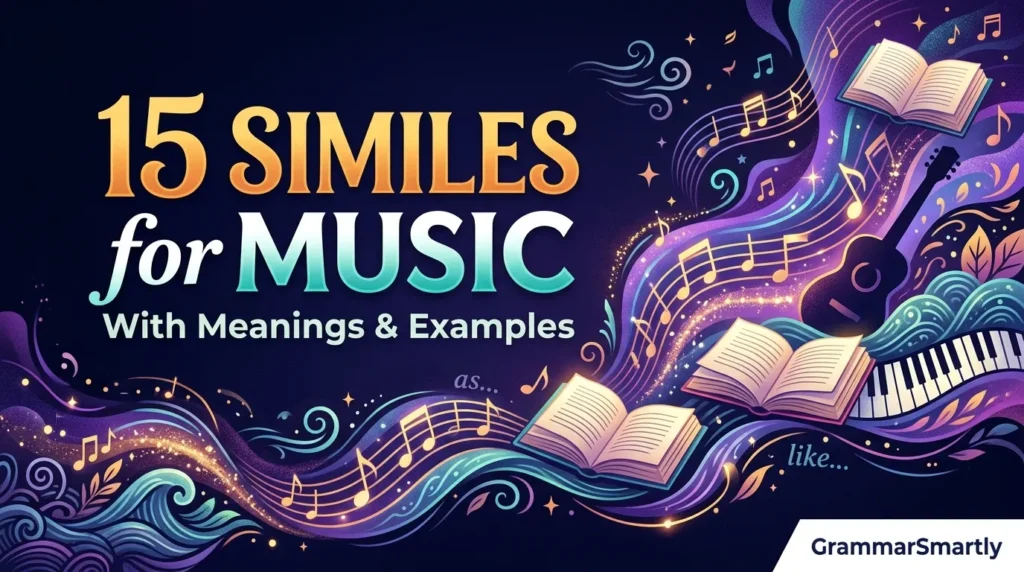
Music can express feelings that ordinary words struggle to capture. A gentle melody may feel comforting, a powerful drumbeat can suggest excitement, and a beautiful voice can leave listeners spellbound. Similes help writers describe these experiences by comparing musical sounds, performances, and emotions with familiar things.
A well-chosen comparison can make a description more vivid. Instead of saying that a singer has a beautiful voice, you might describe it as clear as a bell. Rather than simply calling a melody pleasant, you could say it sounds like a lullaby, suggesting softness, comfort, and peace.
This guide explores 15 similes for music, with clear meanings and original example sentences. It also examines related metaphors in a separate section, because the two figures of speech work differently. A simile makes an explicit comparison, usually with like or as, while a metaphor describes one thing in terms of another.
Some expressions discussed here are established idioms, while others are familiar descriptive comparisons used in everyday English. This distinction matters because an idiom often has a conventional meaning beyond its literal words. For instance, Cambridge Dictionary defines music to someone’s ears as something a person is very pleased to hear, so the expression can describe welcome news rather than music itself.
Whether you are writing a poem, describing a concert, completing a school assignment, or improving your creative writing, these comparisons can help you communicate what music sounds and feels like.
What Makes a Simile for Music Work?
A simile compares one thing with another using words such as like or as. For music, the comparison might focus on sound, rhythm, volume, emotional effect, or the way a performance makes listeners feel.
For example, “The violin sounded like a singing bird” compares the violin’s sound with a bird’s song. The reader can imagine a light, melodic, perhaps high-pitched sound.
A metaphor works differently. “The violin was a singing bird” presents the instrument as something else rather than explicitly comparing the two.
Not every expression about music is a simile. Music to my ears is an established idiom, and the soundtrack of my life is a metaphorical expression. Recognizing these differences helps writers choose language that fits their intended meaning.
Metaphors for Music
Metaphors can describe music as a force, a companion, a language, or an essential part of life. Unlike similes, they do not need like or as to establish the comparison. The following are recognizable metaphorical expressions, though some are flexible descriptions rather than fixed idioms.
Music is a universal language
This metaphor presents music as a language that people can understand emotionally even when they do not share spoken words. It emphasizes music’s ability to communicate moods, ideas, and feelings across cultural and linguistic boundaries.
A writer might say, “Music is a universal language that brings strangers together.” The expression is figurative, not a claim that music follows the same grammar as a spoken language.
Music is the soundtrack of life
A soundtrack accompanies the scenes of a film. Describing music as the soundtrack of life suggests that songs and melodies accompany personal experiences, relationships, and memories.
For example, “The songs of her childhood became the soundtrack of her life.” The metaphor is particularly effective in memoirs, personal essays, and reflective writing.
Music is medicine for the soul
This metaphor portrays music as a source of emotional comfort or relief. It does not mean that listening to music is a substitute for medical treatment. Instead, it emphasizes the way a song can help someone relax, process feelings, or feel less alone.
“After a difficult day, music was medicine for his soul” conveys a sense of personal restoration.
Music is a bridge between people
A bridge connects places that would otherwise be separated. In this metaphor, music connects individuals, communities, and generations.
“Jazz became a bridge between the two generations” suggests that a shared interest in music helped people understand one another.
Music is a journey
This metaphor presents a musical piece as an experience that takes the listener through changing moods, ideas, and emotional landscapes.
“The symphony was a journey from quiet reflection to overwhelming joy” describes the development of the music as though the listener were traveling from one place to another.
Music is a heartbeat
A heartbeat sustains the body and provides a steady rhythm. Calling music a heartbeat can suggest vitality, continuity, or the central role music plays in a person’s life.
“Music is the heartbeat of the festival” conveys that performances and rhythms are central to the event’s energy.
Music is a refuge
A refuge offers shelter from danger, stress, or discomfort. When music is described as a refuge, it becomes a figurative place of safety where someone can find comfort or temporarily escape daily pressures.
“For the lonely teenager, the piano was a refuge” communicates an emotional connection between the person and the instrument.
Music is a spell
A spell can enchant or captivate someone. Describing music as a spell suggests that a performance holds the listener’s attention so completely that the outside world seems to disappear.
“The singer’s voice was a spell that silenced the entire audience” conveys intense fascination. This is a creative metaphor, not a fixed idiom.
15 Similes for Music
The following comparisons focus on the qualities writers most often want to describe: musical beauty, rhythm, energy, volume, and emotional impact. Each expression uses a direct comparison, with an example showing how it can work in a sentence.
1. As clear as a bell
This familiar comparison describes a sound that is exceptionally clear, distinct, and easy to hear. Oxford Learner’s Dictionaries gives as clear as a bell as an example of describing a voice that can be heard clearly.
Applied to music, it can describe a singer with excellent vocal clarity or an instrument whose notes stand out distinctly from the rest of an arrangement.
Example: The soprano’s high notes rang out as clear as a bell above the orchestra.
2. Like a lullaby
A lullaby is a song traditionally sung to help a child fall asleep. Comparing music to a lullaby suggests a gentle, soothing, and comforting quality.
The comparison can describe music that is not literally intended for children. A slow piano composition, a soft guitar melody, or a quiet instrumental piece may all evoke the same sense of peace.
Example: The gentle piano music drifted through the room like a lullaby, easing everyone’s tension.
3. Like a marching band
A marching band is associated with coordinated rhythms, strong beats, and a powerful collective sound. This comparison works well for music that feels energetic, disciplined, or full of forward momentum.
It is especially useful when describing music with a prominent percussion section or a strong, regular beat.
Example: The drums and brass charged through the stadium like a marching band leading a parade.
4. Like a songbird
Songbirds are known for their melodic calls and varied vocal sounds. Comparing a singer or instrument to a songbird suggests a light, tuneful, expressive quality.
The comparison often suits a delicate soprano voice, a flute, or a bright violin passage.
Example: Her flute trilled like a songbird at sunrise.
5. As sweet as honey
Honey is commonly associated with sweetness, making it a natural comparison for a warm, pleasing, or velvety musical sound. When applied to a voice, the phrase emphasizes its attractive tone rather than its volume or technical range.
The expression is descriptive rather than exclusive to music, so context makes its meaning clear.
Example: The singer’s warm alto was as sweet as honey, especially during the final chorus.
6. Like a thunderstorm
A thunderstorm can be loud, forceful, and dramatic. Comparing music to a thunderstorm suggests an overwhelming sound, sudden changes in intensity, or a powerful combination of percussion and low notes.
This simile is particularly effective for dramatic orchestral music, heavy rock, or a forceful live performance.
Example: The percussion crashed like a thunderstorm as the orchestra reached its climax.
7. As steady as a heartbeat
A heartbeat provides a recurring rhythm. This comparison describes music with a consistent pulse that feels natural and reassuring.
It can be used for a bass line, a drum pattern, or an accompaniment that holds a performance together.
Example: The bass drum kept a beat as steady as a heartbeat throughout the song.
8. Like a river flowing
A flowing river suggests continuous movement, smoothness, and an absence of abrupt interruptions. This comparison works for legato melodies, fluid piano passages, and music that develops naturally from one phrase to the next.
It can also suggest that a performance feels effortless.
Example: The pianist’s fingers moved across the keys like a river flowing through a quiet valley.
9. As loud as a siren
A siren is designed to produce a sound that attracts attention. Comparing music to a siren emphasizes its loudness, piercing quality, or ability to dominate the surrounding environment.
This comparison should be used when the sound is genuinely intense, not simply when a song is enjoyable.
Example: The amplified guitar blared as loud as a siren across the crowded concert hall.
10. Like a whisper in the wind
A whisper is quiet and delicate, while wind can carry a sound softly through a space. This comparison suggests music that is faint, subtle, and almost ethereal.
It is particularly suitable for a quiet instrumental passage, a distant vocal line, or ambient music.
Example: The distant flute sounded like a whisper in the wind beneath the evening sky.
11. As bright as a trumpet
A trumpet can produce a brilliant, penetrating tone that stands out in an ensemble. This comparison emphasizes brightness, clarity, and a strong presence in the sound.
It can describe a brass melody, a high-register instrumental line, or a singer with a particularly bright tone. Here, bright refers to the perceived quality of the sound rather than its actual color.
Example: The opening melody rang out as bright as a trumpet, immediately catching the audience’s attention.
12. Like waves on the shore
Waves arrive in recurring movements, sometimes gently and sometimes with considerable force. Comparing music to waves suggests a repeated rise and fall in volume, intensity, or emotional feeling.
The simile works especially well for pieces that build gradually and then recede into quieter passages.
Example: The orchestra swelled and softened like waves on the shore, creating a peaceful atmosphere.
13. As light as a feather
A feather suggests lightness and delicacy. In musical descriptions, this simile can refer to a gentle touch on an instrument, a delicate melody, or a performance that avoids heaviness.
It is useful for classical piano, soft acoustic music, and subtle vocal arrangements.
Example: Her fingers danced over the piano keys as light as a feather.
14. Like a broken record
A broken record is a familiar idiom for someone or something that repeats the same thing continually. The comparison can describe music that repeats a phrase, but it often carries a negative or humorous tone when applied to a person who keeps saying the same thing.
Use it carefully when discussing music itself, since repetition may be intentional and artistically effective.
Example: The chorus repeated like a broken record, which made the song catchy but slightly predictable.
15. Like music to my ears
This expression is commonly used when something sounds especially pleasing or when someone receives welcome news. Cambridge Dictionary records be music to someone’s ears as an established idiom for something a person is very pleased to hear.
Strictly speaking, the expression is an idiom that can function as a simile when written with like. Its meaning often goes beyond the literal sound of music.
Example: Hearing the orchestra begin my favorite composition was like music to my ears.
When and How to Use Similes and Metaphors for Music
Choosing the right comparison depends on your audience, the type of writing, and the musical quality you want to communicate.
In poetry and creative writing
Similes help readers imagine a sound through familiar experiences. A comparison such as the melody flowed like a river creates a sense of continuous movement, while the drums thundered like a storm suggests intensity and power.
Metaphors can make the description more direct. Calling music a refuge gives it an emotional role in the narrative without explaining every detail.
In school assignments
For essays and literary exercises, choose a comparison that clearly illustrates the musical quality being discussed. Explain why the comparison works rather than simply listing expressions.
For example, “The flute sounded like a songbird” is effective because both sounds can be light, melodic, and expressive.
In reviews and formal writing
Musical comparisons can add personality to reviews, but precision matters. A reviewer describing a classical performance might write that the strings were as smooth as silk, while a technical discussion would benefit from more specific language about tone, articulation, dynamics, or tempo.
In academic writing, use figurative language selectively and distinguish subjective impressions from measurable musical characteristics.
In everyday conversation
Familiar expressions are often the most natural choice. Music to my ears works when someone shares welcome news, and as clear as a bell can describe a voice or instrument that sounds distinct.
You do not need elaborate imagery every time you talk about music. A short, familiar comparison is often more effective than an unusual one that distracts from the point.
Common Mistakes and Confusions
Confusing similes with metaphors
A simile explicitly compares two things, usually with like or as. A metaphor describes one thing in terms of another.
- Simile: The melody flowed like a river.
- Metaphor: The melody was a river.
Both are figurative, but their grammatical structures differ.
Assuming every expression containing “like” is a simile
The word like can indicate resemblance, preference, or other relationships. In “I like classical music,” it expresses preference, not comparison.
To identify a simile, look for a comparison between two things rather than the mere presence of a particular word.
Using “as” incorrectly
A common simile pattern is as + adjective + as + noun, as in as clear as a bell. The adjective describes a quality shared, at least figuratively, by the two things.
Not every phrase containing as is a simile. Its grammatical function and meaning determine whether a comparison is being made.
Treating idioms as literal descriptions
Music to my ears often refers to good news, not an actual musical performance. Likewise, like a broken record can criticize repetitive speech rather than describe a damaged recording.
Context determines whether an expression is literal, figurative, or idiomatic.
Choosing comparisons that do not fit the intended mood
A comparison should reinforce the mood of the passage. Describing a peaceful melody as like a thunderstorm may confuse readers unless the contrast is deliberate.
Think about whether the intended effect is calmness, excitement, sadness, tension, or joy before choosing a simile.
Summary
Similes and metaphors make descriptions of music more vivid by connecting sound, rhythm, and emotion with familiar experiences. Similes make comparisons explicit, while metaphors present music as something else to communicate its significance. The strongest choice is the one that helps readers hear, imagine, or feel the music more clearly.
Frequently Asked Questions
1. What is a simile for music?
A simile for music compares a musical sound, performance, or experience with something else, usually using like or as. For example, “The melody flowed like a river” compares the music’s movement with the continuous flow of water.
2. What are five examples of similes for music?
Five examples are:
- As clear as a bell.
- Like a lullaby.
- Like a songbird.
- As steady as a heartbeat.
- Like waves on the shore.
Each comparison emphasizes a different quality, such as clarity, gentleness, melody, rhythm, or changing intensity.
3. What is a metaphor for music?
A metaphor describes music in terms of something else without making an explicit comparison using like or as. For example, “Music is a universal language” suggests that music communicates feelings and ideas beyond the limits of spoken language.
4. What is the difference between a simile and a metaphor about music?
A simile makes an explicit comparison, as in “The violin sounded like a bird.” A metaphor states the comparison more directly, as in “The violin was a bird singing in the forest.”
Both expressions create imagery, but they present the relationship between music and the comparison differently.
5. How can I describe beautiful music using a simile?
You can compare beautiful music with something associated with harmony, clarity, or pleasure. For example, “Her voice was as sweet as honey” emphasizes its pleasing tone, while “The melody floated like a feather on the breeze” suggests lightness and delicacy.
Choose a comparison that reflects the particular quality you want your reader to imagine.
6. What simile describes loud music?
“Loud as a siren” is a useful comparison for music that is piercing or attention-grabbing. For a more dramatic description, you might say, “The drums crashed like a thunderstorm.”
The first emphasizes loudness, while the second evokes a broader sense of power and intensity.
7. Can I use similes for music in formal writing?
Yes. Similes can be effective in essays, reviews, speeches, and literary analysis when they clarify a point. In formal writing, choose precise comparisons and explain their relevance. Avoid using so many figurative expressions that they obscure the actual musical qualities being discussed.