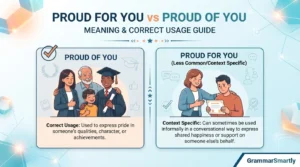
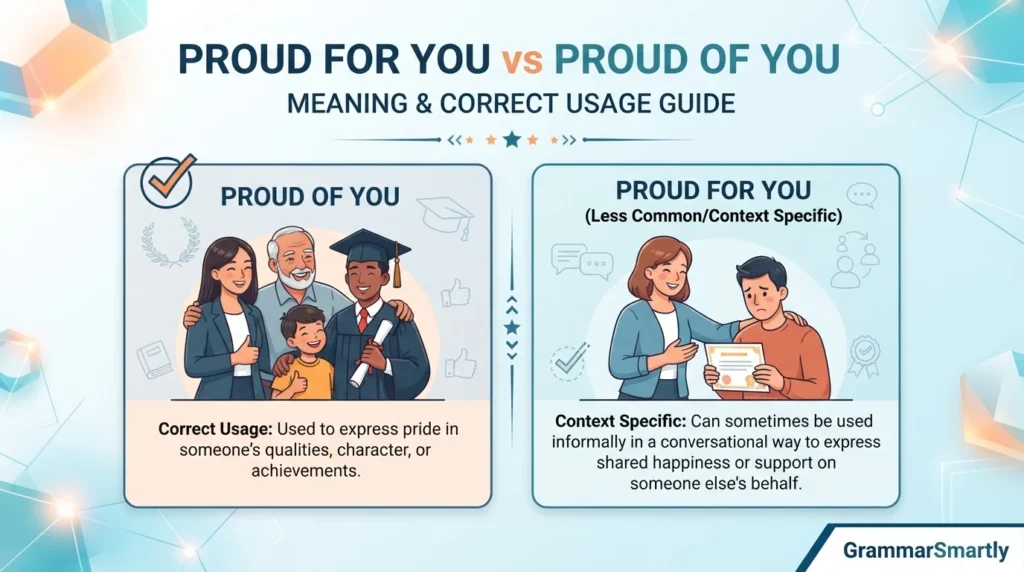
When you want to congratulate someone or show admiration for an achievement, should you say “proud for you” or “proud of you”? The standard English expression is “proud of you.” English normally uses proud of when the person, achievement, quality, or result is the focus of the speaker’s pride. For example, “I’m proud of you for finishing the project.” The expression “proud for you” may occasionally appear in informal speech or online writing, but it is not the usual standard construction for this meaning. This guide explains the difference between the two phrases, their meanings, grammar, pronunciation, common mistakes, and natural examples so you can choose the right expression confidently.
Quick Facts Table
| Feature | Details |
| Standard form | Proud of you |
| Alternative form | Proud for you |
| Word type | Adjective + preposition + pronoun |
| Meaning | Feeling pleasure, satisfaction, or admiration because of someone’s achievement, qualities, or actions |
| Pronunciation | proud /praʊd/ |
| Main difference | Of is the established preposition used with proud when identifying the person or thing that causes the pride |
| Usage status | Proud of you is standard; proud for you is not the normal standard construction for this meaning |
| Common error | Replacing of with for, often because happy for you is a familiar expression |
What Does “Proud For You vs Proud Of You” Mean?
The two phrases look almost identical, but they do not have the same status in standard English.
“Proud of You”
“Proud of you” is the standard expression used when someone’s actions, qualities, progress, or achievements cause you to feel pride.
Examples include:
- I’m proud of you for finishing your degree.
- Your parents are proud of you.
- We are proud of you for staying determined.
- I’m incredibly proud of you.
The person represented by you is the person connected to the speaker’s feeling of pride.
Understanding star similes and their meanings can make descriptive writing more vivid and precise.
“Proud for You”
“Proud for you” is sometimes encountered in informal communication, but it is not the normal standard construction when you mean that you feel pride because of another person’s achievement.
A speaker may produce it by analogy with expressions such as “happy for you” or “excited for you.” However, standard English normally uses proud of for this particular adjective-preposition combination.
For standard writing and careful speech, use:
I’m proud of you.
rather than:
I’m proud for you.
Is “Proud of You” Correct?
Yes. “Proud of you” is correct and standard English.
The structure is:
proud + of + person
For example:
- I’m proud of you.
- She is proud of her daughter.
- They are proud of their team.
- He is proud of himself.
Oxford lists proud of somebody/something/yourself as a standard pattern and also gives the related construction proud of somebody/something/yourself for doing something.
Cambridge likewise uses examples such as proud of his daughters and defines proud in this sense as feeling pleasure and satisfaction because of something you or someone connected with you has done or achieved.
Is “Proud for You” Correct?
“Proud for you” is not the usual standard expression when you want to say that you feel pride in someone.
That does not mean the sequence of words can never appear in English. Individual speakers may use it informally, creatively, or under the influence of expressions such as happy for you. The important point is that it does not replace the established proud of you construction in standard usage.
Therefore, in essays, professional writing, educational writing, formal messages, and careful everyday English, choose proud of you.
What Is the Correct Phrase?

The standard phrase is:
I’m proud of you.
You can also expand it by explaining what caused the feeling of pride:
I’m proud of you for working so hard.
I’m proud of you for completing the course.
I’m proud of you for handling the situation calmly.
Oxford specifically records the pattern proud of somebody/something/yourself for doing something, which makes this structure especially useful when you want to identify the reason for the pride.
The distinction between Unselect and Deselect in English is useful when describing choices, options, and interface actions.
Difference Between “Proud For You” and “Proud Of You”
| Feature | Proud of You | Proud for You |
| Status | Standard English | Not the normal standard construction for this meaning |
| Preposition | of | for |
| Meaning intended | Pride in someone’s achievement, qualities, or actions | Often intended to mean pride or happiness on someone’s behalf |
| Naturalness | Natural | Often sounds unusual |
| Formal writing | Appropriate | Avoid for the intended meaning |
| Everyday standard speech | Common | Not normally used instead of proud of you |
| Example | I’m proud of you for graduating. | I’m proud for you for graduating. |
The key distinction is the preposition. Proud normally takes of when the person or thing is the object of the speaker’s pride. Oxford’s entry explicitly lists of as the preposition used with this sense of proud.
Meaning of “Proud Of You”
Feeling Pride in Someone
When you say “I’m proud of you,” you express pleasure or satisfaction connected with that person’s actions, qualities, progress, or achievements.
For example:
I’m proud of you for finishing the assignment.
The speaker is expressing pride connected with the other person’s action.
Pride in an Achievement

The phrase can refer to a specific accomplishment:
I’m proud of you for passing the exam.
Pride in Effort or Character
The person does not have to win something or achieve a major goal. You can use proud of you to recognize effort, courage, persistence, honesty, or personal growth.
For example:
I’m proud of you for admitting your mistake.
Common Contexts for “Proud Of You”
The expression works naturally in many situations:
- Parents speaking to their children
- Teachers encouraging students
- Friends celebrating personal achievements
- Coaches recognizing effort
- Mentors acknowledging progress
- Managers recognizing successful work
- Partners supporting one another
- Family members celebrating important milestones
It can be used for both major achievements and smaller moments of personal progress.
Pronunciation
The adjective proud is pronounced /praʊd/ in both British and American English according to Oxford and Cambridge.
Syllable Breakdown
proud is a one-syllable word.
The phrase can be divided naturally as:
proud | of | you
In connected speech, of may be pronounced weakly, so the phrase can sound more fluid than it appears in writing.
Pronunciation Tip
The vowel sound in proud is the same general diphthong heard in words such as loud and cloud.
Do not change the spelling of of simply because it may sound weak in rapid speech.
Why Do People Say “Proud For You”?
The confusion is understandable because English uses for with many expressions involving another person’s situation.
For example:
- I’m happy for you.
- I’m excited for you.
- I’m grateful for you.
- I’m sorry for you.
Because happy for you is extremely familiar, a learner may naturally produce proud for you.
However, English adjective-preposition combinations are not always predictable from one adjective to another. The established pattern with proud in this meaning is proud of.
A useful way to remember the distinction is:
happy for you
proud of you
Do not assume that the same preposition must follow every emotion adjective.
Origin and Etymology
The word proud has a long history in English. Oxford traces it to late Old English forms such as prūt and prūd, from Old French prud, with a connection to Latin prodesse, meaning “to be of value.”
The modern meaning has developed beyond its historical associations and now includes the sense of feeling pleased and satisfied about something one has done, owns, or is connected with.
The important point for this usage question is not the historical origin of proud, but its established modern grammatical pattern: proud of someone or something.
How to Remember the Correct Usage
Memory Strategy
Connect the adjective and preposition as one unit:
proud + of
Think:
I’m proud OF what you did.
The word of introduces the person, thing, achievement, or quality connected with the pride.
Quick Memory Trick
Remember:
Proud OF you.
Not:
Proud FOR you.
If you are congratulating someone, you can also use:
I’m happy for you.
But when you specifically mean pride, use:
I’m proud of you.
Word-Family Connection
Related forms include:
- proud
- prouder
- proudest
- proudly
- pride
The noun pride refers to the feeling itself, while proud is the adjective used to describe someone experiencing that feeling.
Examples in Sentences
Here are varied examples showing the standard use of proud of you and the corresponding nonstandard substitution to avoid.
| No. | Standard Sentence | Nonstandard Alternative |
| 1 | I’m proud of you for finishing your degree. | I’m proud for you for finishing your degree. |
| 2 | Your family must be proud of you. | Your family must be proud for you. |
| 3 | I’m proud of you for admitting the mistake. | I’m proud for you for admitting the mistake. |
| 4 | She told her daughter that she was proud of her. | She told her daughter that she was proud for her. |
| 5 | We’re proud of you for completing the project. | We’re proud for you for completing the project. |
| 6 | He is proud of you for staying calm. | He is proud for you for staying calm. |
| 7 | I couldn’t be more proud of you. | I couldn’t be more proud for you. |
| 8 | They are proud of you for representing the school. | They are proud for you for representing the school. |
| 9 | I’m especially proud of you today. | I’m especially proud for you today. |
| 10 | She said she was proud of you after hearing the news. | She said she was proud for you after hearing the news. |
| 11 | Your coach is proud of you for all your effort. | Your coach is proud for you for all your effort. |
| 12 | I’m genuinely proud of you. | I’m genuinely proud for you. |
| 13 | He was proud of himself for keeping his promise. | He was proud for himself for keeping his promise. |
| 14 | We are proud of our team for its hard work. | We are proud for our team for its hard work. |
| 15 | I’m proud of you for taking that difficult step. | I’m proud for you for taking that difficult step. |
The first sentence in each pair follows the standard pattern. The second illustrates the preposition substitution that should generally be avoided when the intended meaning is pride in the person or their achievement.
Common Mistakes to Avoid
1. Using “for” Instead of “of”
The most common problem is:
❌ I’m proud for you.
Use:
✅ I’m proud of you.
2. Confusing “Proud” With “Happy”
The expressions have related positive meanings but different grammatical patterns:
I’m happy for you.
I’m proud of you.
Do not transfer the preposition from one expression to the other.
3. Using “Proud For You For”
A particularly awkward construction is:
❌ I’m proud for you for getting the promotion.
Use:
✅ I’m proud of you for getting the promotion.
The second for is appropriate because it introduces the action that explains the reason for the pride.
4. Forgetting the Preposition
Avoid:
❌ I’m proud you.
Use:
✅ I’m proud of you.
However, English also allows other structures after proud, such as:
I’m proud that you succeeded.
I’m proud to be part of the team.
Oxford records these different grammatical patterns as well.
Similar Commonly Confused Expressions
| Expression | Standard Pattern | Example |
| Proud | proud of | I’m proud of you. |
| Happy | happy for | I’m happy for you. |
| Excited | excited for | I’m excited for you. |
| Afraid | afraid of | She is afraid of spiders. |
| Fond | fond of | He is fond of his dog. |
| Interested | interested in | She is interested in science. |
| Good | good at | He is good at math. |
| Sorry | sorry for/about depending on meaning | I’m sorry for the delay. |
This comparison demonstrates why prepositions should be learned as part of natural word combinations rather than transferred mechanically from another adjective.
Related Words
Synonyms
Depending on context, words related to proud include:
- pleased
- satisfied
- delighted
- glad
- thrilled
These words are not always interchangeable. The exact choice depends on what kind of positive feeling you want to express.
For example:
I’m proud of you.
focuses on pride connected with the person’s achievement or qualities.
I’m happy for you.
focuses more directly on happiness about something good happening to the other person.
Oxford distinguishes proud from related words such as glad, happy, pleased, delighted, relieved, and thrilled.
Related Forms
Common forms include:
- pride, noun
- proud, adjective
- prouder, comparative adjective
- proudest, superlative adjective
- proudly, adverb
Grammar Tips
Proud is an adjective.
The most useful pattern for this topic is:
subject + be + proud + of + person/thing
Examples:
- I am proud of you.
- She is proud of her work.
- They are proud of their daughter.
- We were proud of the team’s performance.
You can then add for + -ing form to explain the action that caused the pride:
I’m proud of you for working so hard.
Oxford explicitly records this pattern as proud of somebody/something/yourself for doing something.
Another possible structure is:
proud + to + verb
I’m proud to be part of this team.
You can also use:
proud + that-clause
She was proud that her daughter had succeeded.
These structures are different, but they all demonstrate that proud has established grammatical patterns beyond the simple phrase proud of you.
Writing Tips
For essays, emails, professional messages, and other edited writing:
- Use proud of when the person or achievement is the object of your pride.
- Use proud of you for + -ing when you want to name the action.
- Do not replace of with for simply because happy for you is familiar.
- Specify the achievement when greater precision is useful.
- Check the entire phrase rather than checking the preposition in isolation.
For example, instead of:
We are proud for you.
write:
We are proud of you for completing the project.
Quick Spelling and Usage Checklist
| Check | Correct Form or Rule |
| Standard phrase | proud of you |
| Common nonstandard substitution | proud for you |
| Meaning | Feeling pride connected with someone or something |
| Pronunciation | proud /praʊd/ |
| Word type | Adjective |
| Key grammar pattern | proud of + person/thing |
| Reason for an action | proud of + person + for + -ing |
| Alternative structure | proud to + verb |
| Another structure | proud that + clause |
| Final proofreading check | Make sure of, not for, follows proud when expressing pride in someone |
Key Takeaways
- “Proud of you” is the standard English expression.
- “Proud for you” is not the normal standard construction for expressing pride in someone.
- Use proud of + person/thing to identify the person or thing connected with your pride.
- Use proud of you for + -ing to explain what the person did.
- Do not confuse proud of you with happy for you.
- Proud is pronounced /praʊd/.
- Proud can also be followed by structures such as to + verb and that + clause.
- The simplest memory aid is: proud OF you.
Conclusion
The difference between “proud for you” and “proud of you” comes down mainly to the established grammatical pattern that follows the adjective proud. When you want to express pride in someone’s achievement, effort, character, or progress, “proud of you” is the standard choice. You can make the sentence more specific with “proud of you for + -ing,” as in “I’m proud of you for finishing the course.” Although “proud for you” can appear in informal communication, it should not normally be used as a replacement for “proud of you.” The easiest way to remember the distinction is to learn proud of as a fixed combination, just as you learn other adjective-preposition patterns. Once this pattern becomes familiar, choosing the correct phrase becomes straightforward.
Frequently Asked Questions
Is “proud for you” correct?
“Proud for you” is not the normal standard construction when you mean that you feel pride in someone. It may appear in informal speech or online writing, but standard English normally uses “proud of you.” For formal, professional, academic, and carefully edited writing, use “proud of you” when expressing pride in another person’s actions, qualities, or achievements.
Is “proud of you” grammatically correct?
Yes. “Proud of you” is a standard grammatical construction. Oxford specifically lists the pattern proud of somebody/something/yourself, while Cambridge provides examples such as proud of his daughters and proud of his achievements. The phrase can stand alone or be expanded to explain the reason for the pride.
What is the difference between “proud for you” and “proud of you”?
“Proud of you” expresses pride connected with the person, their actions, qualities, or achievements. “Proud for you” is sometimes used informally, often under the influence of expressions such as happy for you, but it is not the usual standard construction. If you mean direct pride in someone’s achievement, choose “proud of you.”
Can I say “I’m proud of you for your success”?
Yes, although the exact construction can be made more natural depending on what you want to emphasize. For example, “I’m proud of you for succeeding” directly uses the documented pattern proud of somebody for doing something. You can also say “I’m proud of your success” when you want the achievement itself to be the object of proud of.
Can I say “I’m proud of you for graduating”?
Yes. “I’m proud of you for graduating” is a natural and standard construction. Here, of you identifies the person who is the focus of the pride, while for graduating explains the action that caused the feeling. This pattern is particularly useful when you want to make your compliment specific rather than simply saying “I’m proud of you.”
Why do people say “proud for you”?
People may say “proud for you” because English contains many common emotional expressions with for, including “happy for you” and “excited for you.” A speaker may extend that pattern to proud. However, adjective-preposition combinations are not always interchangeable, and the established standard pattern for proud in this sense is proud of.
Can “proud for you” be used in casual conversation?
You may encounter “proud for you” in casual conversation, texts, comments, or other informal communication. Its appearance does not make it the standard replacement for “proud of you.” If your goal is conventional, natural English, particularly in edited writing, “proud of you” remains the appropriate choice for expressing pride in someone.
What is the pronunciation of “proud”?
Proud is pronounced /praʊd/ in both British and American English according to Oxford and Cambridge. It is a one-syllable word. Its vowel sound is similar to the vowel sound found in words such as loud and cloud. In the phrase proud of you, the small word of may be pronounced weakly in normal connected speech.
Can I say “I’m proud that you succeeded”?
Yes. “Proud” can be followed by a that-clause in appropriate contexts. For example, “She was proud that her daughter had so much talent.” This is different from the proud of + noun/pronoun construction but expresses a closely related idea. Oxford records both proud of and proud that patterns.
Can I say “I’m proud to be part of the team”?
Yes. “Proud to + verb” is another standard construction. For example, “I’m proud to be part of this organization.” The construction focuses on the action, status, or circumstance introduced by the infinitive rather than using of before a noun or pronoun. Oxford and Cambridge both provide examples of this pattern.
What is the easiest way to remember “proud of” versus “proud for”?
Treat proud of as a fixed combination. When you mean that someone or something gives you a feeling of pride, use of: “I’m proud of you.” When you mean that you feel happiness about another person’s good news, happy for you may be the more appropriate expression. Keeping these two patterns separate prevents the most common preposition mistake.