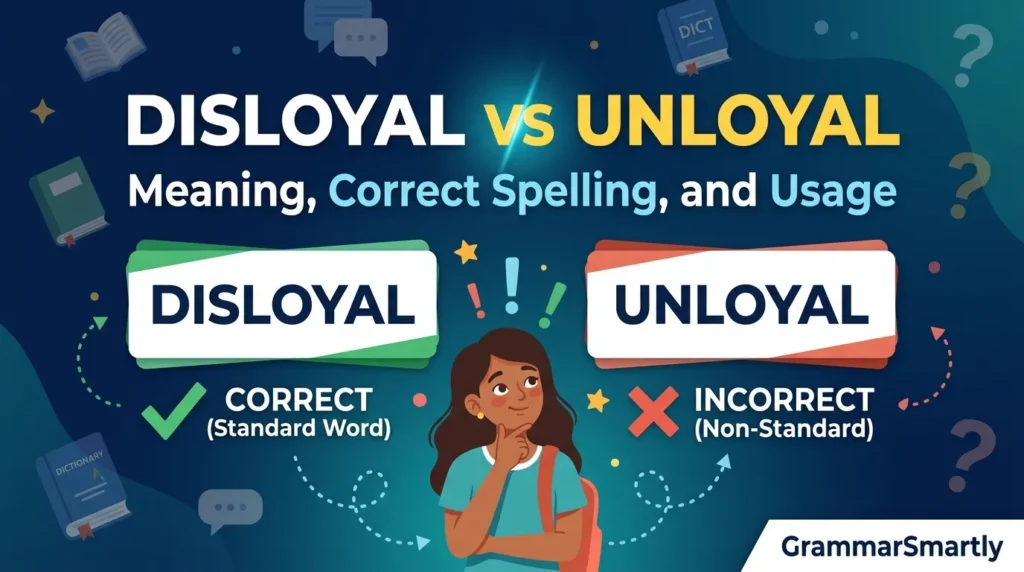
Choosing between disloyal and unloyal can be confusing because both forms suggest a lack of loyalty. However, they are not equally established in modern English. Disloyal is the standard, widely recognized choice for describing someone who is unfaithful, untrustworthy, or not supportive of a person, group, or cause. Unloyal is a much less common alternative that readers may encounter, but it is generally not the preferred form in standard contemporary writing.
Understanding this distinction helps you choose the right word in essays, professional communication, everyday conversation, and exams. This guide explains the meanings, grammatical uses, pronunciation, word formation, and practical differences between disloyal and unloyal, with examples and spelling tips to help you use the appropriate form confidently.
Quick Facts: Disloyal vs Unloyal
| Feature | Details |
| Standard form | Disloyal |
| Alternative form | Unloyal |
| Word type | Adjective |
| Meaning | Not loyal or faithful |
| Pronunciation | Disloyal: /dɪsˈlɔɪəl/ |
| Main difference | Disloyal is the established standard choice; unloyal is much less common. |
| Usage status | Disloyal is preferred in standard modern English. |
| Common error | Choosing unloyal when disloyal is the more natural and conventional word. |
What Does “Disloyal vs Unloyal” Mean?
The comparison concerns two forms that express the opposite of loyalty. The main practical distinction is not a major difference in meaning, but their relative acceptance and naturalness in contemporary English.
Understanding the meaning of Excel vs Accel helps you distinguish the correct spelling from a commonly confused alternative.
What Does Disloyal Mean?

Disloyal describes a person, action, or attitude that fails to show loyalty, faithfulness, or allegiance.
Examples:
- A disloyal friend shares a confidence that was meant to remain private.
- The employee was accused of being disloyal to the company.
- Her decision to betray the team’s trust was considered disloyal.
- The character remains disloyal to the cause he once supported.
The word can describe personal relationships, professional conduct, political allegiance, and commitment to an organization or principle.
What Does Unloyal Mean?
Unloyal is a less common adjective formed with the negative prefix un-. It conveys the idea of not being loyal, but it is less conventional than disloyal in standard contemporary English.
For example:
The writer described the character as unloyal to his former allies.
Although the intended meaning is understandable, disloyal to his former allies would usually be the more idiomatic choice in edited English.
The Main Difference
- Disloyal: The established and preferred adjective for a lack of loyalty.
- Unloyal: A less common alternative that is generally best avoided in formal writing unless a specific context justifies it.
Both forms are understandable, but they are not equally suitable for ordinary modern usage.
Is “Unloyal” Correct?
Unloyal is not simply a random string of letters. It is a recorded English formation, although it is much less established in everyday standard usage than disloyal.
The important distinction is between a word being recognizable and being the best choice in a particular context.
- In formal essays, use disloyal.
- In professional writing, prefer disloyal for clarity and conventional usage.
- When editing a sentence containing unloyal, consider replacing it with disloyal.
- When discussing a historical text or a writer’s deliberate word choice, retain unloyal if the original wording matters.
Practical recommendation: Unless you have a specific reason to use the alternative, choose disloyal.
What Is the Correct Spelling?
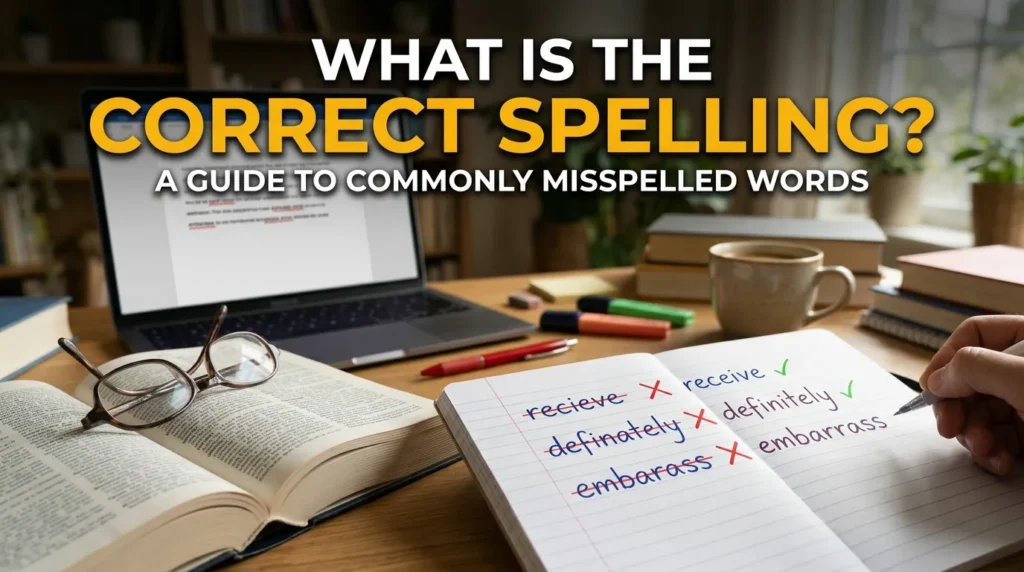
Preferred standard spelling: disloyal
The word disloyal combines the prefix dis- with the adjective loyal. It is the conventional spelling used to describe a lack of faithfulness, allegiance, or support. Oxford Learner’s Dictionaries and Cambridge Dictionary recognize disloyal as an established adjective.
Oxford Learner’s Dictionaries
+1
The spelling is straightforward once you recognize its structure:
- dis-: a prefix that expresses negation or opposition in this word.
- loyal: the base adjective describing faithfulness or allegiance.
- disloyal: the resulting adjective describing a lack of loyalty.
A common alternative is unloyal, formed with un- instead. Although that formation is understandable and has historical attestations, it is not the usual choice in contemporary edited English.
Wiktionary
+1
Related standard forms include:
- Disloyalty, a noun referring to a lack of loyalty.
- Disloyally, an adverb describing an action performed without loyalty.
- Loyal, the positive adjective.
- Loyally, the adverb describing loyal behavior.
Difference Between Disloyal and Unloyal
| Feature | Disloyal | Unloyal |
| Status | Established standard adjective | Recognized but uncommon adjective |
| Meaning | Not loyal or faithful | Not loyal |
| Word type | Adjective | Adjective |
| Pronunciation | /ˌdɪsˈlɔɪ.əl/ | No separate standard pronunciation established here |
| Usage | Natural in contemporary writing | Less conventional |
| Modern standard usage | Preferred | Generally avoid when disloyal fits |
The central distinction is conventional usage rather than a reliable difference in meaning. Both formations communicate a lack of loyalty, but disloyal is the form readers are more likely to expect in ordinary contemporary prose.
For example:
- Preferred: The manager considered the employee’s actions disloyal.
- Less conventional: The manager considered the employee’s actions unloyal.
The second sentence communicates the intended idea, but the first is the better editorial choice.
Meaning of the Standard Word
Literal Meaning
Disloyal means failing to remain faithful or supportive toward someone or something to which loyalty is expected.
It can describe conduct that breaks trust, abandons an allegiance, or undermines a commitment.
Examples:
- A friend reveals a private conversation to embarrass another person.
- A representative secretly works against the organization they pledged to support.
- A team member deliberately shares confidential plans with a rival.
Whether an action is disloyal depends partly on the relationship, expectations, and circumstances involved.
Understanding the meaning of vicious vs viscous helps you distinguish cruelty from thickness when using these commonly confused English words.
Figurative Meaning
The adjective can also describe statements, criticism, or actions that are perceived as undermining a person, institution, or cause.
For example, a leader might call a public criticism disloyal because they believe it weakens the organization. That description expresses the leader’s judgment, however, and does not automatically prove that the criticism is unfair or improper.
Common Contexts
| Context | Example |
| Friendship | His disloyal behavior damaged their friendship. |
| Family | She worried that moving abroad would seem disloyal to her family. |
| Workplace | The supervisor viewed the disclosure as disloyal conduct. |
| Politics | The minister was accused of being disloyal to the party. |
| Sports | The player was criticized for appearing to favor a rival team. |
| Personal commitments | He felt disloyal to his original plan when he changed direction. |
Pronunciation
IPA Pronunciation
The standard pronunciation of disloyal is:
- UK: /ˌdɪsˈlɔɪ.əl/
- US: /ˌdɪsˈlɔɪ.əl/
These pronunciations are given by Cambridge Dictionary.
definition in the Cambridge English Dictionary
+1
Syllable Breakdown
A practical breakdown is dis-loy-al, with three syllables.
The main stress falls on the second syllable, loy.
Pronunciation Tips
- Begin with the short sound in dish without the final sh sound.
- Pronounce loy as in loyalty.
- Finish with the unstressed ending -al.
- Keep the stress on loy, rather than stressing the opening dis-.
The spelling unloyal would naturally be read according to its components, but its relative rarity makes it less familiar to many readers. Do not assume that the two spellings represent different meanings simply because they use different prefixes.
Why Do People Make This Spelling Mistake?
The confusion is understandable because English uses more than one negative prefix. Both dis- and un- can contribute a negative meaning, but they are not freely interchangeable in every word.
1. Applying a General Prefix Rule
A learner may reason that adding un- to loyal should produce the opposite of loyal. The formation is understandable, but established vocabulary depends on conventional usage as well as word-building logic.
2. Confusing Meaning With Standard Usage
Because unloyal can be understood, a writer may assume it is equally natural in every context. Comprehensibility and conventionality are different questions.
3. Extending a Familiar Pattern
English contains many common adjectives beginning with un-, including unfair, untrue, and unhappy. Learners may extend that pattern to loyal without knowing that disloyal is the established choice.
4. Remembering the Meaning but Not the Form
Someone may recall the concept of being unfaithful but hesitate over which negative prefix belongs in the sentence. Remembering the conventional word as a complete unit can prevent this uncertainty.
Origin and Etymology
The history of disloyal helps explain why its spelling is established.
Oxford Learner’s Dictionaries traces the word to late fifteenth-century English, from Old French desloial. The older French form combines des-, expressing negation, with loial, meaning loyal.
Oxford Learner’s Dictionaries
The related word loyal has a history connected with Old French loial and Latin legalis.
Dictionary.com
The modern spelling therefore reflects an established historical formation rather than a rule that requires every negative adjective to begin with dis-.
By contrast, unloyal is transparently formed from un- and loyal, and historical examples demonstrate that the form has been used in English. Its existence does not make it the preferred modern alternative.
Wiktionary
+1
How to Remember the Correct Spelling
Quick Memory Trick
Remember this sentence:
When loyalty is broken, think disloyal.
The phrase connects the established adjective with a situation in which trust or allegiance has been undermined.
Another useful method is to learn the word alongside its noun form:
- loyal
- disloyal
- loyalty
- disloyalty
Recognizing the related forms makes the conventional spelling easier to retrieve when writing.
Word-Family Connection
| Word | Part of speech | Meaning |
| Loyal | Adjective | Faithful or supportive |
| Disloyal | Adjective | Not faithful or supportive |
| Loyalty | Noun | The quality of being loyal |
| Disloyalty | Noun | A lack of loyalty |
| Loyally | Adverb | In a loyal manner |
| Disloyally | Adverb | In a disloyal manner |
A useful editing habit is to check whether the word fits the sentence grammatically before checking its spelling. If you need an adjective describing a lack of loyalty, disloyal is the usual choice.
Examples in Sentences
Because disloyal and unloyal are competing forms rather than a simple correct-versus-incorrect spelling pair, the examples below demonstrate the preferred wording and the less conventional alternative.
| No. | Preferred form: disloyal | Alternative form: unloyal |
| 1 | She felt disloyal when she revealed her friend’s secret. | She felt unloyal when she revealed her friend’s secret. |
| 2 | The director considered the leak disloyal to the company. | The director considered the leak unloyal to the company. |
| 3 | His disloyal conduct damaged the team’s confidence in him. | His unloyal conduct damaged the team’s confidence in him. |
| 4 | The adviser was accused of being disloyal to the president. | The adviser was accused of being unloyal to the president. |
| 5 | He refused to make a disloyal remark about his colleague. | He refused to make an unloyal remark about his colleague. |
| 6 | The novel follows a disloyal courtier who betrays the king. | The novel follows an unloyal courtier who betrays the king. |
| 7 | She worried that her resignation would appear disloyal. | She worried that her resignation would appear unloyal. |
| 8 | The player denied being disloyal to his former club. | The player denied being unloyal to his former club. |
| 9 | They viewed the secret agreement as a disloyal act. | They viewed the secret agreement as an unloyal act. |
| 10 | The witness rejected the accusation that he was disloyal. | The witness rejected the accusation that he was unloyal. |
| 11 | Her disloyal response surprised everyone at the meeting. | Her unloyal response surprised everyone at the meeting. |
| 12 | The committee investigated allegations of disloyal behavior. | The committee investigated allegations of unloyal behavior. |
| 13 | He did not want to seem disloyal by supporting the proposal. | He did not want to seem unloyal by supporting the proposal. |
| 14 | The employee’s disloyal actions violated the team’s trust. | The employee’s unloyal actions violated the team’s trust. |
| 15 | They debated whether the public statement was disloyal to the cause. | They debated whether the public statement was unloyal to the cause. |
The paired sentences illustrate the intended meaning, not equal stylistic acceptability. In ordinary contemporary writing, select the disloyal version unless a quotation, historical context, or deliberate stylistic choice calls for unloyal.
Common Mistakes to Avoid
- Treating the prefixes as interchangeable: English word formation has patterns, but a possible formation is not always the conventional choice.
- Calling unloyal a meaningless string: The form has been recorded in English, even though it is uncommon.
- Using disloyal as a synonym for every kind of dishonesty: Disloyalty concerns loyalty or allegiance, while dishonesty specifically concerns truthfulness.
- Confusing disloyal with disloyalty: The first is an adjective; the second is a noun.
- Writing disloyally when an adjective is needed: Use disloyal to describe a person or thing, and disloyally to modify a verb.
- Assuming criticism is automatically disloyal: Disagreement and betrayal are not necessarily the same.
- Overcorrecting a historical quotation: Preserve the original wording when accuracy requires it, and explain unusual vocabulary if necessary.
Similar Commonly Misspelled or Confused Words
These related examples illustrate the importance of learning conventional word forms rather than relying entirely on prefix logic.
| Confused or incorrect form | Preferred form | Reason for confusion |
| Unloyal (when a standard form is intended) | Disloyal | Competing negative prefixes |
| Disloyalty (used as an adjective) | Disloyal | Confusion between noun and adjective |
| Disloyally (used as an adjective) | Disloyal | Confusion between adverb and adjective |
| Unfaithfull | Unfaithful | Extra final letter |
| Untruely | Untruly | Incorrect spelling of the adverb |
| Disagreeement | Disagreement | Extra letter in the noun |
| Irresponsable | Irresponsible | Vowel confusion in the suffix |
| Inloyal (as a substitute for the standard adjective) | Disloyal | Unfamiliar prefix formation |
These examples are not all the same kind of error. Some concern spelling, some concern grammar, and others involve choosing a less conventional form. That distinction matters when editing accurately.
Related Words
Synonyms
Several words can express a lack of loyalty, but their meanings are not identical.
| Synonym | Meaning and distinction |
| Unfaithful | Not faithful to a person, commitment, or relationship. |
| Faithless | Lacking faithfulness, trustworthiness, or fidelity. |
| Treacherous | Likely to betray trust, often in a particularly dangerous or deceptive way. |
| Disloyal | Not faithful or supportive toward someone or something. |
| Betraying | Describes an act that violates someone’s trust or allegiance. |
| Untrustworthy | Not deserving of trust, which does not necessarily mean disloyal. |
| Perfidious | A formal word for deliberate betrayal or deceit. |
Choose the synonym that describes the actual behavior. For example, a person can disagree with a friend without being treacherous, and a person can make a mistake without being disloyal.
Antonyms
The principal opposite of disloyal is loyal. Other alternatives depend on context.
- Faithful: Remaining true to a person, commitment, or duty.
- Trustworthy: Deserving another person’s confidence.
- Devoted: Showing strong commitment or affection.
- Allegiant: Faithfully committed or loyal, particularly to a person or cause.
These words overlap with loyal, but they are not interchangeable in every sentence.
Related Forms
| Word | Part of speech | Example |
| Loyal | Adjective | She is a loyal colleague. |
| Loyalty | Noun | Their loyalty was appreciated. |
| Disloyal | Adjective | His conduct seemed disloyal. |
| Disloyalty | Noun | The accusation of disloyalty upset him. |
| Loyally | Adverb | She loyally supported the project. |
| Disloyally | Adverb | He acted disloyally toward his allies. |
Grammar Tips
The word disloyal is an adjective. Its related noun, disloyalty, and adverb, disloyally, serve different grammatical functions.
1. Use the Correct Form
- Adjective: The decision was disloyal.
- Noun: The decision showed disloyalty.
- Adverb: He acted disloyally.
2. Use the Common Preposition
The adjective commonly takes to when identifying the person, group, or cause involved.
Examples:
- She was disloyal to her friends.
- He remained disloyal to the organization.
- The remark seemed disloyal to the cause.
3. Use It After Linking Verbs
Like other adjectives, disloyal can follow verbs such as be, seem, and become.
- His behavior was disloyal.
- The comment seemed disloyal.
- Their actions became disloyal to the original agreement.
4. Choose the Correct Comparative Form
The usual comparative and superlative forms are more disloyal and most disloyal.
Examples:
- That action was more disloyal than the earlier remark.
- The committee described it as the most disloyal act in the dispute.
Writing Tips
Using disloyal appropriately requires more than choosing the conventional spelling. It also requires considering the evidence and tone of your sentence.
- Essays: Define the relationship or obligation that makes an action disloyal.
- Exams: Choose disloyal when a question asks for the standard contemporary adjective.
- Academic writing: Distinguish observable conduct from judgments about someone’s motives.
- Professional emails: Describe specific actions rather than labeling a colleague disloyal without explanation.
- Proofreading: Check the adjective, noun, and adverb forms separately.
- Editing historical material: Preserve unloyal when it appears in an authentic quotation or when the historical wording is the subject of discussion.
For instance, The employee shared confidential information with a competitor describes an action. Calling that action disloyal adds an interpretation that should be justified by the circumstances.
Quick Spelling Checklist
| Check | Correct form or rule |
| Standard spelling | Disloyal |
| Less conventional alternative | Unloyal |
| Meaning | Not loyal or faithful |
| Pronunciation | /ˌdɪsˈlɔɪ.əl/ |
| Word type | Adjective |
| Key spelling pattern | dis- + loyal |
| Common usage | Disloyal to someone or something |
| Final proofreading check | Confirm that the adjective fits the sentence and context. |
Key Takeaways
- Disloyal is the preferred standard adjective in contemporary English.
- Unloyal is a recognizable, less common alternative, not simply a meaningless spelling.
- Both forms convey a lack of loyalty, so the main distinction is conventional usage.
- The noun form is disloyalty, while the adverb is disloyally.
- The usual construction is disloyal to someone or something.
- The word’s history explains its established dis- prefix.
- Use disloyal in ordinary essays, professional writing, and exams unless context requires otherwise.
Conclusion
Choosing between disloyal and unloyal becomes easier when you distinguish word formation from established usage. Although both forms can communicate the idea of lacking loyalty, disloyal is the conventional choice for modern English writing. It works naturally when discussing relationships, workplace conduct, political allegiance, or commitment to a cause.
The simplest way to remember the preferred form is to connect disloyal with loyal and disloyalty. Learning this word family helps you recognize the correct adjective, noun, and adverb without confusing their grammatical roles. It is also worth remembering that disloyalty is a judgment about loyalty, not an automatic synonym for dishonesty, disagreement, or independence.
When writing an essay, email, report, or exam answer, choose disloyal unless you have a specific reason to preserve the less common alternative. This approach keeps your writing clear, conventional, and easy for readers to understand.
Frequently Asked Questions
1. Is disloyal or unloyal correct?
Disloyal is the preferred standard form in contemporary English. Unloyal is also a recorded formation meaning not loyal, but it is much less conventional. For ordinary conversation, schoolwork, professional communication, and edited writing, choose disloyal unless a particular context calls for the alternative.
2. Is unloyal a real English word?
Yes, unloyal has been used in English and can be understood as meaning not loyal. Its existence does not mean it is equally common or suitable in every context. When you want the conventional modern adjective, disloyal is the safer choice.
3. What does disloyal mean?
Disloyal describes someone or something that fails to demonstrate expected loyalty, faithfulness, or support. It can refer to a person who betrays a confidence, an employee who undermines an organization, or a representative who acts against a cause they previously supported.
4. What is the difference between disloyal and disloyalty?
Disloyal is an adjective used to describe a person, action, or statement. Disloyalty is a noun referring to a lack of loyalty. For example, His conduct was disloyal describes the conduct, while His disloyalty damaged the relationship names the quality or behavior.
5. How do you pronounce disloyal?
Cambridge Dictionary gives the pronunciation /ˌdɪsˈlɔɪ.əl/ for both British and American English. A helpful syllable breakdown is dis-loy-al, with the main stress on loy. Connecting the pronunciation with the familiar word loyal can make the spelling easier to remember.
6. Is disloyal an adjective or a noun?
Disloyal is an adjective, not a noun. It describes a person, action, attitude, or statement. The corresponding noun is disloyalty. In a sentence such as The employee was disloyal, the word describes the employee’s conduct or attitude rather than naming a quality directly.
7. What is the opposite of disloyal?
The clearest opposite is loyal. Depending on the sentence, faithful, trustworthy, or devoted may also express a contrasting quality. However, these words have different nuances. Someone may be trustworthy without being committed to a particular group, so context determines the best choice.
8. Can I use unloyal in an academic essay?
You generally should use disloyal in an academic essay because it is the conventional modern form. Unloyal may be appropriate when analyzing historical language, quoting a source, or discussing unusual word formation. Otherwise, the established adjective is clearer and less likely to distract readers.
9. What is the adverb form of disloyal?
The adverb is disloyally. It describes an action performed without loyalty. For example, The adviser acted disloyally toward the organization uses the adverb to modify acted. Do not substitute disloyal in this position, because the adjective and adverb perform different grammatical functions.
10. How can I remember whether to write disloyal or unloyal?
Associate disloyal with the familiar word family loyal, loyalty, and disloyalty. Practise writing a short sentence such as He was disloyal to his friend. Recalling the complete word in context is more reliable than assuming every adjective must take the prefix un- to express a negative meaning.