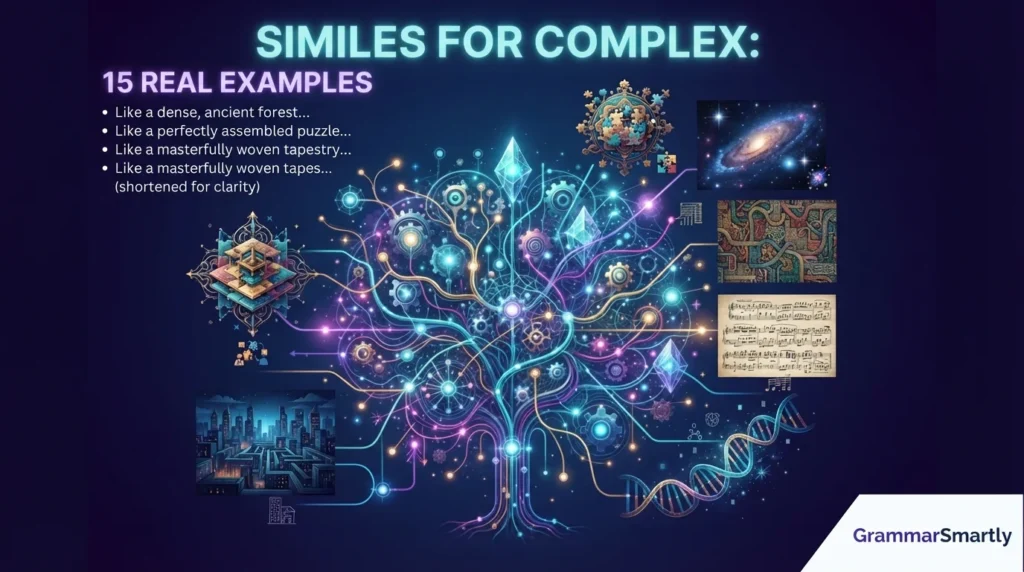
When something is complex, it may contain many connected parts, difficult steps, confusing details, or several problems that must be understood at once. In everyday English, speakers often make this idea easier to picture by comparing complexity with familiar things such as mazes, puzzles, tangled threads, or complicated machines.
This article focuses specifically on real, attested similes for complex things and situations. A simile makes a comparison using words such as like or as. For example, saying that a complicated legal problem is like a maze compares the problem with a maze without saying that the problem literally is a maze.
Some expressions commonly associated with complexity are actually metaphors or idioms rather than similes. They are kept separate below so that the distinction remains clear. The 15 expressions in the main simile section are genuine comparative constructions found in established usage, dictionaries, educational material, technical writing, or other documented English sources. Where an expression describes difficulty more than complexity itself, that limitation is explained.
Knowing perseverance similes with practical examples makes it easier to describe determination without sounding repetitive._
What Makes a Simile for Complex Work?
A useful simile for complex usually compares an abstract idea with something that has many parts, difficult connections, confusing paths, or a demanding solution.
For example:
The legal case was like a maze.
The case is not literally a maze. The comparison emphasizes that it has many paths and is difficult to navigate.
This differs from a metaphor such as:
The legal case was a maze.
The second sentence identifies the case directly with a maze. It is metaphorical rather than a simile.
Writers can make descriptions of sunlight more vivid with Similes For Sun that create striking imagery.
Metaphors That Describe Complexity
The following expressions are useful for describing complexity, but they are not counted among the 15 similes because they do not themselves make a comparison with like or as.
A Gordian knot
A Gordian knot is an established metaphor for an intricate or apparently insoluble problem. Merriam-Webster defines it as an “intricate problem,” especially one that cannot be solved within its existing terms.
Example:
The negotiations became a Gordian knot of legal and financial problems.
Because the sentence says the negotiations became a Gordian knot, rather than saying they were like one, this is a metaphor.
A Chinese puzzle

Chinese puzzle is an established noun phrase for something complicated and difficult to understand. Cambridge Dictionary gives this figurative meaning directly, while Collins defines it as an intricate or complicated problem.
Example:
The new tax regulations were a Chinese puzzle to ordinary taxpayers.
This is metaphorical rather than a simile.
A tangled web
A tangled web can describe a complicated network of relationships, facts, or consequences. The image comes from the literal complexity of threads crossing and becoming difficult to separate. Merriam-Webster documents spider’s web, while established usage frequently applies the web image to interconnected systems and problems.
Example:
The investigation uncovered a tangled web of financial connections.
Again, there is no explicit like or as, so this is not a simile.
Spaghetti code
Spaghetti code is a well-established metaphor in computing for code with a confusing, tangled structure. IBM describes it as code with a confusing structure that is difficult to modify and understand.
Example:
The old application had become spaghetti code.
This is a metaphorical technical expression, not a simile.
15 Similes for Complex
1. Like a maze
Like a maze is a natural and widely attested comparison for something with many confusing paths or possible directions. A maze is an especially useful image because reaching the correct destination may require navigating numerous turns and dead ends. Educational material, for example, compares the process of working through an algorithm with searching a maze.
Example:
The company’s organizational structure was like a maze.
This simile works particularly well for complicated systems, procedures, organizations, and situations where it is difficult to determine the right route.
Choosing creative similes to describe sunsets helps capture changing colors, glowing skies, and peaceful evening scenes.
2. Like a jigsaw puzzle
Like a jigsaw puzzle compares something complex with a puzzle whose individual pieces must fit together to form a complete picture. The expression is well established in academic and technical writing. A PubMed-indexed article, for example, describes biomechanical treatment as “like a jigsaw puzzle” because it involves many interdependent pieces.
Example:
Putting all the evidence together was like solving a jigsaw puzzle.
This simile emphasizes interconnected parts rather than simple confusion.
Writers can portray complete quiet vividly through Similes For Silent in descriptive writing.
3. Like spaghetti

Like spaghetti can describe something tangled, disorganized, or difficult to follow. The comparison is especially common in discussions of software, wiring, infrastructure, and interconnected systems. One technical writer describes complicated code as having everything intertwined “like spaghetti.”
Example:
The dependencies in the old software were like spaghetti.
The image is effective when the complexity comes from many elements crossing and becoming difficult to trace.
4. Like a spider’s web
A system can be described as like a spider’s web when many elements are connected in an intricate network. Merriam-Webster’s documented examples include comparisons of interconnected systems to a spider’s web, showing that the image is used beyond its literal meaning.
Example:
The relationships between the companies were like a spider’s web.
This simile is particularly suitable when complexity involves connections and dependencies.
5. As clear as mud
As clear as mud is an established humorous simile meaning that something is very difficult to understand. Cambridge Dictionary specifically defines it as “very difficult to understand.”
Example:
The instructions were as clear as mud.
This is one of the most useful choices when complex means confusing or hard to understand, rather than merely containing many components.
Its humorous tone makes it more appropriate for conversation and informal writing than for highly formal reports.
6. Like herding cats
Like herding cats is an established informal simile for something extremely difficult to organize or accomplish. Cambridge Dictionary gives the expression as an idiom and describes it as something extremely difficult to do.
Example:
Coordinating all six departments was like herding cats.
The expression does not mean that the thing itself is structurally complex. Instead, it emphasizes the difficulty of controlling many independent elements.
7. Like looking for a needle in a haystack
Like looking for a needle in a haystack is a well-established simile for an extremely difficult search, especially when the thing being sought is hidden among a very large number of possibilities. Cambridge explicitly documents the construction and gives examples using like looking for a needle in a haystack.
Example:
Finding the relevant document among those millions of files was like looking for a needle in a haystack.
This is best used when complexity comes from too many possibilities or too much information.
8. Like a Gordian knot
Although Gordian knot is itself a metaphorical noun phrase, like a Gordian knot is a genuine simile when used in a sentence with like. The underlying expression refers to an intricate problem, and documented English usage uses the comparison in this way.
Example:
The dispute was like a Gordian knot with no obvious solution.
This is stronger than simply saying something is complicated. It suggests that the problem is deeply tangled and exceptionally difficult to resolve.
9. Like a Rube Goldberg machine
Like a Rube Goldberg machine is an established comparison for something that accomplishes a relatively simple result through an unnecessarily complicated series of steps. A Rube Goldberg machine itself is defined as a deliberately complex contraption designed to perform a simple task in an overcomplicated way.
Example:
The company’s approval process was like a Rube Goldberg machine.
This is an excellent simile when complexity is unnecessary, excessive, or inefficient.
It should not be used simply to mean “detailed.” The comparison carries the additional idea of needless complication.
Writers can express isolation more vividly with Similes For Loneliness that create powerful emotional imagery.
10. Like a Swiss watch
Like a Swiss watch is an established comparison associated with precision, carefully engineered parts, and interconnected mechanisms. ICANN discusses the expression directly and uses the Swiss watch as a framework for describing an evolving system made up of intermeshed components.
Example:
The financial system was like a Swiss watch, with every component affecting the others.
This simile works best when complexity is organized, precise, and highly coordinated, rather than chaotic.
11. Like untangling a knot
Like untangling a knot is a documented comparison for working through something confusing or complicated. The image is straightforward: a knot contains intertwined strands that must be separated carefully. Contemporary English usage applies the comparison to problems, calculations, and other difficult tasks.
Example:
Understanding the contract was like untangling a knot.
This expression emphasizes the process of gradually making a complicated situation understandable.
12. Like untangling a ball of yarn
Like untangling a ball of yarn provides a more elaborate version of the knot image. It has been used to describe complicated interactions and systems that contain many intertwined elements. NOAA, for example, uses the image of a ball of yarn to explain complex interactions in climate forecasting.
Example:
Tracing all the causes of the problem was like untangling a ball of yarn.
This simile suggests that the complexity consists of many interconnected strands, with one part leading to another.
13. Like a Rubik’s Cube
Like a Rubik’s Cube is a recognizable comparison for a problem involving multiple interconnected elements that must be manipulated in the correct way. Modern scientific writing has explicitly used the Rubik’s Cube as an analogy for solving extremely complex mathematical problems.
Example:
The negotiations were like a Rubik’s Cube, because changing one agreement affected several others.
This comparison is especially useful when solving one part changes the state of other parts.
14. Like a three-dimensional chess game
Like a three-dimensional chess game can describe a situation requiring several layers of thought, strategy, and relationships to be considered simultaneously. The Society of Illustrators uses this comparison to describe work whose complexity required an artist to visualize how many layers would interact.
Example:
Managing the competing interests was like a three-dimensional chess game.
The simile is strongest when complexity involves strategy, multiple levels, and anticipating the consequences of several moves.
15. Like a human brain
Like a human brain can be used as a comparison for something exceptionally intricate, interconnected, and difficult to fully understand. Academic sources describe the human brain as a supreme example of a complex system, while contemporary writing also uses the brain as a model for sophisticated systems.
Example:
The new artificial intelligence system was like a human brain, with countless processes interacting at once.
This is a broader and more descriptive simile than a fixed idiom. It is appropriate when the intended meaning is extreme interconnected complexity, rather than confusion alone.
When and How to Use These Similes
The best simile depends on the kind of complexity you want to describe.
For confusion, as clear as mud is particularly effective:
The explanation was as clear as mud.
For many interconnected parts, choose like a jigsaw puzzle or like a spider’s web:
The investigation was like a jigsaw puzzle.
The business relationships were like a spider’s web.
For unnecessary complication, like a Rube Goldberg machine is more precise:
The registration system is like a Rube Goldberg machine.
For a difficult problem, like a Gordian knot gives the strongest sense of seriousness:
The dispute became like a Gordian knot.
For a difficult search, use like looking for a needle in a haystack:
Finding the original record was like looking for a needle in a haystack.
For informal conversation, like herding cats and as clear as mud are natural choices. They have a humorous quality and may sound too casual in a formal academic paper.
For technical or professional writing, like a jigsaw puzzle, like a spider’s web, like spaghetti, and like a Swiss watch can work well when the comparison accurately describes the structure being discussed.
Common Mistakes and Confusions
Calling every complex comparison a simile
Not every figurative expression about complexity is a simile. A Gordian knot, a tangled web, a Chinese puzzle, and spaghetti code function as metaphorical expressions when they directly identify something with another thing.
Compare:
The problem is a Gordian knot.
This is a metaphor.
The problem is like a Gordian knot.
This is a simile.
Writers describing wealth and spending can use Similes For Money to create vivid comparisons.
Using “complex” when you really mean “difficult”
Complexity and difficulty overlap, but they are not identical.
Something can be complex without being difficult for an expert. Likewise, something can be difficult without having a complicated structure.
Like herding cats mainly emphasizes difficulty in coordinating people or things. Like looking for a needle in a haystack emphasizes difficulty in finding something. They are useful for certain meanings of complex, but they should not be treated as exact synonyms.
Using “as clear as mud” literally
This expression is normally humorous and figurative. It means that something is not clear at all, rather than saying that the subject contains many components.
The instructions were as clear as mud.
The speaker means that the instructions were very difficult to understand.
Assuming every “like” construction is an idiom
A sentence can contain a genuine simile without the whole comparison being a fixed idiom.
For example:
The system was like a Rubik’s Cube.
This is a valid simile, but it is not necessarily a fixed idiom in the same way that like herding cats is.
That distinction matters when describing established English expressions accurately.
Overusing dramatic comparisons
Expressions such as like a Gordian knot and like a three-dimensional chess game suggest considerable complexity. They can sound exaggerated if used for a routine task.
Instead of:
Choosing a lunch menu was like a Gordian knot.
a simpler description would usually be more natural.
Summary
English has several established similes for describing different kinds of complexity, from like a maze and like a jigsaw puzzle to like a Rube Goldberg machine and like a spider’s web. The best choice depends on whether the complexity involves confusion, interconnected parts, excessive steps, difficult searching, or strategic relationships.
FAQs
What is a good simile for complex?
Like a maze is a versatile simile for something complex because a maze has many paths, turns, and possible wrong directions. For complicated systems with interconnected parts, like a spider’s web or like a jigsaw puzzle may be more precise.
Is “as clear as mud” a simile for complex?
Yes. As clear as mud is an established simile and idiom meaning very difficult to understand. Cambridge Dictionary specifically records this meaning.
Is “Gordian knot” a simile or metaphor?
Gordian knot by itself is a metaphorical expression for an intricate problem. Like a Gordian knot is a simile because it explicitly compares one thing with a Gordian knot. Merriam-Webster defines Gordian knot as an intricate problem.
Is “like herding cats” a simile?
Yes. Like herding cats is an established informal idiom and simile. Cambridge Dictionary defines it as something extremely difficult to do.
What simile describes unnecessary complexity?
Like a Rube Goldberg machine is especially appropriate. It suggests that a simple goal is being achieved through an unnecessarily complicated chain of actions.
What simile describes a complicated system?
Like a spider’s web, like a jigsaw puzzle, like spaghetti, and like a Swiss watch can all describe complicated systems, but each emphasizes something different. A spider’s web highlights connections, a jigsaw puzzle highlights interdependent pieces, spaghetti suggests tangling, and a Swiss watch suggests precise coordination.
Is “like looking for a needle in a haystack” about complexity?
It describes extreme difficulty in finding something, particularly when there are many possible places to search. Cambridge Dictionary explicitly records this simile and its meaning.
How many genuine similes are listed here?
There are 15 documented similes in the main list. They are kept separate from metaphorical expressions such as a Gordian knot, a tangled web, a Chinese puzzle, and spaghetti code, so the grammatical distinction between simile and metaphor is not blurred.