
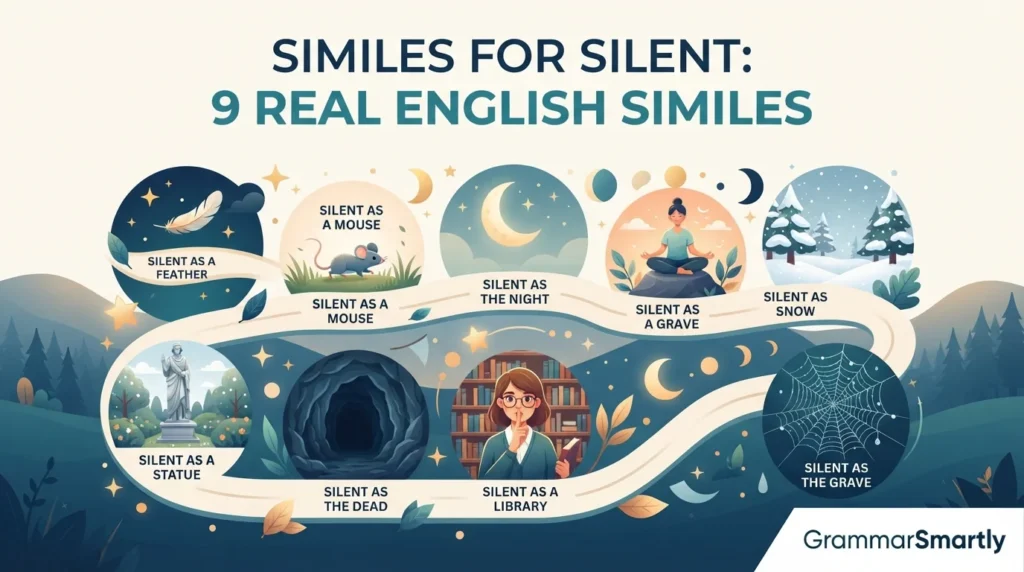
When you want to describe someone or something as extremely quiet, a well-chosen simile can make the silence much more vivid. Instead of simply saying that a room was “very quiet,” English speakers can compare its silence with a grave, a mouse, a tomb, or another notably still thing.
However, there is an important limitation with the keyword “similes for silent.” English does not have 15 equally well-established similes that specifically mean “silent.” Many lists online pad their numbers with phrases that are merely possible comparisons, ordinary descriptive sentences, metaphors, or weakly attested expressions. For that reason, this article gives 9 genuine, attested simile forms that can reasonably be used to express silence, quietness, muteness, or extreme stillness.
Established references identify expressions such as “as silent as the grave,” “as quiet as a mouse,” “as quiet as a church mouse,” “silent as the tomb,” and “as still as a mouse” as genuine comparisons. Cambridge specifically defines “as silent as the grave” as meaning completely silent, while Merriam-Webster defines “as quiet as a mouse” as very quiet.
The expressions below are separated from metaphors so that the distinction remains clear. When describing foolish behavior, Similes For Dumb offer colorful comparisons for creative writing.
What Makes a Simile for Silent Work?
A simile makes a comparison using words such as like or the paired construction as … as. For example, “The room was as silent as the grave” compares the room’s silence with the perceived silence of a grave.
A metaphor works differently. “The room was a tomb” does not explicitly say that the room is as silent as a tomb. It presents the room as something else for figurative effect.
The expressions in this article are therefore treated as similes only when the comparison itself is established and uses a simile structure. Some related expressions describe stillness as well as silence, so their precise meaning is explained individually.
Metaphors for Silent
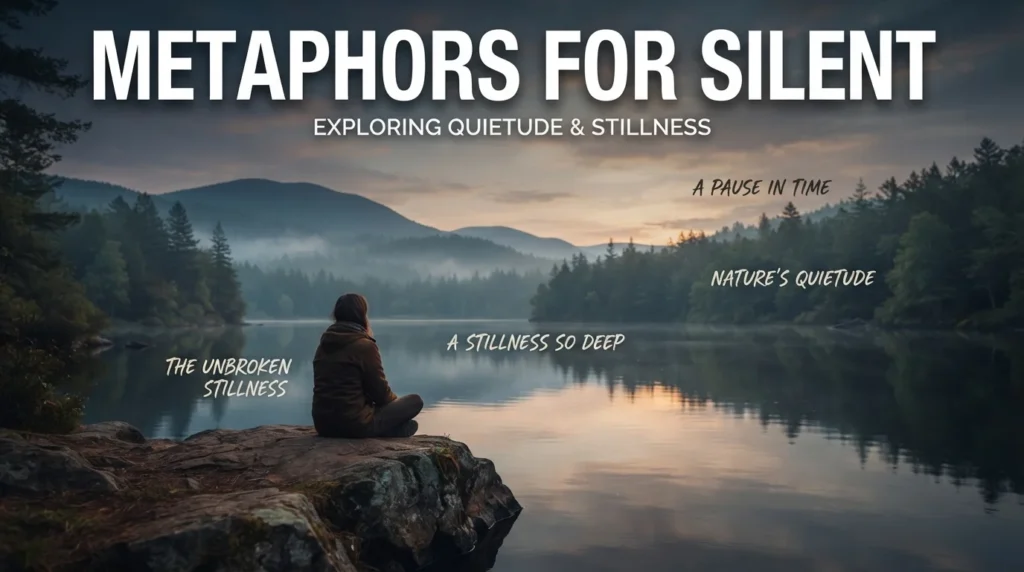
There are many English metaphors associated with silence, including expressions such as “a wall of silence” and “dead silence.” However, these are not similes, so they are not counted among the nine similes in this article.
For example, “a wall of silence” metaphorically presents silence as a wall that prevents information or communication from passing through. “Dead silence” uses “dead” figuratively to intensify the absence of sound. Neither expression makes an explicit comparison with “like” or “as … as.”
Because the focus here is specifically on similes for silent, these metaphorical expressions are kept separate rather than being used to inflate the count.
Similes for Silent
As Silent as the Grave
As silent as the grave is one of the strongest established similes for complete silence. Cambridge lists the expression as a literary collocation meaning “completely silent,” with examples describing streets and rooms.
The comparison can describe either a place that has no noticeable sound or, in some contexts, a person who says absolutely nothing. Wiktionary explicitly classifies “silent as the grave” as an idiomatic simile and notes its use for someone saying nothing, particularly about a particular subject.
The house was as silent as the grave after everyone had gone to bed.
This expression often carries an eerie, ominous, or serious feeling rather than simply suggesting peaceful quiet.
Silent as the Grave
Silent as the grave is the shorter form of as silent as the grave. It retains the same comparison and meaning.
The phrase can describe a person who refuses to speak or a place where there is almost no sound. Wiktionary treats it as a simile and gives both human and environmental uses.
The witnesses remained silent as the grave during the investigation.
Although the wording is especially useful in literary or dramatic contexts, it is also understandable in ordinary English.
As Quiet as the Grave
As quiet as the grave is a closely related simile meaning extremely quiet. Wiktionary explicitly identifies “(as) quiet as a grave” as a simile meaning “very quiet.”
Cambridge also groups as quiet/silent as the grave among expressions used for profound quietness, particularly when the atmosphere is frightening or ominous.
The abandoned building was as quiet as the grave.
This version emphasizes quietness rather than specifically emphasizing a person’s refusal to speak.
As Quiet as a Mouse

As quiet as a mouse is one of the most familiar English similes for being very quiet. Merriam-Webster defines it as an idiom meaning “very quiet.”
Dictionary.com gives the related sense “silent, without noise” and provides examples of both people and movement. It also records still as a mouse as a related form.
She crept down the hallway as quiet as a mouse.
This simile is generally less ominous than as silent as the grave. It often suggests someone making very little noise, especially while moving carefully.
Quiet as a Mouse
Quiet as a mouse is the shortened form of as quiet as a mouse. It is widely used in speech and writing.
The expression is specifically classified as an idiomatic simile in Wiktionary, with the meaning “very quiet, so as to not be heard.”
The children sat quiet as a mouse while the baby slept.
The comparison is especially natural when describing a child, person, animal, or someone trying not to attract attention.
As Quiet as a Church Mouse
As quiet as a church mouse is an established alternative to as quiet as a mouse. Wiktionary identifies it as a simile and an idiomatic alternative form of quiet as a mouse.
He was as quiet as a church mouse during the entire meeting.
The expression is slightly more colorful than as quiet as a mouse, but the essential meaning is the same: extremely quiet and unobtrusive.
The related expression has a long history. A reference discussing the history of “as quiet as a mouse” notes that expressions involving the quietness and stillness of mice go back centuries, while cautioning that the precise origin of the modern wording is not firmly established.
As Still as a Mouse
As still as a mouse is an older simile associated with both stillness and silence. Dictionary.com lists still as a mouse as an alternative expression alongside quiet as a mouse and describes it as meaning silent and without noise. It dates the expression to the 1300s.
The child remained as still as a mouse when she heard the floorboard creak.
This expression focuses more strongly on not moving than on simply making no sound. Depending on context, that stillness naturally implies quietness.
As Silent as the Tomb
As silent as the tomb is a genuine variant of silent as the grave. Wiktionary lists silent as the tomb as a synonym of silent as the grave.
The old cemetery was as silent as the tomb.
The comparison creates an image of profound, almost deathlike silence. It is more literary and less conversational than as quiet as a mouse.
Because it is essentially a variant of silent as the grave, it should not be presented as a completely unrelated idiom simply to increase a list’s numerical count.
Creative writers can give solitude more depth by incorporating Similes For Loneliness into descriptive passages.
As Mute as a Fish
As mute as a fish is an established simile for someone who is completely silent or refuses to speak. Brewer’s Dictionary of Phrase and Fable records “mute as a fish” with the meaning “quite silent.”
A modern English phrase reference likewise defines (as) mute as a fish as describing someone who refuses to talk much or is completely silent.
When questioned about the incident, he was as mute as a fish.
Unlike as quiet as a mouse, this expression usually concerns speech rather than the general sound level of a place. It can suggest that someone is deliberately saying nothing.
A Note About the Count
The nine expressions above are not nine completely unrelated concepts. English has several established variants built around the same comparisons.
For example:
- as silent as the grave and silent as the grave are grammatical variants.
- as quiet as a mouse and quiet as a mouse are shortened forms.
- as quiet as a church mouse is an alternative form of the mouse comparison.
- silent as the tomb is explicitly treated as a synonym of silent as the grave.
- as still as a mouse shifts the focus from sound to physical stillness.
That distinction matters for accurate language content. Counting every grammatical variation as an entirely independent idiom can make a list appear larger than the underlying vocabulary actually is.
Some other expressions frequently found on websites, such as “quiet as a whisper,” “quiet as the night,” or “silent as a shadow,” can certainly be constructed and understood as comparisons. However, they do not have the same level of dictionary or established-idiom support as the expressions above. They should therefore not automatically be presented as fixed English similes simply because examples can be found online.
Writers describing spending habits can use Similes For Money to make financial ideas vivid.
When and How to Use These Similes
The best expression depends on what kind of silence you want to describe.
For ordinary quietness, use as quiet as a mouse. It is familiar, natural, and suitable for everyday conversation.
For someone making no noise while moving, as quiet as a mouse or as still as a mouse works particularly well.
For an eerie or ominous atmosphere, as silent as the grave is much stronger. Cambridge specifically notes that the grave comparison can describe a frightening kind of quietness.
For someone refusing to speak, silent as the grave or as mute as a fish can be appropriate.
For literary or dramatic writing, as silent as the tomb can create a darker, more solemn image.
The expressions involving a grave, tomb, or death generally carry heavier emotional associations than the mouse comparison, so they are not interchangeable in every situation.
Common Mistakes and Confusions
Confusing a simile with a metaphor
“The room was as silent as the grave” is a simile.
“The room was a tomb” is a metaphor.
Both can communicate an eerie silence, but they use different figurative structures.
Treating every comparison as an established idiom
A sentence can be grammatically valid without being a recognized fixed expression. For example, a writer can invent a comparison such as “the room was as silent as a sleeping forest,” but that does not automatically make it an established English simile.
For vocabulary articles, it is better to distinguish creative comparisons from attested idiomatic expressions.
Using “quiet” and “silent” as exact synonyms
They overlap, but they are not always identical. Quiet can mean having little noise, while silent generally suggests an absence of sound or speech. Cambridge defines quiet in one sense as the state of being silent, but the words still have different ranges of use.
Assuming “still” always means silent
Still can describe a lack of movement rather than a lack of sound. In as still as a mouse, both ideas can overlap, but the expression primarily emphasizes stillness and unobtrusiveness.
Counting variants as unrelated expressions
A list containing as silent as the grave, silent as the grave, as quiet as the grave, and silent as the tomb may look like four entirely different comparisons. In reality, they are closely related forms built around the same grave or tomb imagery.
Accurate vocabulary writing should make that relationship clear.
Summary
There are fewer than 15 strongly established similes specifically suited to silent, so padding the list with invented or weakly attested comparisons would be misleading. The strongest verified choices include as silent as the grave, as quiet as a mouse, as quiet as a church mouse, as still as a mouse, as silent as the tomb, and as mute as a fish, with several recognized shortened or variant forms.
FAQs
What is the best simile for silent?
As silent as the grave is one of the strongest established similes for complete silence. Cambridge defines it as meaning completely silent and notes its literary use.
What is a simple simile for being very quiet?
As quiet as a mouse is a simple and familiar choice. Merriam-Webster defines the expression as meaning “very quiet.”
Is “silent as the grave” a simile?
Yes. Silent as the grave is explicitly classified as an idiomatic simile by Wiktionary, and Cambridge lists as silent as the grave as a collocation meaning completely silent.
Is “quiet as a mouse” a simile?
Yes. Quiet as a mouse is an established idiomatic simile meaning very quiet or quiet enough not to be heard.
Is “quiet as a church mouse” a real simile?
Yes. It is an established alternative form of quiet as a mouse, and Wiktionary explicitly labels it a simile and idiom.
Is “as mute as a fish” a simile for silent?
Yes. Mute as a fish is an established expression meaning completely silent or unwilling to speak. Brewer’s Dictionary of Phrase and Fable records it with the meaning “quite silent.”
Is “as still as a mouse” the same as “as quiet as a mouse”?
They are closely related but emphasize slightly different ideas. As quiet as a mouse primarily emphasizes lack of noise, while as still as a mouse emphasizes remaining motionless and unobtrusive. Dictionary.com records both expressions and distinguishes their wording.
Are there really 15 common similes for silent?
Not 15 equally well-established ones. There are several genuine expressions and variants, but many additional lists online include creative comparisons or ordinary phrases without strong evidence that they are established similes. For an accuracy-focused article, it is better to report the verified expressions than to invent entries to reach a target number.









1 thought on “9 Similes for Silent: Real English Examples & Meanings”