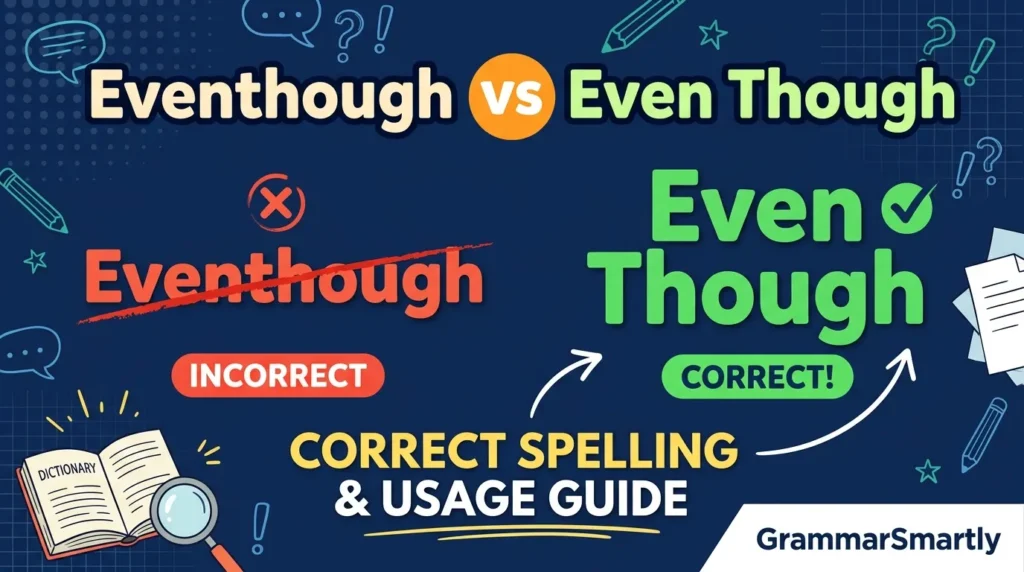
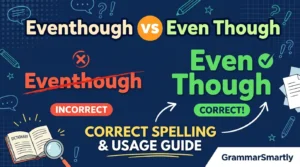
The difference between eventhough vs even though is a matter of standard English spelling and word spacing. Even though is the correct standard form, while eventhough is a common nonstandard spelling created by joining two separate words. The confusion occurs because the expression functions as a single grammatical unit, introducing a contrast between two ideas, even though it contains two words.
For example, write “Even though it was raining, we continued the journey,” not “Eventhough it was raining, we continued the journey.” The meaning remains understandable in the incorrect version, but the spelling does not follow standard written English.
This guide explains the meaning, grammar, pronunciation, origin, and correct usage of even though. You will also learn why the words should remain separate, how to remember the correct form, and how to use the expression confidently in academic, professional, and everyday writing.
Quick Facts Table
| Feature | Details |
| Standard form | Even though |
| Nonstandard form | Eventhough |
| Word type | Multiword subordinating conjunction |
| Meaning | Although; despite the fact that |
| Pronunciation | /ˌiːvən ˈðoʊ/ in common American English pronunciation |
| Main difference | Two words versus one incorrectly joined word |
| Usage status | Even though is standard; eventhough is nonstandard |
| Common error | Omitting the space between even and though |
What Does Eventhough vs Even Though Mean?
The expression even though introduces a fact that contrasts with another fact or makes the main statement seem unexpected. It connects a subordinate clause to a main clause.
For example:
Even though the road was crowded, the bus arrived on time.
The crowded road might normally cause a delay, but the bus still arrived on time. The expression highlights this contrast.
The two forms in the keyword have different spelling statuses, not different meanings.
- Even though: The correct, standard expression used to introduce a contrasting fact.
- Eventhough: A nonstandard spelling of the same expression, usually caused by joining the two words together.
Consider another example:
Even though Maya was tired, she finished her assignment.
The sentence communicates that Maya completed her assignment despite being tired. Writing eventhough instead would not create a new meaning or a different grammatical expression. It would simply introduce a spelling error.
Understanding the difference between cancelled and canceled helps you choose the correct spelling for your audience and region.
Is Eventhough Correct?
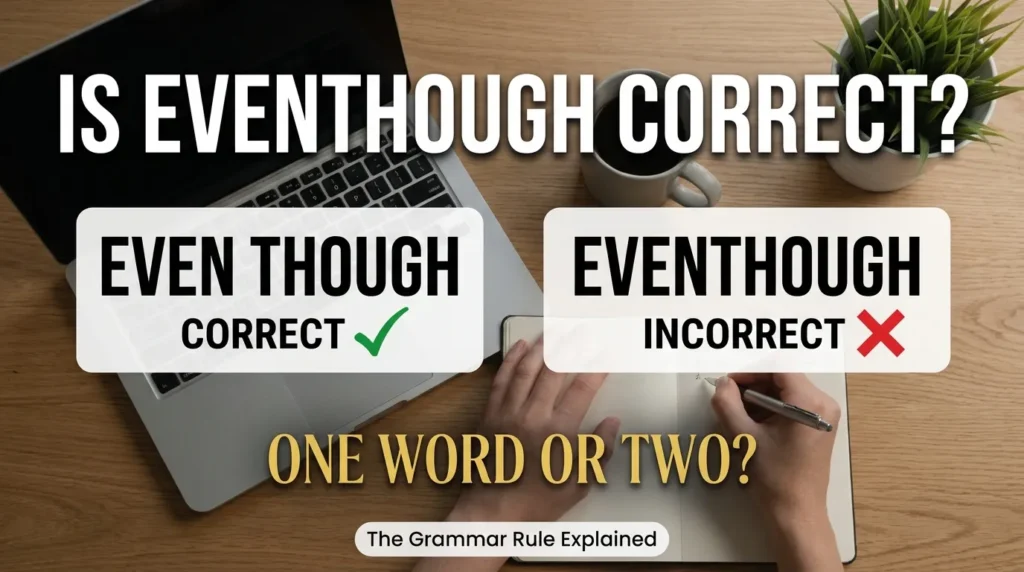
No. In standard modern English, eventhough is not the accepted spelling of the conjunction. The correct form is even though, written as two separate words.
This distinction matters in several contexts:
- Academic writing: Use even though in essays, research papers, and examinations.
- Professional communication: Keep the expression correctly spaced in reports, emails, and business documents.
- Digital writing: Use the standard form in blog posts, articles, captions, and other published content.
- Informal messages: The intended meaning of eventhough may be clear, but even though remains the correct spelling.
The fact that readers can understand a nonstandard spelling does not make it an accepted alternative. Unlike expressions that have legitimate one-word and two-word variants, even though should ordinarily be written with a space.
What Is the Correct Spelling?
Correct spelling: even though
The expression consists of two independently spelled words:
- Even: An adverb that adds emphasis to the contrast introduced by the expression.
- Though: A subordinating conjunction that introduces a contrasting or concessive clause.
Together, these words form the established expression even though.
The main spelling mistake is the omission of the space. The letters themselves are not rearranged, and no letter needs to be added or removed to correct the expression.
Compare the forms:
- Correct: Even though the shop was closing, we had enough time to buy groceries.
- Incorrect: Eventhough the shop was closing, we had enough time to buy groceries.
A useful proofreading habit is to check familiar expressions that function as a unit. Some English expressions are written as one word, while others remain separate words even when they work together grammatically.
Difference Between Eventhough and Even Though
| Feature | Even though | Eventhough |
| Status | Standard English expression | Nonstandard spelling |
| Meaning | Despite the fact that | Intended to mean the same thing |
| Word type | Multiword conjunction | Incorrectly joined form |
| Pronunciation | Commonly /ˌiːvən ˈðoʊ/ in American English | Intended pronunciation is the same |
| Usage | Accepted in standard writing | Avoid in edited writing |
| Modern standard usage | Correct | Not the standard form |
The most important distinction is spacing, not meaning or pronunciation. Readers will usually understand eventhough from context, but understanding an expression does not make its spelling standard.
English contains many multiword expressions that function together without becoming single words. The correct spelling must be learned as part of the expression rather than inferred from how smoothly it sounds when spoken.
Meaning of Even Though
Literal Meaning
Even though means although or despite the fact that. It introduces information that contrasts with the main statement.
For example:
Even though the room was small, it accommodated all the guests.
The room’s limited size might suggest that it could not hold everyone, but the sentence explains that it did.
Figurative Meaning
The expression does not have a separate figurative meaning that needs to be memorized. Its effect depends on the relationship between the clauses.
For example:
Even though he had lost the competition, he walked away with his confidence intact.
The expression emphasizes that losing did not prevent him from maintaining his confidence.
Common Contexts
Use even though when you want to express contrast, concession, or an unexpected result.
- Weather: Even though the wind was strong, the boat continued sailing.
- Education: Even though the question was difficult, Noor solved it.
- Work: Even though the deadline was tight, the team delivered the report.
- Relationships: Even though they disagreed, they listened respectfully.
- Travel: Even though our flight was delayed, we reached the hotel before midnight.
- Daily life: Even though I had eaten lunch, I was hungry again by late afternoon.
Pronunciation
IPA Pronunciation
The expression has two words but is often pronounced as one flowing unit.
- American English: /ˌiːvən ˈðoʊ/
- British English: /ˌiːvən ˈðəʊ/
Individual speakers may vary slightly in stress and vowel quality.
Syllable Breakdown
A simple breakdown is:
E-ven though
The expression contains three spoken syllables: e, ven, and though.
Many writers confuse these phrases, so learning the correct spelling of too early in English can improve clarity.
Pronunciation Tips
- Begin with the long ee sound in even.
- Pronounce the middle syllable with a relaxed vowel.
- Start though with the voiced th sound, as in this, not the unvoiced sound in think.
- Avoid inserting a noticeable pause between the words when speaking naturally.
Remember that fluent pronunciation does not determine whether words should be joined in writing. A natural spoken connection can still represent two separate written words.
Why Do People Make This Spelling Mistake?
The error usually results from treating a familiar expression as a single written unit.
Several factors can contribute to the confusion:
- Connected speech: The words often flow together, making the space less noticeable when listening.
- Word grouping: Because even though expresses one relationship between ideas, writers may mistakenly assume it must be one word.
- Typing quickly: Fast typing can lead to omitted spaces, especially in informal messages.
- Visual familiarity: Repeated exposure to an incorrect spelling can make it look familiar without making it correct.
- Uncertainty about compounds: English contains both closed compounds, such as notebook, and open expressions, such as even though. There is no universal rule that every frequently used expression eventually becomes one word.
The best solution is to learn even though as a fixed two-word expression and check its spacing during proofreading.
Origin and Etymology
The expression combines two established English words with related but distinct functions.
Even developed from Old English efen, a form associated with equality or being level. In modern usage, it also functions as an adverb that adds emphasis.
Though comes from Old English þēah, a conjunction expressing concession or contrast. Its spelling and usage developed over the history of English.
In even though, the word even strengthens the concessive force of though. The combination emphasizes that the main statement remains true despite the circumstance introduced by the subordinate clause.
This explanation concerns the development of the component words. It should not be taken as a claim about a specific date when the modern two-word expression first appeared.
How to Remember the Correct Spelling
The easiest approach is to memorize the expression as two separate words rather than as a single unit.
Quick Memory Trick
Remember this simple pattern:
EVEN + THOUGH = EVEN THOUGH
There are two recognizable words, and each keeps its own spelling. Leave a space between them every time you use the expression.
A practical reminder is to ask yourself: Can I identify the word even before I reach though? If so, preserve the boundary between the two words in writing.
Word-Family Connection
Compare these related expressions:
- Even though: Even though the train was late, we arrived before the meeting.
- Even if: Even if the train is late, we will wait at the station.
- As though: He looked as though he had seen something frightening.
- Although: Although the train was late, we arrived before the meeting.
- Though: The train was late. We arrived before the meeting, though.
These expressions have different grammatical structures or meanings, but they demonstrate that English often uses separate words to form a single grammatical expression.
Examples in Sentences
The following 20 examples demonstrate the correct use of even though in varied contexts.
| Incorrect Sentence | Correct Sentence |
| Eventhough the museum was crowded, we enjoyed the exhibition. | Even though the museum was crowded, we enjoyed the exhibition. |
| Eventhough I had prepared carefully, I felt nervous before the interview. | Even though I had prepared carefully, I felt nervous before the interview. |
| Eventhough the recipe looked complicated, the cake was easy to make. | Even though the recipe looked complicated, the cake was easy to make. |
| Eventhough the road was narrow, the driver passed safely. | Even though the road was narrow, the driver passed safely. |
| Eventhough she had little experience, she handled the project well. | Even though she had little experience, she handled the project well. |
| Eventhough the library was quiet, I struggled to concentrate. | Even though the library was quiet, I struggled to concentrate. |
| Eventhough the tickets were expensive, the family attended the concert. | Even though the tickets were expensive, the family attended the concert. |
| Eventhough he apologized, his colleague needed time to rebuild trust. | Even though he apologized, his colleague needed time to rebuild trust. |
| Eventhough the garden looked dry, several flowers were blooming. | Even though the garden looked dry, several flowers were blooming. |
| Eventhough the instructions were brief, the students understood the task. | Even though the instructions were brief, the students understood the task. |
| Eventhough the phone was old, its camera still worked well. | Even though the phone was old, its camera still worked well. |
| Eventhough the shop had limited stock, I found the book I wanted. | Even though the shop had limited stock, I found the book I wanted. |
| Eventhough the match was postponed, the supporters remained cheerful. | Even though the match was postponed, the supporters remained cheerful. |
| Eventhough the water was cold, the children enjoyed swimming. | Even though the water was cold, the children enjoyed swimming. |
| Eventhough the instructions seemed clear, one step was missing. | Even though the instructions seemed clear, one step was missing. |
| Eventhough the candidate answered confidently, the panel asked more questions. | Even though the candidate answered confidently, the panel asked more questions. |
| Eventhough the village was remote, it had reliable internet access. | Even though the village was remote, it had reliable internet access. |
| Eventhough the painting was unfinished, its main idea was clear. | Even though the painting was unfinished, its main idea was clear. |
| Eventhough the meeting ran late, everyone agreed on the next steps. | Even though the meeting ran late, everyone agreed on the next steps. |
| Eventhough the evidence was limited, the researchers identified a useful pattern. | Even though the evidence was limited, the researchers identified a useful pattern. |
Notice that every correction restores the same space. The grammatical meaning and sentence structure remain unchanged.
Common Mistakes to Avoid
- Joining the words: Write even though, not eventhough.
- Confusing it with even if: Use even though to present a fact or accepted circumstance, and even if to express a possibility or condition.
- Replacing it with despite incorrectly: Write even though it was raining or despite the rain. Do not write despite it was raining in standard usage.
- Using even alone as a conjunction: In a sentence such as Even though she was tired, she continued, the complete expression introduces the subordinate clause.
- Misplacing punctuation: When the subordinate clause comes first, a comma usually separates it from the main clause. When it comes second, a comma is generally unnecessary.
- Assuming a readable error is correct: A reader may understand eventhough, but standard spelling still requires two words.
- Using although and but together unnecessarily: Avoid constructions such as Although it was late, but we continued. Use Although it was late, we continued or It was late, but we continued.
Similar Commonly Misspelled Words
The confusion between eventhough and even though involves an omitted space. Similar errors can occur when writers join words that standard English convention keeps separate.
| Common Error | Correct Form | Reason for Confusion |
| atleast | at least | Two words are incorrectly joined |
| alot | a lot | A common expression is mistaken for one word |
| infact | in fact | A preposition and noun are combined |
| incase | in case | A two-word expression is treated as a compound |
| aswell | as well | An adverbial expression loses its space |
| eventhough | even though | Two words functioning together are joined |
| eachother | each other | A reciprocal expression is written as one word |
| everyday (when meaning every day) | every day | An adjective is confused with a time expression |
| may be (when meaning perhaps) | maybe | A verb phrase is confused with an adverb |
| its a | it’s a | A missing apostrophe changes the written form |
Not every similar-looking pair is a spelling error in every context. For example, everyday is correct in everyday clothes, while every day is correct in I exercise every day. Likewise, maybe and may be are both standard forms with different grammatical functions.
Related Words
Synonyms
Several expressions can replace even though when the sentence structure allows it.
| Alternative | Example | Important Difference |
| Although | Although it was cold, we went hiking. | Usually conveys contrast without the same added emphasis. |
| Though | Though the task was difficult, she completed it. | Often more conversational, with flexible placement in a sentence. |
| Despite the fact that | Despite the fact that it was cold, we went hiking. | Longer and more formal-sounding in many contexts. |
| In spite of the fact that | In spite of the fact that it was cold, we went hiking. | Similar meaning, but a longer expression. |
These alternatives are not interchangeable in every grammatical construction. In particular, despite and in spite of normally take a noun phrase, pronoun, or -ing form, rather than a straightforward clause introduced by a subject and verb.
Antonyms
There is no single direct antonym for even though. It expresses a relationship between clauses rather than a simple quality that has an opposite.
Depending on the sentence, words such as because or since may express a reason instead of a concession. However, they are not direct antonyms, and they change the logical relationship between the ideas.
Related Forms
The most useful related forms are:
- Even: An adverb that can add emphasis.
- Though: A conjunction or adverb, depending on its use.
- Although: A conjunction used to introduce a contrasting fact.
- Even if: An expression that introduces a condition or possibility.
- As though: An expression meaning approximately as if.
- Though not: A construction that can introduce a qualification, as in Though not perfect, the plan was workable.
These expressions help learners understand the grammar around even though without treating the incorrect spelling as a separate word.
Grammar Tips
Even though functions as a subordinating conjunction. It introduces a subordinate clause that expresses a fact or circumstance contrasted with the main clause.
Sentence Structure
Two common patterns are:
Pattern 1: Subordinate clause first
Even though the weather was poor, the event continued.
Place a comma after the introductory subordinate clause.
Pattern 2: Main clause first
The event continued even though the weather was poor.
A comma is generally unnecessary when the subordinate clause follows the main clause naturally.
Even Though Versus Even If
This distinction is important because the expressions look similar but do not always communicate the same idea.
- Even though: Introduces a fact or circumstance treated as real. Even though she was exhausted, she completed the assignment.
- Even if: Introduces a condition or possibility. Even if she feels exhausted tomorrow, she plans to attend the workshop.
The difference is not simply spelling. Choosing the wrong expression can change the intended meaning.
Avoid Sentence Fragments
A clause beginning with even though is normally dependent and needs a main clause to complete the thought.
Incomplete: Even though the train arrived early.
Complete: Even though the train arrived early, we missed our connection.
The first version may work as an intentional fragment in informal or creative writing, but it is generally unsuitable as a complete sentence in formal prose.
Writing Tips
For Essays and Academic Writing
Use even though when acknowledging an opposing fact or an unexpected result. It can help develop an argument without making the relationship between ideas confusing.
Example: Even though the initial results were promising, the researchers recommended further testing.
Do not use the expression merely to make a sentence sound sophisticated. The contrast should be meaningful.
For Exams
Remember the two-word spelling and check punctuation when the subordinate clause comes first. In a proofreading question, look for joined forms such as eventhough and correct them to even though.
For Professional Emails
Use the expression to acknowledge a limitation while communicating a decision or outcome.
Example: Even though the delivery was delayed, we completed the installation before the deadline.
Keep the sentence concise and ensure that the contrast is logical.
For Proofreading
When reviewing a document, search for eventhough as a single string. Replace it with even though where that is the intended expression. Then check whether the sentence uses the correct conjunction and punctuation.
Quick Spelling Checklist
| Check | Correct Form or Rule |
| Standard spelling | Even though |
| Common misspelling | Eventhough |
| Meaning | Despite the fact that; although |
| Pronunciation | Commonly /ˌiːvən ˈðoʊ/ in American English |
| Word type | Multiword subordinating conjunction |
| Key spelling pattern | Keep even and though separate |
| Common usage | Introduce a contrasting or concessive clause |
| Final proofreading check | Verify the space and the sentence’s grammatical structure |
Key Takeaways
- Even though is the standard spelling, written as two words.
- Eventhough is a nonstandard spelling, not a different conjunction with a separate meaning.
- The expression means although or despite the fact that.
- It introduces a subordinate clause expressing a fact that contrasts with the main clause.
- Use a comma when the introductory subordinate clause comes before the main clause.
- Do not confuse even though, which presents a fact, with even if, which commonly introduces a condition or possibility.
- Remember the spelling by recognizing the two separate words: even + though.
Conclusion
Choosing between eventhough and even though is straightforward once you understand the spelling convention. Even though is the correct standard form, while eventhough is a nonstandard spelling that joins two separate words. Both forms may communicate the same intended idea to a reader, but only the two-word expression should be used in standard written English.
The expression means although or despite the fact that and introduces a contrast between a circumstance and the main statement. Understanding its grammatical role will help you use it naturally in essays, examinations, professional emails, and everyday communication.
For an easy memory aid, remember that even and though remain separate words even when they work together. Before submitting any written work, check for missing spaces and review the punctuation around introductory clauses. With this simple habit, you can use even though accurately and confidently.
Frequently Asked Questions
Is eventhough one word or two words?
The standard spelling is even though, written as two separate words. Although the expression functions as a single grammatical unit, that does not mean its components should be joined. Use the two-word form in academic assignments, professional documents, emails, and other standard English writing.
What does even though mean?
Even though means although or despite the fact that. It introduces a circumstance that contrasts with the main statement. For example, Even though the shop was busy, the staff served everyone quickly. The expression highlights the unexpected result rather than simply listing two unrelated facts.
Why is eventhough considered incorrect?
Eventhough is considered nonstandard because standard English spelling keeps the words even and though separate in this expression. Their close connection in speech can make the joined form seem reasonable, but pronunciation does not determine written spacing. In edited writing, use even though.
Is even though a conjunction?
Yes. Even though functions as a subordinating conjunction, introducing a dependent clause that expresses concession or contrast. In Even though the equipment was expensive, the school purchased it, the opening clause provides the circumstance, while the main clause explains what happened despite that circumstance.
What is the difference between even though and although?
Both expressions introduce contrasting ideas, and they are often interchangeable. However, even though generally adds stronger emphasis to the contrast. For example, Although the task was difficult, she finished it and Even though the task was difficult, she finished it communicate the same basic outcome, with the second stressing the contrast more.
What is the difference between even though and even if?
Even though generally introduces a fact or circumstance treated as real, whereas even if commonly introduces a condition or possibility. Compare Even though it was raining, we played outside with Even if it rains tomorrow, we will play outside. The first describes an actual circumstance; the second considers a possible one.
Should I use a comma after even though?
Use a comma when the subordinate clause introduced by even though comes before the main clause. For example, Even though the road was icy, the driver remained calm. When the subordinate clause follows the main clause, a comma is generally unnecessary: The driver remained calm even though the road was icy.
Can I use even though at the beginning of a sentence?
Yes. Beginning a sentence with even though is grammatically correct when the introductory subordinate clause is followed by a main clause. For example, Even though the instructions were confusing, the students completed the exercise. In standard prose, place a comma between the introductory clause and the main clause.
What is another word for even though?
Depending on the context, alternatives include although, though, despite the fact that, and in spite of the fact that. The alternatives differ in structure and emphasis. For example, use even though it was late but despite the late hour. Choose an alternative that preserves the intended meaning and grammatical structure.
How can I remember the correct spelling of even though?
The simplest memory trick is to recognize the two component words: even + though. Write each word separately, regardless of how smoothly the expression sounds when spoken. Reading the sentence aloud can help you check its meaning, but visually checking the space between the words is the most reliable way to catch this particular spelling mistake.
Is even though acceptable in formal writing?
Yes. Even though is appropriate in formal writing, including essays, reports, research papers, and professional correspondence. It expresses a contrast clearly and naturally. The important points are to spell the expression as two words, use it where the logical relationship fits, and punctuate the sentence according to the placement of the subordinate clause.


1 thought on “Is It Eventhough or Even Though? Meaning & Grammar Guide”