
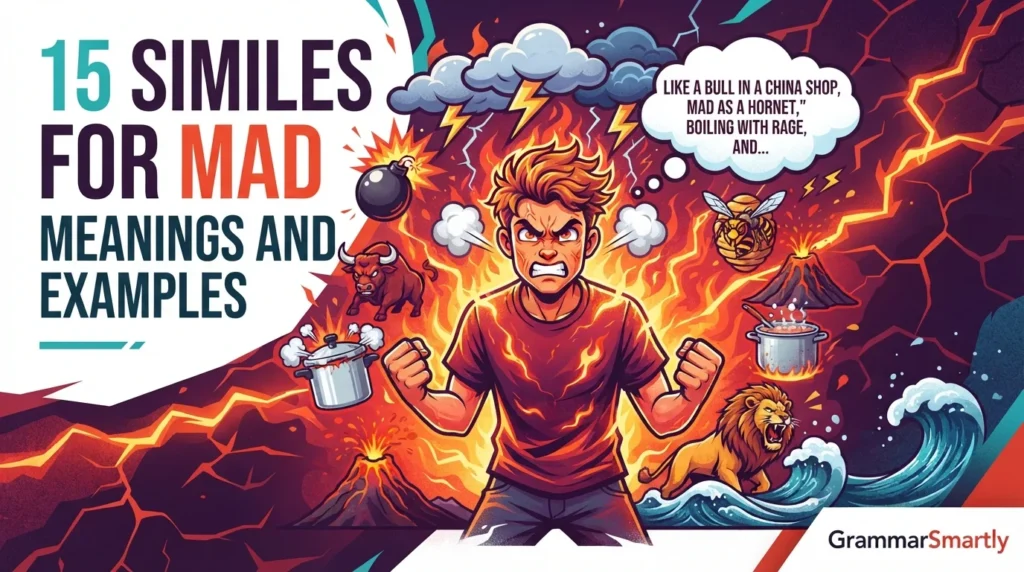
When you want to describe someone who is extremely angry, unusually excited, irrational, or simply behaving in a strange way, ordinary words such as angry, furious, or crazy can sometimes feel too plain. English has a long tradition of using vivid comparisons to make these states more memorable. Expressions such as mad as a hornet, mad as a hatter, and mad as a March hare compare a person’s behavior or emotional state with something associated with aggression, wildness, eccentricity, or unpredictability.
The phrase mad is especially interesting because it has two major everyday senses. In British English, it can mean crazy or mentally unsound, while in American English it commonly means angry. Some expressions preserve one meaning more strongly than the other. For example, mad as a wet hen normally means extremely angry, whereas mad as a hatter generally means crazy or eccentric.
This article presents 15 attested similes connected with mad, including regional and informal expressions. The list deliberately separates genuine similes from metaphors and avoids invented comparisons presented as established English expressions.
For clearer descriptions, consider using common friendship similes and their meanings in everyday writing and conversation.
What Makes a Simile About “Mad” Work?
A simile makes an explicit comparison, commonly with as or like. In as mad as a hornet, the person is compared with a hornet to emphasize anger. In mad as a March hare, the comparison highlights wild or unpredictable behavior.
A metaphor works differently. It identifies one thing with another without using a comparative structure. For example, He is a volcano can metaphorically portray a furious person, while He is as mad as a hornet is a simile.
This distinction matters because many expressions associated with anger are metaphors or idioms rather than similes. The 15 expressions below have therefore been selected because their established forms contain an explicit comparison.
Metaphors Related to Mad
These expressions are useful for comparison, but they are not included in the count of 15 similes.
See red
See red is an established idiom meaning to become extremely angry. It works figuratively because the person does not literally have to see the color red. Cambridge classifies it as an idiom meaning to become very angry.
Example: She saw red when she discovered that someone had damaged her car.
Blow your top
Blow your top means to suddenly become very angry. The expression uses figurative imagery rather than a direct comparison with another object, so it is not a simile. Cambridge and Collins both record it as an informal idiom for suddenly becoming angry.
Example: Dad will blow his top when he hears what happened.
Go through the roof
Go through the roof can describe someone becoming extremely angry. It is an idiomatic metaphor, not a simile, because there is no explicit like or as comparison.
Example: Her parents went through the roof when they saw the broken window.
15 Similes for Mad
1. Mad as a hatter
Mad as a hatter is one of the best-known English similes for someone who is crazy, eccentric, or behaving strangely. Cambridge records the expression alongside mad as a March hare, while dictionary sources describe it as meaning crazy or demented.
The expression is normally informal and can be humorous. Its exact origin is uncertain, although the traditional explanation connects hatmaking with exposure to mercury compounds. That explanation should not be presented as certain, because the etymology is disputed.
Example: That old inventor is mad as a hatter, but his ideas are fascinating.
2. Mad as a March hare
Mad as a March hare describes someone who behaves in a wild, excitable, or seemingly irrational way. The comparison refers to the energetic behavior traditionally associated with hares during their breeding season. Merriam-Webster notes that forms of the expression go back to the sixteenth century, well before Lewis Carroll’s Alice’s Adventures in Wonderland.
This expression is particularly associated with British English and can describe unusual behavior rather than anger alone.
Example: He was running around the house as mad as a March hare.
Stronger descriptions may come from creative similes for feeling lonely when ordinary words do not fully capture isolation.
3. Mad as a hornet
Mad as a hornet means extremely angry or enraged. The comparison is easy to understand because hornets are associated with aggressive attacks and stinging. Dictionary.com identifies it specifically as a simile for being very angry.
This is one of the clearest choices when mad means angry, especially in American English.
Example: She was as mad as a hornet when she found out who had taken her seat.
4. Mad as a wet hen
Mad as a wet hen is an American colloquial simile meaning extremely angry or furious. It has a long-established history, with Dictionary.com noting an early recorded example from 1823.
The expression is informal and often humorous. It is best understood as an emphatic way of saying that someone is very angry.
Example: Dad was mad as a wet hen when he discovered that someone had scratched his truck.
5. Mad as hops
Mad as hops is an informal expression meaning very angry. It is less common today than mad as a hornet or mad as a wet hen, but it is a genuine established expression rather than a newly invented comparison. Dictionary sources trace the expression to the nineteenth century.
It is particularly useful when writing about informal or older varieties of English.
Example: She was mad as hops after waiting three hours for the delayed train.
6. Mad as a cut snake
Mad as a cut snake is an Australian English simile with two closely related meanings. It can mean extremely angry, or it can mean crazy or eccentric. The Australian National Dictionary Centre records both senses and notes that the related form mad as a snake was recorded as early as 1900.
Example: The manager was mad as a cut snake when he saw the damage.
7. Mad as a meat axe

Mad as a meat axe is an Australian colloquial simile. It can describe someone who is extremely angry or someone who is crazy with rage. The expression is recorded in established idiom references as an Australian usage.
Because it is strongly regional and informal, it may sound unusual to speakers unfamiliar with Australian English.
Example: He was mad as a meat axe after the referee rejected the goal.
8. Mad as a box of frogs
Mad as a box of frogs is an informal expression meaning completely mad, insane, or crazy. It is particularly associated with British usage, although it can be encountered elsewhere. WordReference records it as a UK informal expression, while other dictionary sources define it as completely crazy.
It normally describes eccentric or irrational behavior rather than straightforward anger.
Example: You would have to be mad as a box of frogs to attempt that climb without equipment.
9. Mad as a bear with a sore head
Mad as a bear with a sore head means exceptionally angry, annoyed, or irritable. The related form like a bear with a sore head is also an established simile meaning very irritable or bad-tempered.
The image is of a powerful animal made even more irritable by discomfort.
Example: He was as mad as a bear with a sore head after being woken before sunrise.
10. Mad as a bag of ferrets

Mad as a bag of ferrets is a British slang expression used for someone who is extremely crazy, uncontrolled, or, in some contexts, furious. It is recorded in multilingual dictionaries and established idiom discussions, although it is much less common than the traditional expressions in this list.
Its informal and humorous character makes it unsuitable for formal writing.
Example: Everyone thought the eccentric inventor was mad as a bag of ferrets.
11. Mad as a snake
Mad as a snake is an established expression, particularly associated with Australian English. It can mean extremely angry or crazy. The Australian National Dictionary Centre specifically records mad as a snake as a form related to mad as a cut snake and gives historical evidence for the expression.
Example: The boss was as mad as a snake when the shipment arrived damaged.
12. Crazy as a bedbug
Crazy as a bedbug is a US informal simile describing someone or something as not at all sensible or practical. Collins records the expression in its idiom dictionary and provides corpus examples showing real usage.
Although it uses crazy rather than mad, it belongs naturally in a list of similes for the sense of mad meaning irrational or mentally wild.
Example: You must be crazy as a bedbug if you think that plan will work.
13. As nutty as a fruitcake
As nutty as a fruitcake describes someone as very strange or crazy. Cambridge lists it as an informal idiom, while Oxford gives as nutty as a fruitcake as an example of nutty meaning completely crazy.
This expression is usually humorous and should not be confused with a literal description of food.
Example: My uncle is as nutty as a fruitcake, but everyone enjoys his company.
14. Daft as a brush
Daft as a brush is a British informal simile meaning very silly or foolish. Cambridge records it as an idiom, and Collins similarly defines it as very silly or stupid.
It does not normally mean furious. Instead, it fits the British sense of mad meaning foolish, silly, or somewhat crazy.
Example: He’s as daft as a brush if he thinks he can finish all that work in an hour.
Students can strengthen descriptive writing with similes for students with meanings and examples that make ideas clearer.
15. Crazy as a loon
Crazy as a loon is an established informal simile meaning extremely crazy or eccentric. It appears in modern published usage and dictionary-style references, where crazy as a loon is associated with words such as nuts, bonkers, loony, and mad.
Like mad as a hatter, it normally emphasizes eccentricity or irrationality rather than anger.
Example: She may sound crazy as a loon, but her unusual plan actually worked.
When and How to Use These Similes
The most important consideration is what mad means in the sentence.
If you mean angry, expressions such as mad as a hornet, mad as a wet hen, mad as hops, mad as a meat axe, and mad as a bear with a sore head are the closest matches.
If you mean crazy, irrational, or eccentric, expressions such as mad as a hatter, mad as a March hare, mad as a box of frogs, crazy as a bedbug, as nutty as a fruitcake, and crazy as a loon are more appropriate.
Regional usage also matters. Mad as a cut snake, mad as a meat axe, and mad as a snake have strong Australian associations. Daft as a brush is strongly associated with British English. Some expressions are informal or humorous and may sound unnatural in academic, legal, business, or highly professional writing.
For everyday conversation, however, these expressions can make descriptions more vivid:
- She was mad as a hornet when she saw the bill.
- He is mad as a hatter, but he’s entertaining.
- They were running around like mad March hares.
- You’d have to be crazy as a bedbug to try that.
Common Mistakes and Confusions
Treating every expression with “mad” as a simile
Not every figurative expression about anger is a simile. See red, blow your top, and go through the roof do not contain an explicit comparison with like or as. They are idiomatic or metaphorical expressions.
Assuming “mad” always means angry
The meaning depends heavily on dialect and context. In American English, mad commonly means angry. In British English, mad can commonly mean crazy or insane. Expressions such as mad as a wet hen therefore have a different emphasis from mad as a hatter.
Using regional expressions without considering the audience
An Australian speaker may readily understand mad as a cut snake, while another English speaker may find it unfamiliar. Likewise, daft as a brush is strongly British.
Assuming “mad as a hatter” came from Alice’s Adventures in Wonderland
The phrase predates Lewis Carroll’s 1865 novel. Carroll used the related idea of the March Hare being unusually mad in March, but mad as a hatter was already established.
Confusing a simile with a metaphor
He is a volcano is a metaphor. He is as mad as a hornet is a simile. The presence of an explicit comparison is the key distinction.
Using “mad” when “angry” is clearer
In formal writing, direct vocabulary is often preferable. Instead of writing The manager was mad as a hornet, a formal report might simply say The manager was extremely angry. Figurative similes are generally better suited to conversation, creative writing, journalism, storytelling, and informal prose.
Summary
There are many established English similes for mad, but they do not all express exactly the same idea. Mad as a hornet and mad as a wet hen emphasize anger, while mad as a hatter, mad as a March hare, and crazy as a loon generally emphasize craziness or eccentricity. Regional expressions such as mad as a cut snake add further variety to the language.
FAQs
What is a good simile for being very mad?
Mad as a hornet is one of the clearest established similes for being extremely angry. Mad as a wet hen is another common informal choice.
What is the most famous simile for crazy?
Mad as a hatter is probably one of the best-known English similes for someone who is crazy or eccentric. It is an established idiom recorded by major dictionaries.
Is “mad as a March hare” a simile?
Yes. Mad as a March hare is a simile because it explicitly compares someone’s behavior with that of a March hare. The expression is also a long-established English idiom.
Is “mad as a hornet” a simile or metaphor?
It is a simile. The word as introduces a direct comparison between the angry person and a hornet. Dictionary.com explicitly classifies the expression as a simile for extreme anger.
Does “mad as a wet hen” mean crazy?
Usually, no. Mad as a wet hen normally means extremely angry or furious, especially in American English.
What does “mad as a cut snake” mean?
In Australian English, mad as a cut snake can mean very angry, crazy, or eccentric. The Australian National Dictionary Centre records both the angry and crazy senses.
Is “nutty as a fruitcake” a real simile?
Yes. As nutty as a fruitcake is an established informal idiom meaning very strange or crazy. Cambridge and Oxford both document the expression or its underlying usage.
Which simile for mad is best for formal writing?
None of these is ideal for highly formal writing. In professional or academic contexts, words such as angry, furious, irrational, unreasonable, or eccentric are usually clearer and more precise.




1 thought on “15 Similes for Mad: Meanings and Examples”