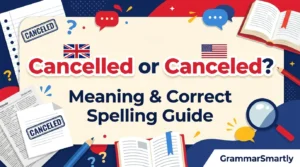
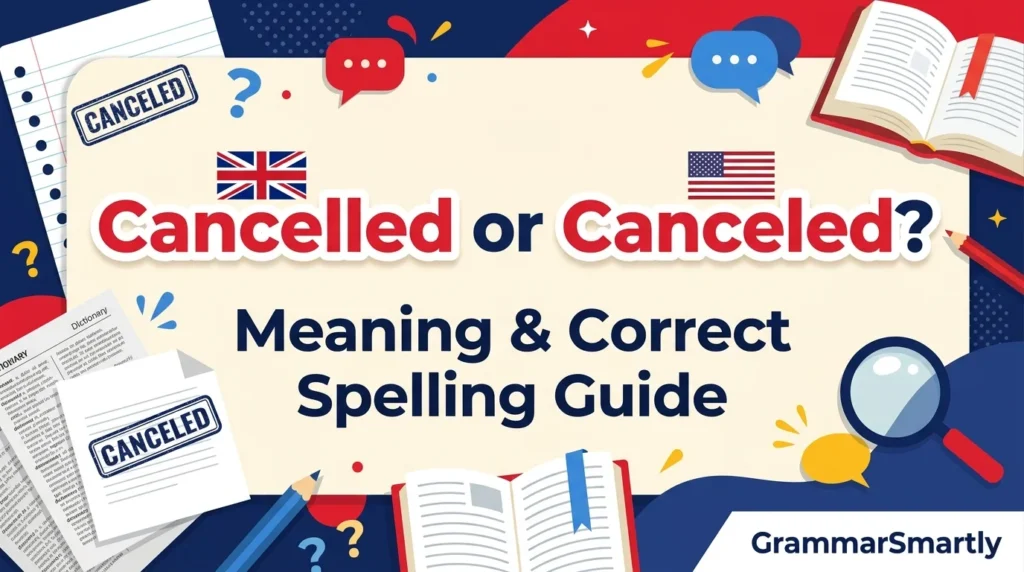
When deciding between cancelled or canceled, the correct choice depends on which variety of English you are using. Both spellings are correct, and both are the past tense and past participle of the verb cancel. The main difference is regional spelling preference: canceled is the standard and more common form in American English, while cancelled is the preferred form in British English.
Neither spelling changes the meaning of the word. Both describe an event, appointment, reservation, order, or arrangement that has been called off. However, choosing the appropriate spelling matters when writing essays, professional emails, academic assignments, and website content. This guide explains the difference between cancelled and canceled, shows how to use each form in sentences, and provides practical spelling tips to help you write consistently and confidently.
Quick Facts: Cancelled vs. Canceled
| Feature | Details |
| Standard American spelling | Canceled |
| Standard British spelling | Cancelled |
| Word type | Verb, past tense and past participle |
| Meaning | Called off, discontinued, or made no longer valid |
| Pronunciation | Essentially the same for both forms |
| Main difference | One l versus two ls |
| Usage status | Both are correct spellings |
| Common error | Treating one regional spelling as universally incorrect |
What Does Cancelled or Canceled Mean?
The words cancelled and canceled have exactly the same meaning. They are different spellings of the past tense and past participle of cancel.
The verb cancel means to decide that something previously arranged will not happen, to stop an order or service, or to invalidate something.
For example:
- Cancelled: The school cancelled the outdoor event because of heavy rain.
- Canceled: The school canceled the outdoor event because of heavy rain.
Both sentences communicate the same information. The spelling changes, but the grammar and meaning remain the same.
Common uses include:
- Events: The festival was cancelled after the storm.
- Travel: The airline canceled our flight.
- Appointments: The dentist cancelled my appointment.
- Subscriptions: I canceled my streaming subscription.
- Orders: The supplier cancelled the shipment.
- Plans: They canceled their weekend trip.
The choice between the two forms is primarily a matter of regional English conventions, not a difference in meaning.
Understanding the difference between Tweek vs Tweak spelling and meaning helps writers avoid confusion when choosing the correct word.
Is Cancelled Correct?

Yes. Cancelled, with two ls, is a correct spelling in British English and is also accepted in American English.
Use cancelled when following British English spelling conventions or a style guide that prefers the double-l form.
Examples:
- The concert was cancelled because of technical problems.
- Her appointment was cancelled without warning.
- The company cancelled its planned expansion.
- The final examination was cancelled due to severe weather.
The spelling is especially appropriate for writing intended for readers who expect British English conventions.
Is Canceled Correct?
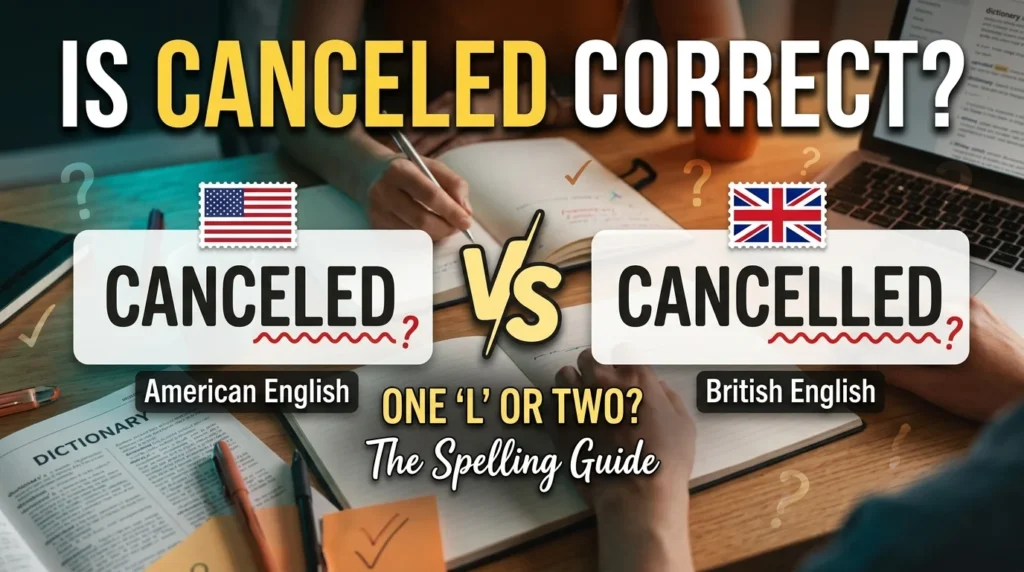
Yes. Canceled, with one l, is the standard and more common spelling in American English.
Use it when writing for a United States audience or following an American English style guide.
Examples:
- The baseball game was canceled because of rain.
- The manager canceled the meeting.
- My flight was canceled at the last minute.
- The bank canceled the old credit card.
Although cancelled is also acceptable in American English, canceled is generally the safer choice when you want to follow standard American spelling preferences.
What Is the Correct Spelling?
Both spellings are correct, so the best choice depends on your intended audience.
- American English: canceled
- British English: cancelled
The distinction also appears in the present participle:
| Word form | American English | British English |
| Base verb | cancel | cancel |
| Third-person singular | cancels | cancels |
| Past tense | canceled | cancelled |
| Past participle | canceled | cancelled |
| Present participle | canceling | cancelling |
| Noun | cancellation | cancellation |
One important detail is that the noun is normally spelled cancellation in both varieties of English. American English does not automatically remove the second l from every word related to cancel.
Difference Between Cancelled and Canceled
| Feature | Cancelled | Canceled |
| Spelling | Two ls | One l |
| Status | Correct | Correct |
| Meaning | Called off or discontinued | Called off or discontinued |
| Word type | Past tense or past participle | Past tense or past participle |
| Regional preference | British English | American English |
| Pronunciation | Same | Same |
| Typical example | The match was cancelled. | The match was canceled. |
The central distinction is spelling convention. Neither form is inherently more grammatical than the other.
For example, a British newspaper might report that a train service was cancelled, while an American newspaper might report that the same service was canceled. Both versions are standard within their respective conventions.
If you are writing for an international audience, choose one spelling system and use it consistently throughout the document.
Meaning of Cancelled and Canceled in Different Contexts
The meaning stays the same across different situations, although the object of the verb may change.
Events and activities
When an organized activity will no longer take place, either spelling works.
The charity concert was cancelled after the venue lost electricity.
The charity concert was canceled after the venue lost electricity.
Appointments and reservations
Both forms describe an appointment or reservation that has been called off.
The clinic cancelled my appointment because the doctor was unavailable.
The hotel canceled our reservation after a payment problem.
Orders and subscriptions
The verb can also refer to stopping a requested product, service, or recurring payment.
The retailer cancelled the order before dispatch.
I canceled my subscription before the next billing date.
Agreements and official arrangements
In appropriate contexts, cancel can refer to ending or invalidating an arrangement.
The organizers cancelled the agreement with the supplier.
The agency canceled the booking after receiving new instructions.
In each case, the choice between cancelled and canceled follows the preferred spelling convention, not the situation being described.
Pronunciation of Cancelled and Canceled
IPA pronunciation
Both forms have the same pronunciation in ordinary use. Cambridge gives the pronunciation of cancel as /ˈkæn.səl/ in both British and American English. The past-tense spellings do not introduce a meaningful pronunciation difference.
Syllable breakdown
The base word cancel has two syllables:
can-cel
The forms cancelled and canceled are also generally pronounced with two syllables. The additional written l in cancelled does not create another syllable.
Pronunciation tips
- Begin with the short vowel sound in cat.
- Pronounce the second syllable with an unstressed vowel.
- Do not pronounce the two written ls in cancelled as two separate sounds.
Remember that the difference between the spellings is visual, not an indication that one form should sound different from the other.
Understanding Optimization vs Optimisation spelling differences helps writers choose the correct form for their intended audience.
Why Do People Confuse Cancelled and Canceled?
Several factors make these spellings easy to mix up.
Different English spelling conventions
British and American English use different conventions for doubling the final l in certain verb forms. This explains familiar pairs such as travelled/traveled and labelling/labeling, as well as cancelled/canceled.
Familiarity with different reading materials
A person who regularly reads British websites may naturally write cancelled. Someone accustomed to American newspapers, books, or software may prefer canceled.
Neither habit is wrong. Problems arise when writers assume that their familiar form is the only acceptable one.
Automatic spelling correction
Word processors and browsers may flag a spelling because their language settings use a different regional convention. For example, a program configured for American English may suggest canceled when a writer enters cancelled.
A spelling suggestion does not necessarily mean the alternative is incorrect. Check the language settings and follow the conventions required for the document.
Confusion about the word family
Writers may assume that every form of cancel follows the same pattern. However, cancellation normally has two ls in both American and British English, even though the preferred past-tense spellings differ.
Origin and Etymology
The difference between cancelled and canceled is part of the broader history of spelling variation between British and American English.
American spelling reform helped establish simplified spellings in a number of words. Noah Webster was an influential advocate of spelling reform in the United States, and his dictionaries contributed to the development of American spelling conventions. The one-l form canceled fits this broader pattern.
British English retained the double-l form as its standard spelling. Today, the two forms remain established alternatives rather than one being a modern invention or a simple spelling error.
How to Remember the Correct Spelling
The easiest way to remember the difference is to connect each spelling with its regional convention.
Quick memory trick
Think of the spelling as a regional pair:
- US: canceled
- UK: cancelled
If you are writing for an American audience, choose one l. If you are writing for a British audience, choose two.
Word-family connection
Memorize the common forms together rather than learning canceled in isolation.
| American English | British English |
| canceled | cancelled |
| canceling | cancelling |
| cancellation | cancellation |
The final row is important because cancellation normally retains two ls in both varieties.
A practical proofreading trick
Search your document for cancel before submitting it. Check whether you have used canceled and cancelled inconsistently.
A document can use either accepted form, but switching between them without a reason may make the writing look unedited.
Examples in Sentences
The following 15 examples show how the two spellings work in everyday English. Each pair has the same meaning, with the spelling adjusted for the chosen convention.
| No. | Canceled, American English | Cancelled, British English |
| 1 | The airline canceled our flight before sunrise. | The airline cancelled our flight before sunrise. |
| 2 | Heavy rain canceled the school picnic. | Heavy rain cancelled the school picnic. |
| 3 | Maya canceled her dentist appointment. | Maya cancelled her dentist appointment. |
| 4 | The organizer canceled the charity auction. | The organizer cancelled the charity auction. |
| 5 | Our manager canceled the afternoon meeting. | Our manager cancelled the afternoon meeting. |
| 6 | The theater canceled tonight’s performance. | The theater cancelled tonight’s performance. |
| 7 | The customer canceled the online order. | The customer cancelled the online order. |
| 8 | The university canceled the guest lecture. | The university cancelled the guest lecture. |
| 9 | The coach canceled the outdoor training session. | The coach cancelled the outdoor training session. |
| 10 | We canceled our hotel reservation. | We cancelled our hotel reservation. |
| 11 | The company canceled the product launch. | The company cancelled the product launch. |
| 12 | The museum canceled its evening tour. | The museum cancelled its evening tour. |
| 13 | The bank canceled the outdated payment card. | The bank cancelled the outdated payment card. |
| 14 | The publisher canceled the magazine’s next issue. | The publisher cancelled the magazine’s next issue. |
| 15 | Officials canceled the public demonstration because of safety concerns. | Officials cancelled the public demonstration because of safety concerns. |
These examples demonstrate that the spelling choice does not affect the sentence’s grammar or meaning. The key is to use the version that matches your intended English convention.
Common Mistakes to Avoid
- Calling cancelled incorrect in American English. It is an accepted alternative, although canceled is more common in standard American usage.
- Calling canceled universally wrong in British English. The double-l form is the British preference, but the broader distinction is regional spelling convention.
- Mixing forms in the same document. Choose a spelling system and maintain it unless you are quoting a source or reproducing an official title.
- Writing cancell as the base verb. The standard base form is cancel, with one l.
- Writing cancelation by assuming the American spelling rule applies everywhere. Cancellation is the usual spelling in both American and British English.
- Assuming the forms sound different. The difference is primarily written, not spoken.
- Ignoring the required style guide. Academic institutions, publishers, and employers may specify which English variety to follow.
Similar Commonly Confused Spellings
The cancelled/canceled distinction belongs to a wider group of spelling differences between American and British English.
| American English | British English | Meaning |
| traveled | travelled | Went from one place to another |
| traveling | travelling | Going from one place to another |
| labeled | labelled | Marked or identified with a label |
| labeling | labelling | The act of marking or identifying |
| modeled | modelled | Represented or demonstrated |
| modeling | modelling | The act of representing or demonstrating |
| canceled | cancelled | Called off or discontinued |
| canceling | cancelling | The act of calling off or discontinuing |
These are regional spelling alternatives, not pairs in which one word has a different meaning from the other. Individual words can have additional variations, so follow a reliable dictionary or your required style guide when a particular form is uncertain.
Related Words
Synonyms
Depending on the context, several words can express a meaning similar to cancel.
- Call off: To decide that a planned event or activity will not happen.
- Abandon: To stop pursuing a plan or undertaking.
- Revoke: To officially withdraw permission, a decision, or an authorization.
- Rescind: To formally withdraw or annul a decision, order, or agreement.
- Terminate: To bring something to an end.
These words are not interchangeable in every sentence. For example, a concert can be called off, while an official authorization may be revoked.
Antonyms
Possible opposites depend on the context.
- Confirm: To establish that an arrangement will proceed.
- Proceed with: To continue with a planned activity.
- Approve: To give permission or acceptance.
- Continue: To keep something going rather than stop it.
Related forms
| Word | Part of speech | Example |
| Cancel | Verb | Please cancel the order. |
| Cancels | Verb | The company cancels unneeded bookings. |
| Canceled | Past tense or past participle | They canceled the appointment. |
| Cancelled | Past tense or past participle | They cancelled the appointment. |
| Canceling | Present participle | She is canceling the subscription. |
| Cancelling | Present participle | She is cancelling the subscription. |
| Cancellation | Noun | We received a cancellation notice. |
| Cancellable | Adjective | Check whether the booking is cancellable. |
| Cancelable | Adjective | Check whether the booking is cancelable. |
The adjectives cancelable and cancellable are also spelling variants. As with the verb forms, preferred usage can depend on the English variety and the applicable style guide.
Grammar Tips
Understanding how cancelled and canceled function in a sentence helps prevent grammatical errors.
Past tense
Use either spelling to describe an action that happened in the past.
- American: The director canceled the rehearsal yesterday.
- British: The director cancelled the rehearsal yesterday.
Past participle
Both forms can follow has, have, or had.
- American: The airline has canceled the flight.
- British: The airline has cancelled the flight.
They can also appear in passive constructions.
- American: The event was canceled.
- British: The event was cancelled.
Present participle
Use canceling in standard American English and cancelling in British English.
- American: We are canceling the reservation.
- British: We are cancelling the reservation.
Noun usage
Use cancellation when referring to the act or result of canceling something.
For example, The cancellation of the event disappointed the audience.
Writing Tips for Essays, Emails, and Professional Documents
Choosing the right spelling is especially useful when your writing must follow a consistent editorial standard.
- Identify your audience. Use canceled for standard American English and cancelled for standard British English.
- Check your style guide. Follow the spelling requirements of your school, employer, publication, or client.
- Keep related forms consistent. Pair canceled with canceling in standard American writing, or cancelled with cancelling in British writing.
- Proofread the noun separately. Remember that cancellation is normally spelled with two ls in both varieties.
- Review automated corrections. A word processor may use different regional settings from your intended audience.
- Avoid unnecessary changes. If a source uses an accepted regional spelling in a quotation, preserve it when accuracy requires the original wording.
Consistency makes your writing easier to edit and more suitable for its intended readers.
Quick Spelling Checklist
| Check | Correct form or rule |
| Standard American spelling | Canceled |
| Standard British spelling | Cancelled |
| Meaning | To call off or discontinue |
| Pronunciation | Essentially the same |
| Word type | Past tense or past participle |
| Present participle | Canceling (US), cancelling (UK) |
| Noun | Cancellation |
| Final proofreading check | Use one spelling convention consistently |
Key Takeaways
- Both cancelled and canceled are correct English spellings.
- American English generally prefers canceled, with one l.
- British English generally prefers cancelled, with two ls.
- Both forms have the same meaning and pronunciation.
- The same regional distinction applies to canceling and cancelling.
- Cancellation is the usual noun spelling in both varieties.
- Your audience and style guide should determine which form you use.
Conclusion
The choice between cancelled or canceled is a matter of regional spelling preference rather than a difference in meaning or grammar. Both forms describe something that has been called off, discontinued, or no longer allowed to proceed. American English generally favors canceled, while British English prefers cancelled. Understanding this distinction helps you avoid unnecessary corrections and choose the right form for your readers.
The most useful memory strategy is to associate one l with the standard American form and two ls with the standard British form. Remember, too, that the noun cancellation normally keeps two ls in both varieties. When preparing an essay, email, report, or website article, check the applicable style guide and remain consistent throughout. With this simple approach, you can use both forms confidently and recognize why different writers may choose different spellings.
Frequently Asked Questions
1. Is it cancelled or canceled?
Both are correct. Canceled is the standard and more common American English spelling, while cancelled is the preferred British English spelling. They are forms of the same verb and have the same meaning. Choose according to your audience or the style guide you are following rather than treating one form as universally incorrect.
2. Is canceled wrong in British English?
Cancelled is the standard British English spelling, so it is usually the better choice when writing for a British audience. However, canceled is a recognized spelling variant, not an invented word. For formal British writing, follow the spelling conventions specified by your publisher, institution, or employer.
3. Is cancelled wrong in American English?
No. Cancelled is accepted in American English, although canceled is more commonly preferred. If you are writing for a US publication, following an American style guide, or completing an assignment that requires American spelling, choose canceled for consistency.
4. Why does American English use canceled with one L?
American English developed spelling preferences that differ from British conventions in several words. The single-l spelling canceled fits a broader pattern of American spelling simplification associated with influential lexicographers such as Noah Webster. The difference is historical and conventional, not a reflection of a different pronunciation or meaning.
5. Do cancelled and canceled mean the same thing?
Yes. Both forms mean that something planned, scheduled, ordered, or arranged has been called off or discontinued. For example, The meeting was canceled and The meeting was cancelled communicate the same information. The difference is which spelling convention the writer follows.
6. Is it canceling or cancelling?
Both spellings are used. Canceling is the standard and more common American English form, while cancelling is standard in British English. The same regional pattern applies to canceled and cancelled. When writing a document, choose the form that matches your intended English variety.
7. Is cancellation spelled with one L or two?
The usual spelling is cancellation, with two ls, in both American and British English. Although cancelation occurs as a variant, cancellation is the conventional choice for most writing. Do not assume that the single-l spelling canceled means every related word must also have one l.
8. How do you pronounce cancelled and canceled?
Both spellings are pronounced essentially the same way. The base verb cancel has two syllables, and the additional written l in cancelled does not create an extra syllable. If you are unsure, consult a reliable dictionary’s audio pronunciation rather than using the number of written letters to determine how the word should sound.
9. Can I use canceled and cancelled in the same article?
You can, but switching between the two spellings without a clear reason is generally best avoided. Choose the spelling convention appropriate for your audience and use it consistently. Exceptions may be necessary when preserving an exact quotation, an official title, or a source’s original wording.
10. Which spelling should I use in academic writing?
Follow the spelling requirements of your university, instructor, journal, or publisher. If the document follows American English, canceled is generally appropriate. If it follows British English, cancelled is generally preferred. Consistency throughout the paper is more important than assuming one accepted spelling is universally correct.
11. Is the spelling canceled or cancelled used in Australia?
Australian English generally follows British-style spelling conventions, so cancelled is the usual choice. Nevertheless, individual publications and organizations may specify their own style preferences. If you are preparing content for an Australian audience, consult the relevant editorial guidelines and use the preferred spelling consistently.
12. What is the easiest way to remember cancelled vs. canceled?
Remember the regional association: US, canceled; UK, cancelled. This simple distinction works for the standard past-tense forms. Also memorize cancellation separately because it normally contains two ls in both varieties. When proofreading, search for all forms of cancel to check that the spelling remains consistent.