
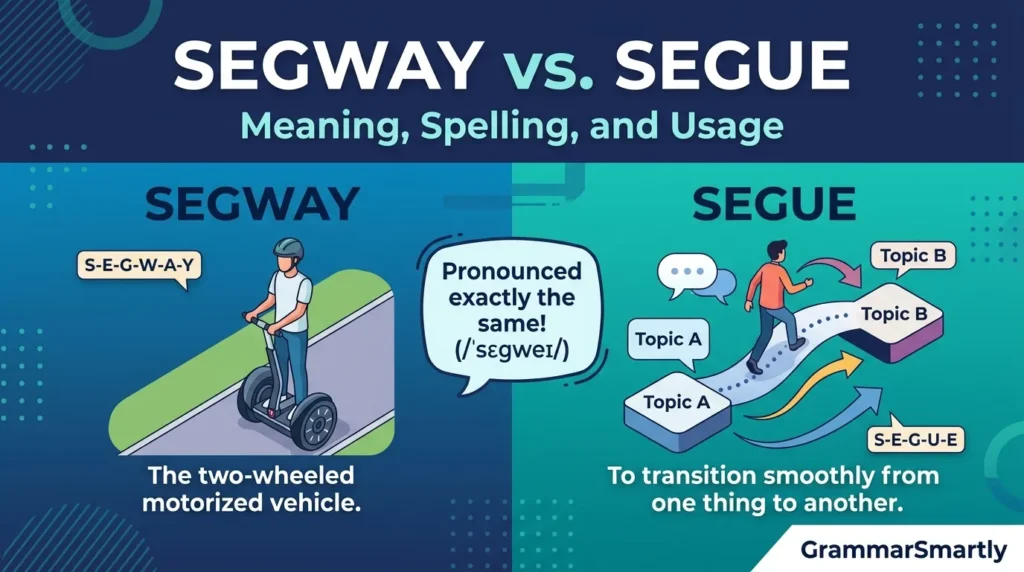
The difference between Segway vs Segue comes down to meaning, spelling, and context. Both are legitimate English words, but they are not interchangeable. Segway is a brand name commonly associated with a self-balancing, two-wheeled personal transporter. Segue means to move smoothly from one topic, activity, scene, or musical passage to another. The confusion is understandable because the two words are pronounced alike or very similarly in common English usage, despite having different spellings and meanings.
If you are writing an essay, preparing a presentation, editing a report, or describing a transition between ideas, choosing the correct word matters. This guide explains the definitions, pronunciation, origins, grammatical patterns, spelling tricks, and practical examples that will help you distinguish Segway from segue confidently.
Quick Facts: Segway vs Segue
| Feature | Segway | Segue |
| Standard form | Segway | Segue |
| Word type | Proper noun when referring to the brand; also used informally as a common noun | Noun and verb |
| Meaning | A brand associated with personal transporters; informally, a transporter of this type | A smooth transition between subjects, scenes, or activities |
| Pronunciation | Commonly /ˈsɛɡ.weɪ/ | Commonly /ˈsɛɡ.weɪ/ |
| Main difference | Refers to a product or mode of transport | Refers to a transition or the act of transitioning |
| Usage status | Established brand name; generic lowercase use depends on context | Standard English word |
| Common error | Writing Segway when segue is intended | Misspelling segue as segway |
What Does “Segway vs Segue” Mean?
The phrase Segway vs segue describes a comparison between two words that sound alike but communicate different ideas. The spelling you choose depends on what you mean.
Understanding the meaning of entwined vs intertwined helps clarify how these similar words describe connections between people, objects, and ideas.
What Does Segway Mean?

Segway is the name of a brand associated with self-balancing personal transporters. The word is also sometimes used informally to refer to a transporter of that general type.
Examples:
- The tour guide rode a Segway through the historic district.
- We rented Segways to explore the waterfront.
- The security officer used a personal transporter to move around the large venue.
In formal writing, capitalize Segway when referring to the brand. If you mean a generic personal transporter rather than the brand, choose a suitably descriptive term unless the context clearly supports the informal use of segway.
What Does Segue Mean?
Segue is a noun or verb that describes a smooth transition from one thing to another.
As a noun, it refers to the transition itself:
The segue from the introduction to the main argument felt natural.
As a verb, it describes the act of transitioning:
The presenter used a question to segue into the next topic.
The word is useful in several contexts:
- Conversation: Moving from one subject to another.
- Presentations: Connecting one section to the next.
- Writing: Linking ideas or paragraphs.
- Music: Moving from one musical passage to another.
- Film and performance: Transitioning between scenes, acts, or sequences.
The Essential Difference
Remember the distinction this way:
- Segway relates to a personal transporter or the brand.
- Segue relates to a smooth transition.
For example, a presenter might ride a Segway onto a stage and then segue into a discussion about transportation. The sentence uses both words correctly because each describes something different.
Is Segway Correct?
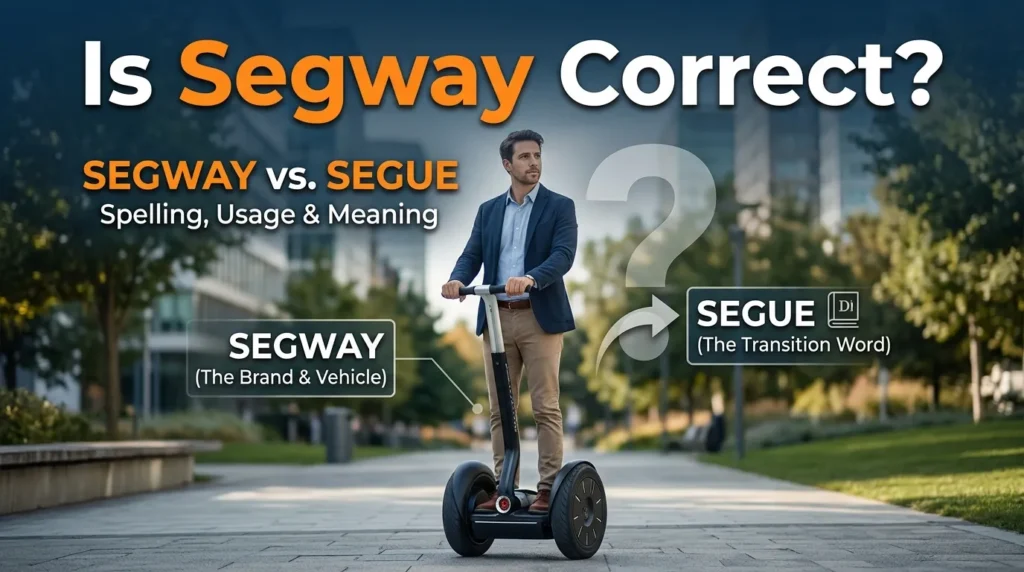
Yes. Segway is a legitimate spelling, particularly when referring to the brand or its associated personal transporters.
It is not automatically a misspelling simply because segue is the intended word in some situations. The problem occurs when a writer uses Segway to describe a transition between ideas.
Consider these examples:
- Correct: The guests toured the campus on a Segway.
- Incorrect word choice: The speaker made a smooth Segway into the next subject.
- Better: The speaker made a smooth segue into the next subject.
In the second sentence, the intended meaning is a transition, so segue is the appropriate word.
Is Segue Correct?
Yes. Segue is the standard English spelling for the noun and verb referring to a smooth transition.
Its spelling can surprise readers because the final letters do not correspond to the pronunciation they might expect from familiar English spelling patterns. Nevertheless, segue is an established word, not a misspelling or an informal substitute for Segway.
Examples:
- Correct: Her question provided a natural segue into the discussion.
- Correct: The interview segued from career advice into personal stories.
- Incorrect for the intended meaning: Her question provided a natural Segway into the discussion.
The last sentence should use segue because it describes a transition, not a transportation product.
What Is the Correct Spelling?
Both Segway and segue are correctly spelled words. The correct choice depends on the intended meaning.
Spelling Segway
The spelling is S-e-g-w-a-y.
Notice the ending -way, which may help you associate the word with a vehicle that takes someone from one place to another. This is a memory association rather than an explanation of the word’s historical origin.
When using the brand name, capitalize the first letter:
- a Segway
- a Segway tour
- a Segway personal transporter
Spelling Segue
The spelling is S-e-g-u-e.
The final three letters, gue, are part of the conventional spelling of this word. Although the spelling may look unfamiliar, the word is pronounced like Segway in common usage.
Useful examples include:
- a segue between paragraphs
- a natural segue into a new topic
- to segue from one point to another
- the segue into the final scene
Clear cancelled and canceled examples in sentences show how both spellings work naturally in everyday written English.
Common Spelling Error
The most important mistake is not necessarily misspelling either word in isolation. It is choosing the correct spelling for the wrong meaning.
If you mean a transition, write segue. If you mean the branded transporter, write Segway.
Difference Between Segway and Segue
| Feature | Segway | Segue |
| Spelling | S-e-g-w-a-y | S-e-g-u-e |
| Status | Established brand name | Standard English word |
| Meaning | Brand associated with personal transporters | A smooth transition |
| Word type | Proper noun for the brand; informal common-noun use also occurs | Noun and verb |
| Pronunciation | /ˈsɛɡ.weɪ/ | /ˈsɛɡ.weɪ/ |
| Typical use | Transport, tours, personal mobility | Conversation, writing, music, presentations |
| Example | We hired a Segway for the tour. | The host made a segue into the next segment. |
| Modern standard usage | Capitalize the brand name | Use for transitions |
The central distinction is semantic, meaning that the words differ in what they communicate rather than in how they sound. A listener may understand the intended word from context, but a reader needs the correct spelling to avoid confusion.
Meaning of Segway and Segue
The Meaning of Segway
The primary meaning of Segway is associated with the branded personal transporter.
A Segway is designed to carry a rider and is commonly associated with self-balancing personal mobility. The name may also appear in references to guided tours, security work, and other activities involving these transporters.
Examples:
- The museum organized a guided Segway tour.
- Visitors received instructions before using a Segway.
- The company displayed a Segway at the technology exhibition.
The word can appear in informal contexts as a generic label for similar transporters. However, generic usage should not be confused with the formal brand name.
The Meaning of Segue
The word segue expresses continuity between one thing and another.
Segue as a Noun
As a noun, segue names the transition itself.
Examples:
- The anecdote was an effective segue into the main presentation.
- The film’s segue between scenes was almost imperceptible.
- A brief summary served as a segue to the conclusion.
Segue as a Verb
As a verb, segue describes the process of moving smoothly into another subject, activity, or passage.
Examples:
- The lecturer segued from historical background to modern applications.
- After discussing the budget, the manager segued into the hiring plan.
- The song segues into a quieter instrumental passage.
Common Contexts for Segue
You will often encounter segue in these situations:
- Public speaking: Connecting one presentation section to another.
- Academic writing: Establishing a logical link between ideas.
- Journalism: Moving between subjects in an interview or article.
- Music: Linking musical passages.
- Entertainment: Transitioning between scenes or segments.
- Everyday conversation: Shifting from one subject to another without an abrupt change.
A segue does not have to be perfectly seamless. The word describes a transition or movement between elements, often with an emphasis on continuity.
Pronunciation of Segway and Segue
IPA Pronunciation
Both words are commonly pronounced /ˈsɛɡ.weɪ/ in English.
A simple pronunciation guide is SEG-way, with the stress on the first syllable.
The shared pronunciation is the main reason people confuse these words in writing. Hearing either word in conversation does not usually reveal which spelling the speaker intends.
Syllable Breakdown
Both words are commonly divided into two spoken syllables:
- Segway: SEG-way
- Segue: SEG-way
The spelling segue is particularly surprising because its final letters do not look like the familiar spelling of the sound in way.
Pronunciation Tips
To pronounce either word:
- Begin with the sound in set.
- Add a hard g sound, as in get.
- Finish with the sound of way.
Say the result as SEG-way, with the first syllable receiving the main stress.
Remember that identical pronunciation does not mean identical spelling or meaning. Context determines which word belongs in your sentence.
Why Do People Confuse Segway and Segue?
Several factors contribute to this confusion.
1. They Sound Alike
The strongest source of confusion is their shared pronunciation. Someone who hears the word in a meeting or conversation must determine its spelling from the meaning.
A writer who knows the sound but has not encountered segue in print may naturally choose the more familiar-looking spelling.
2. Segue Has an Unexpected Spelling
The ending -gue can look unusual to readers who are unfamiliar with the word. Because Segway visually suggests the familiar word way, it may seem like the obvious spelling when someone writes from memory.
However, the correct spelling for a transition remains segue.
3. Context Can Be Overlooked
Writers sometimes focus on how a word sounds instead of what the sentence means.
Compare:
- The group rode a Segway through the park.
- The guide used a segue to introduce the next activity.
The first sentence concerns transportation. The second concerns a transition between activities.
4. Spellcheck May Not Catch the Error
Both forms are legitimate words. A spelling checker may therefore accept Segway in a sentence where the writer intended segue. Correct spelling alone does not guarantee correct word choice.
Proofreading for meaning is especially important with homophones and other words that share a pronunciation.
Origin and Etymology
The two words have different histories, which helps explain why their spellings differ despite their similar pronunciation.
Origin of Segway
Segway is a brand name associated with personal transporters. The name is commonly understood as a play on segue, drawing on the idea of moving smoothly from one place or state to another.
The brand spelling uses -way rather than the traditional spelling -gue. When referring to the brand, preserve the established capitalization and spelling.
Origin of Segue
Segue comes from Italian, where segue is a form of the verb seguire, meaning “to follow.” The English word retains its association with following smoothly from one passage, subject, or activity to another.
Its use in music is especially consistent with this idea of continuity, although the word is also widely used for transitions in conversation, writing, and other settings.
The shared pronunciation of the two words reflects the relationship between the brand name and the existing English word. It does not make their meanings interchangeable.
How to Remember the Correct Spelling
The easiest approach is to connect each spelling with its purpose.
Quick Memory Trick
Use this simple contrast:
- Segway has WAY: Think of a vehicle used to travel along a way.
- Segue has GUE: Remember this less familiar spelling for a transition between ideas.
For example:
I rode a Segway, then used a segue to introduce my next point.
This sentence contains both words and gives each one a separate role.
Word-Family Connection
For segue, remember its grammatical forms:
- Segue: The transition itself.
- To segue: To move smoothly into another topic.
- Segues: More than one transition, or the verb form used with a singular third-person subject.
- Segued: Moved smoothly from one subject or activity to another.
- Segueing: Moving smoothly into another subject or activity.
Examples:
- The host created several segues between the interview segments.
- She segues from the introduction into the main argument.
- The conversation segued into a discussion of travel.
- The presenter is segueing into the final section.
For Segway, the useful association is with the brand and its transporters, not with a verb meaning to change topics.
Examples in Sentences
The following examples show how to use both words naturally. Each pair highlights a different context so you can recognize the intended meaning.
| No. | Segway Example | Segue Example |
| 1 | The tourists rented a Segway to explore the old town. | The guide used a short story to segue into local history. |
| 2 | A staff member demonstrated how to operate the Segway safely. | The speaker made a smooth segue from safety to responsibility. |
| 3 | We saw a Segway displayed at the mobility exhibition. | The final paragraph provides a segue into the conclusion. |
| 4 | The photographer captured the rider balancing on a Segway. | The editor added a segue between the two interview clips. |
| 5 | The company offered a guided Segway tour along the waterfront. | Her question created a segue into the subject of tourism. |
| 6 | The security team used a Segway to move around the large venue. | The presenter found a segue from customer service to staff training. |
| 7 | The visitor asked whether the Segway was available to rent. | The musician created a segue into the next piece. |
| 8 | The rider parked the Segway beside the entrance. | The journalist used the answer as a segue to a new question. |
| 9 | The instructor explained the Segway’s controls before the ride. | A brief anecdote served as a segue into the lecture. |
| 10 | The travel group included a Segway experience in its itinerary. | The documentary’s segue into the next scene felt natural. |
| 11 | The demonstration showed how the Segway responded to the rider’s movements. | The teacher used a comparison to segue into the next concept. |
| 12 | A visitor photographed a Segway near the exhibition entrance. | The host needed a better segue between the two discussion topics. |
| 13 | The rental operator checked the Segway before handing it over. | The author developed a segue from the problem to its possible solutions. |
| 14 | The tour began with a briefing on Segway operation. | The conversation segued from weekend plans to career goals. |
| 15 | The brochure described the Segway tour as part of the visitor experience. | The presenter segued into the final remarks after answering questions. |
Incorrect and Correct Usage
These additional examples focus on the most common word-choice error.
| Incorrect Sentence | Correct Sentence |
| The speaker made a smooth Segway into the next topic. | The speaker made a smooth segue into the next topic. |
| Her joke was a clever Segway to the serious discussion. | Her joke was a clever segue to the serious discussion. |
| The article needs a better Segway between its sections. | The article needs a better segue between its sections. |
| He used a personal segue to travel around the park. | He used a personal Segway to travel around the park. |
| The guide explained how to ride a segue. | The guide explained how to ride a Segway. |
The corrections demonstrate why meaning matters as much as spelling. A sentence can contain a perfectly spelled English word and still be incorrect because that word does not express the intended idea.
Common Mistakes to Avoid
Keep these distinctions in mind when editing your writing:
- Using Segway for a transition: Write segue when referring to a connection between ideas, scenes, or activities.
- Using segue for a vehicle: Write Segway when referring to the brand or an appropriate informal use of its name.
- Capitalizing every occurrence of segue: The ordinary word segue is lowercase unless it begins a sentence or appears in a title where capitalization is required.
- Writing segway in formal brand references: Use Segway when the brand is intended.
- Assuming spellcheck guarantees accuracy: Both words can pass a spelling check even when one is wrong for the context.
- Confusing a transition with a physical journey: A segue describes a transition in subject or activity. A Segway is associated with physical transportation.
- Using the wrong verb form: The standard forms include segue, segues, segued, and segueing.
Similar Commonly Misspelled Words
The following examples illustrate related spelling challenges, particularly words whose written forms may surprise readers or whose meanings require careful attention.
| Common Error or Confusion | Correct Form | Reason for Confusion |
| Segway used for a transition | Segue | Identical or very similar pronunciation |
| Principal vs. principle | Principal / principle | Similar pronunciation but different meanings |
| Stationary vs. stationery | Stationary / stationery | Homophones with distinct meanings |
| Complement vs. compliment | Complement / compliment | Similar pronunciation and spelling |
| Affect vs. effect | Affect / effect | Related sounds and overlapping contexts |
| Accept vs. except | Accept / except | Similar sounds but different functions |
| Allude vs. elude | Allude / elude | Similar spelling and pronunciation |
| Ensure vs. insure | Ensure / insure | Overlapping usage in some contexts |
| Advice vs. advise | Advice / advise | Similar spelling with different final sounds |
| Breath vs. breathe | Breath / breathe | Related forms with different pronunciations |
These are not all misspellings in their own right. Most are legitimate words that become errors when substituted for one another. Like Segway and segue, they require attention to meaning and context.
Related Words
Synonyms
The best synonyms depend on the meaning of segue.
| Word | Meaning and Difference |
| Transition | A general movement from one state, subject, or stage to another |
| Shift | A change in direction, focus, position, or subject |
| Bridge | A connecting element between ideas, sections, or stages |
| Link | A connection between related elements |
| Continuation | The act or state of carrying something forward |
| Move | A general term for changing position or changing focus |
| Lead-in | An introduction that prepares the audience for what follows |
These words are not exact replacements in every sentence. For example, transition works in many contexts where segue is appropriate, while lead-in often emphasizes preparation for what comes next.
Antonyms
There is no single universal antonym for segue. Depending on the context, useful contrasts include:
- Abrupt shift: A sudden change without a smooth connection.
- Discontinuity: A break in continuity.
- Interruption: An event that stops or disrupts an ongoing process.
These terms describe possible opposites of a smooth transition, rather than strict dictionary antonyms.
Related Forms
The main grammatical forms of segue are:
| Form | Example |
| Noun: segue | The segue was effective. |
| Plural noun: segues | The presentation contains several segues. |
| Base verb: segue | We will segue into the next topic. |
| Third-person singular: segues | She segues into the conclusion. |
| Past tense: segued | The discussion segued into another issue. |
| Present participle: segueing | He is segueing into the final section. |
Segway has the plural form Segways when used as a countable brand reference or informal common noun. It does not have the same standard grammatical function as the verb segue.
Grammar Tips
Understanding how segue works in a sentence makes it easier to avoid errors.
Using Segue as a Noun
As a noun, segue can be used with an article or another determiner.
Examples:
- That was an effective segue.
- The segue between the chapters needs improvement.
- Her final comment provided a natural segue into the announcement.
The plural form is segues.
Using Segue as a Verb
As a verb, segue can describe movement from one topic or activity into another.
Common patterns include:
- Segue into something: The presenter segued into the results.
- Segue from one thing to another: The discussion segued from theory to practice.
- Segue to something: The host used the final question to segue to the next segment.
The preposition depends on the intended relationship. Into emphasizes entering a subject or activity, while from … to … makes the starting point and destination explicit.
Using Segway as a Noun
When referring to the brand, use Segway as a proper noun.
Examples:
- The Segway was stored in the equipment room.
- They booked a Segway tour.
- Several Segways were available for the demonstration.
Do not use Segway as a verb meaning to transition between subjects.
Writing Tips
In Essays and Academic Writing
Use segue when explaining how one argument connects to another. A clear transition can help readers follow the progression of your reasoning.
For example:
This evidence establishes the problem. The next section segues into possible solutions.
In a formal essay, you may prefer a more direct expression such as transitions to or leads into if it makes the sentence clearer.
In Professional Presentations
A good segue helps a presenter move between sections without making the talk feel disconnected.
For example:
Having reviewed our results, let’s segue into the proposed next steps.
You can also use a question, summary, or brief example to create a natural transition.
In Emails and Reports
When describing a shift in discussion, use segue rather than Segway.
For example:
After reviewing the completed tasks, I would like to segue into the outstanding priorities.
In many business emails, however, a direct phrase such as Next, let’s discuss the outstanding priorities may sound simpler and more natural.
In Proofreading
When reviewing a document, search for both Segway and segue. Check every occurrence rather than automatically replacing one spelling with the other.
Ask yourself:
- Does the sentence refer to a transporter or brand?
- Does it describe a transition between subjects or activities?
- Is the capitalization appropriate?
- Does the word function grammatically as a noun or verb?
This method catches contextual errors that ordinary spelling checks may miss.
Quick Spelling Checklist
| Check | Correct Form or Rule |
| Standard spelling | Both Segway and segue are correct in their respective contexts. |
| Common word-choice error | Using Segway when segue is intended |
| Meaning | Segway relates to a brand and personal transporters; segue means a transition. |
| Pronunciation | Both are commonly pronounced /ˈsɛɡ.weɪ/. |
| Word type | Segue is a noun and verb; Segway is a brand name and may be used informally as a common noun. |
| Key spelling pattern | Segway ends in -way; segue ends in -gue. |
| Common usage | Ride a Segway; segue into a new topic. |
| Final proofreading check | Confirm the intended meaning before choosing the spelling. |
Key Takeaways
- Both spellings are legitimate English forms. Neither is universally incorrect.
- Segway refers primarily to a brand associated with personal transporters.
- Segue means a smooth transition and can function as either a noun or a verb.
- Both words are commonly pronounced the same way, making them easy to confuse when writing from speech.
- Use segue in essays, conversations, presentations, and other contexts involving transitions.
- Capitalize Segway when referring to the brand.
- Remember the contrast: ride a Segway, then segue into a new subject.
- Proofread for meaning as well as spelling because a spellchecker may accept either word.
Conclusion
Understanding Segway vs segue becomes much easier when you focus on meaning rather than pronunciation. Both words are correctly spelled, and both are commonly pronounced SEG-way, but they serve different purposes. Segway refers primarily to a brand associated with personal transporters, while segue describes a smooth transition between ideas, subjects, scenes, or activities.
The simplest way to remember the difference is to associate Segway with transportation and segue with transitions. When writing an essay, preparing a presentation, or editing a professional email, consider what the sentence is trying to communicate before choosing the spelling. If you are connecting two ideas, segue is the appropriate choice. If you are referring to the transporter, use Segway. With this distinction in mind, you can avoid a common word-choice error and use both words accurately and confidently.
Frequently Asked Questions
Is Segway or segue the correct spelling?
Both Segway and segue are correct spellings, but they have different meanings. Segway is the name of a brand associated with personal transporters. Segue is an English noun and verb referring to a smooth transition between subjects, activities, or passages. Choose the spelling that matches your intended meaning rather than treating one form as a misspelling of the other.
What does segue mean in simple English?
A segue is a smooth change from one subject, activity, scene, or musical passage to another. For example, a teacher might use a question to segue from a lesson about history into a discussion of modern society. The word can describe the transition itself as a noun or the act of moving smoothly between subjects as a verb.
Why are Segway and segue pronounced the same?
The two words are commonly pronounced /ˈsɛɡ.weɪ/, which makes them difficult to distinguish when heard without context. Their spellings differ because they have different histories and uses. Segue comes from Italian, while Segway is a brand name associated with personal transporters. Their similar pronunciation does not make them interchangeable in written English.
Is segue a real English word?
Yes. Segue is a standard English word that functions as both a noun and a verb. As a noun, it refers to a transition between things. As a verb, it describes moving smoothly from one subject or activity into another. It is appropriate in everyday conversation, professional communication, academic writing, music, and discussions of film or performance.
Can I use Segway as a verb?
In standard usage, Segway is not the appropriate verb for describing a transition between topics. The correct verb is segue. For example, write, “The speaker segued into the next subject,” rather than “The speaker Segwayed into the next subject.” When referring to the branded transporter, Segway is ordinarily used as a noun.
What is the plural of segue?
The plural noun form of segue is segues. For example, “The presentation includes several segues between its major sections.” When segue functions as a verb, segues is also the third-person singular present form, as in “The discussion segues into a new topic.” Context determines whether the word is being used as a noun or a verb.
How do you use segue in a sentence?
You can use segue as a noun or a verb. As a noun, write, “The example provided a natural segue into the next section.” As a verb, write, “The presenter segued from the budget discussion into the staffing plan.” In both cases, the word communicates a transition rather than a physical journey or a means of transportation.
Is segue appropriate for formal and academic writing?
Yes. Segue can be used in academic essays, research presentations, professional reports, and other formal contexts when describing a transition between ideas or sections. However, it should not replace every transition word. Depending on the sentence, expressions such as transition to, lead into, or move on to may communicate the relationship more directly.
What is the easiest way to remember Segway vs segue?
Associate Segway with a vehicle and segue with a transition. You can reinforce the distinction with this sentence: “I rode a Segway before using a segue to introduce my next point.” Both words appear in one sentence, but each has a different meaning. Recalling this contrast is often more reliable than trying to remember their spellings in isolation.
Does a spellchecker know the difference between Segway and segue?
A spellchecker may recognize both words as correctly spelled, even when one is inappropriate for the sentence. For instance, it might accept “a smooth Segway into the conclusion” because Segway is a valid word. To catch this error, review the meaning and grammatical role of each occurrence instead of relying exclusively on automatic spelling correction.
Is segue related to the Italian word seguire?
Yes. The English word segue comes from Italian segue, a form of seguire, meaning “to follow.” This origin is consistent with the modern English idea of following smoothly from one passage, subject, or activity into another. The connection helps explain the word’s meaning, although it does not change the spelling convention used in modern English.
Should Segway always be capitalized?
Capitalize Segway when referring to the brand. In contrast, segue is ordinarily lowercase unless it appears at the beginning of a sentence or in a title that calls for capitalization. Informal generic uses of a brand name may follow different conventions, so descriptive terms such as personal transporter can be preferable when the brand itself is not intended.