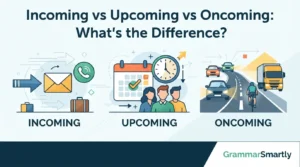
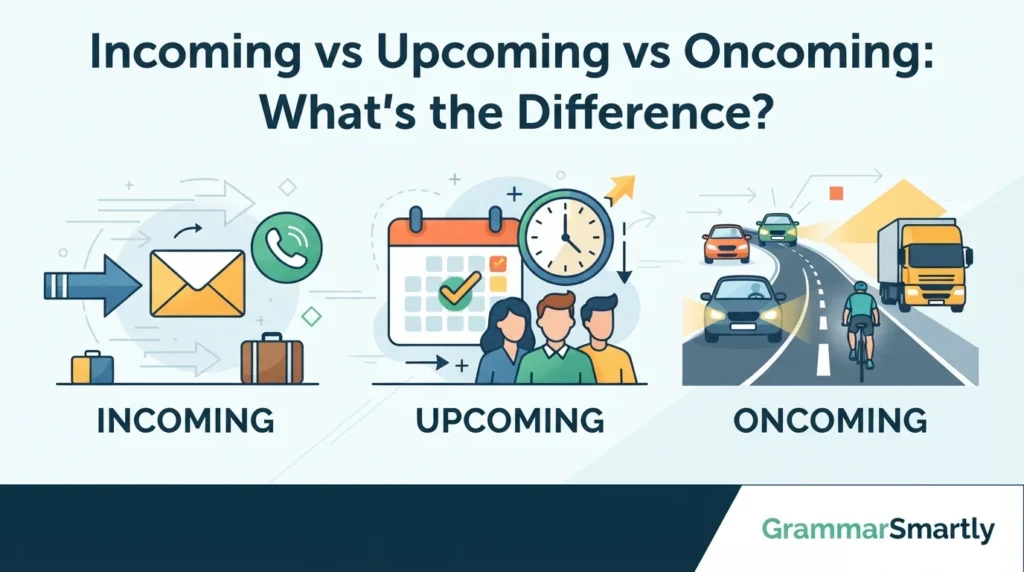
Incoming, upcoming, and oncoming look and sound similar, but they describe different kinds of arrival, future events, and movement. The easiest way to separate them is to focus on what is arriving, what is happening soon, and what is moving toward you.
This distinction matters in everyday English, especially with phrases such as incoming call, upcoming meeting, and oncoming traffic. Current dictionary definitions and usage examples support these differences.
Writers often confuse them, so learning Inter vs Intra differences with examples makes word choices much clearer.
Incoming vs Upcoming vs Oncoming at a Glance
| Word | Main idea | Typical use | Example |
| Incoming | Arriving or being received | Calls, emails, flights, people, information | an incoming call |
| Upcoming | Happening soon | Events, meetings, exams, elections | an upcoming meeting |
| Oncoming | Moving toward someone or something | Traffic, vehicles, waves, dangers | oncoming traffic |
A simple memory rule is:
Incoming = coming in
Upcoming = coming soon
Oncoming = coming toward you
However, these shortcuts are not perfect in every context, so the differences are worth understanding more carefully.
What Does “Incoming” Mean?
Incoming describes something that is arriving, coming into a place, or being received. Cambridge gives examples such as incoming mail, incoming phone calls, and an incoming flight. It can also describe someone who is about to begin a new role, such as an incoming government or incoming president.
Common uses of incoming
You can use incoming for:
- phone calls
- emails and messages
- flights and passengers
- information or data
- deliveries
- people arriving
- a newly appointed or elected person or administration
Examples of incoming
- I have an incoming call from my manager.
- The airport has delayed several incoming flights.
- Please check your incoming emails before the meeting.
- The system automatically filters incoming messages.
- The incoming president will take office next month.
Notice that incoming often emphasizes arrival or reception, rather than simply saying that something will happen in the future.
What Does “Upcoming” Mean?
Upcoming means happening soon or expected to happen in the near future. It is particularly common for events, plans, activities, and scheduled occasions. Cambridge lists examples such as an upcoming concert tour and an upcoming election.
Common uses of upcoming
You commonly see upcoming with:
- meetings
- events
- elections
- exams
- holidays
- concerts
- conferences
- projects
- releases
- competitions
- appointments
Examples of upcoming
- We discussed the upcoming meeting yesterday.
- She is studying for her upcoming exam.
- Tickets for the upcoming concert are already selling quickly.
- The company announced its upcoming product launch.
- Voters are preparing for the upcoming election.
The key point is that upcoming focuses on a future event, rather than something physically moving toward you.
What Does “Oncoming” Mean?
Oncoming describes something moving toward you or approaching you. It is especially common when talking about vehicles, traffic, people, waves, or other things moving in your direction. Cambridge defines it as something moving toward or approaching you.
Common uses of oncoming
You will often see oncoming with:
- traffic
- cars
- trucks
- trains
- vehicles
- waves
- pedestrians
- opponents
- storms
- dangers or threats
Examples of oncoming
- Be careful of the oncoming traffic.
- The driver swerved to avoid an oncoming truck.
- We could see an oncoming train in the distance.
- The surfer prepared for the oncoming wave.
- The soldiers prepared for the oncoming attack.
Importantly, oncoming is not limited to literal vehicles. It can also describe an approaching situation or threat, as in an oncoming crisis. Cambridge itself gives oncoming crisis as an example.
Understanding single vs double-decker cooler differences helps shoppers compare storage capacity and practical design features.
The Main Difference Between Incoming and Upcoming
The difference between incoming and upcoming is mainly about arrival versus future occurrence.
Incoming
Something is coming in or being received.
We received an incoming call from the customer.
The call is arriving at the phone.
Upcoming
Something is going to happen soon.
We have an upcoming meeting with the customer.
The meeting is a future event.
Compare these:
- incoming email = an email being received
- upcoming meeting = a meeting that will happen soon
- incoming flight = a flight arriving at an airport
- upcoming conference = a conference scheduled for the near future
This is why incoming meeting usually sounds wrong when you mean a meeting scheduled for tomorrow. Upcoming meeting is the natural choice.
The Main Difference Between Upcoming and Oncoming
The distinction becomes clearer when you think about time versus direction.
Upcoming is mainly about time:
The upcoming festival starts next week.
Oncoming is mainly about movement toward a particular point or person:
The cyclist moved away from the oncoming car.
So:
- upcoming event ✔
- oncoming traffic ✔
- upcoming election ✔
- oncoming vehicle ✔
- oncoming meeting ✘
- upcoming traffic ✘ in the usual intended sense
There can be exceptions when oncoming is used figuratively, but it still retains the idea of something approaching.
The Main Difference Between Incoming and Oncoming
These two are especially easy to confuse because both can describe something approaching.
The difference is where the thing is coming from and how the movement is viewed.
Incoming often means something is coming into a place, system, or recipient.
The company received an incoming email.
Oncoming emphasizes something approaching from the direction toward you.
The driver stopped for oncoming traffic.
Compare:
- incoming passengers = passengers arriving at a location
- oncoming passengers = passengers moving toward you, a much more specific physical perspective
- incoming call = a call being received
- oncoming car = a car approaching you
The word oncoming is particularly natural when the approaching thing is visible or physically moving.
Incoming vs Upcoming vs Oncoming Examples
Here are some common situations where choosing the right word matters.
Phone calls
I missed an incoming call from my sister.
Not:
I missed an upcoming call.
If you mean a call that is scheduled for later, you could say:
I have an upcoming call with my doctor.
Here, upcoming is possible because the call is a future appointment rather than a call currently arriving.
Meetings
We have an upcoming meeting on Friday.
Usually not:
We have an incoming meeting on Friday.
The meeting is scheduled to happen, so upcoming is the natural choice.
Traffic
Watch out for the oncoming traffic.
Here, oncoming emphasizes vehicles moving toward you.
Emails
I received several incoming emails this morning.
Incoming works because the messages are being received.
Events
Are you attending the upcoming conference?
Upcoming works because the conference is a future event.
Vehicles
The driver failed to notice the oncoming truck.
Oncoming works because the truck is physically approaching the driver.
Can “Incoming” Refer to the Future?
Yes. This is an important nuance.
It would be too simplistic to say that incoming always means something happening right now.
For example, incoming government, incoming president, and incoming director can refer to someone who has been chosen for a role but has not yet taken it. Cambridge specifically includes this sense in its definition of incoming.
So:
The incoming president will announce the new cabinet next week.
Here, incoming does not mean that the president is physically arriving at the moment. It identifies someone who is about to take over a position.
Can “Oncoming” Be Used for Things Other Than Vehicles?
Yes.
Although oncoming traffic, oncoming cars, and oncoming vehicles are especially common, the word can describe other things approaching you or a particular point.
For example:
- an oncoming wave
- an oncoming storm
- an oncoming attack
- an oncoming crisis
- an oncoming threat
The expression oncoming crisis is particularly useful because it shows that oncoming can have a figurative meaning.
Still, upcoming is usually the better choice when you are simply talking about a scheduled or expected event.
Common Mistakes With Incoming, Upcoming, and Oncoming
Mistake 1: “Incoming meeting”
If you mean a meeting scheduled for later, use upcoming.
❌ We have an incoming meeting tomorrow.
✔ We have an upcoming meeting tomorrow.
Mistake 2: “Upcoming email”
If an email is currently arriving or being received, use incoming.
❌ I have an upcoming email from my manager.
✔ I have an incoming email from my manager.
If you mean an email you plan to send later, you would normally say an email I need to send, not upcoming email.
Mistake 3: “Oncoming event”
An event that will happen soon is normally an upcoming event.
❌ We are preparing for the oncoming event.
✔ We are preparing for the upcoming event.
Mistake 4: Treating the three words as interchangeable
Although all three contain the idea of something “coming,” their meanings are not identical.
- Incoming focuses on arrival or reception.
- Upcoming focuses on a future occurrence.
- Oncoming focuses on movement or approach toward a person or point.
A Simple Way to Remember the Difference
Think about three questions.
Is it coming in?
Use incoming.
incoming call
incoming email
incoming flight
Is it happening soon?
Use upcoming.
upcoming exam
upcoming holiday
upcoming election
Is it moving toward you?
Use oncoming.
oncoming car
oncoming traffic
oncoming wave
This gives you a practical shortcut:
Incoming = arrival
Upcoming = future event
Oncoming = approach
Incoming vs Upcoming vs Oncoming: Which Word Should You Use?
Choose incoming when something is arriving, entering, or being received.
Choose upcoming when something is expected or scheduled to happen soon.
Choose oncoming when something is approaching you or moving toward a particular point, especially in a physical sense.
For example:
Incoming: I answered the incoming call.
Upcoming: I am preparing for the upcoming meeting.
Oncoming: The driver slowed down for the oncoming truck.
Once you identify whether your sentence is about arrival, future timing, or movement toward you, the correct word is usually easy to choose.
FAQs About Incoming, Upcoming, and Oncoming
Is incoming the same as upcoming?
No. Incoming usually emphasizes something arriving or being received, while upcoming means something will happen soon. An incoming call is being received, whereas an upcoming meeting is scheduled for the future.
Is upcoming the same as oncoming?
No. Upcoming normally refers to something that will happen soon, while oncoming describes something approaching or moving toward you.
Is “upcoming meeting” correct?
Yes. Upcoming meeting is a natural phrase for a meeting that will take place soon.
Is “incoming meeting” correct?
Usually not if you mean a meeting scheduled for the future. In that situation, upcoming meeting is the natural expression.
Is “oncoming traffic” correct?
Yes. Oncoming traffic refers to vehicles approaching from the opposite direction or moving toward you.
Can I say “incoming traffic”?
Yes, but the meaning depends on context. Incoming traffic can refer to traffic arriving at or entering a particular area, whereas oncoming traffic emphasizes traffic approaching you, often from the opposite direction.
Can “oncoming” describe a crisis?
Yes. Oncoming crisis is possible because oncoming can be used figuratively for something approaching or developing. Cambridge includes oncoming crisis as an example.
Is “upcoming” formal English?
Yes. Upcoming is standard English and is commonly used in professional, academic, business, and everyday contexts. Cambridge also lists it in Business English examples.
What is the easiest way to remember these three words?
Remember:
Incoming = coming in
Upcoming = coming soon
Oncoming = coming toward you
Final Takeaway
Incoming, upcoming, and oncoming are related, but they are not interchangeable.
- Incoming means arriving, entering, or being received.
- Upcoming means happening soon in the future.
- Oncoming means moving toward or approaching someone or something.
So, you receive an incoming call, prepare for an upcoming exam, and watch out for oncoming traffic. Learning this difference makes your English more precise and helps you avoid awkward word choices.