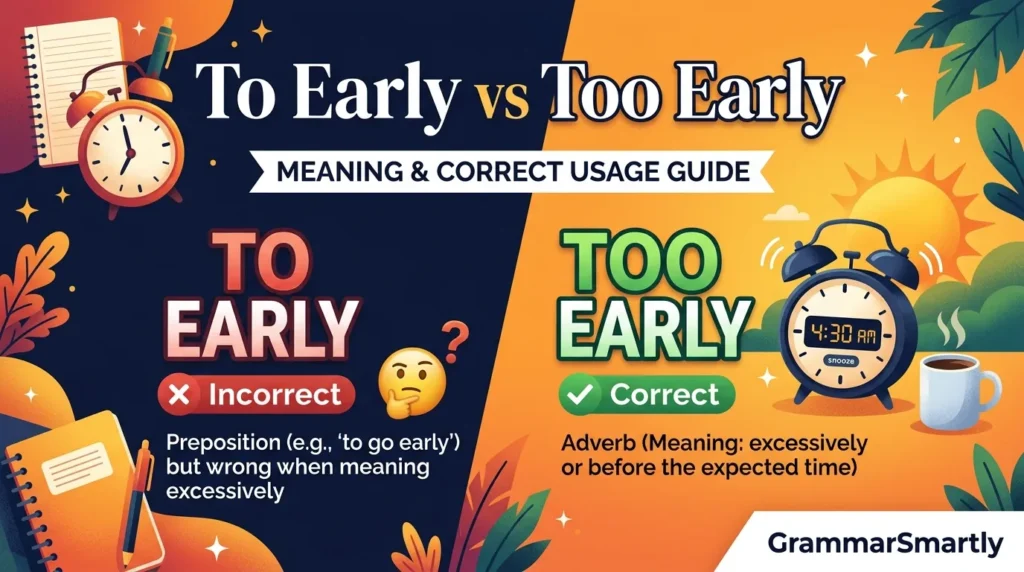
The difference between “to early” and “too early” comes down to the meaning and grammatical function of the words to and too. In standard English, “too early” is correct when you mean before the appropriate time, sooner than expected, or earlier than is suitable. By contrast, “to early” is generally a spelling or word-choice error when used with that meaning. The word to is commonly used before a verb or to express direction, purpose, or a relationship, while too means “more than necessary” or “also.” Because these words sound alike in many varieties of English, it is easy to choose the wrong one while writing. This guide explains their meanings, grammar, pronunciation, examples, and practical ways to remember which form to use.
Quick Facts Table
| Feature | Details |
| Standard form | Too early |
| Common error | To early |
| Word type | To: preposition or infinitive marker; too: adverb; early: adverb or adjective |
| Meaning of “too early” | Before the appropriate or expected time |
| Pronunciation | To and too are generally pronounced alike |
| Main difference | To and too have different grammatical functions and meanings |
| Usage status | “Too early” is standard for this meaning |
| Common error | Writing “to early” when expressing that something happens prematurely |
What Does “To Early vs Too Early” Mean?
The phrase “To Early vs Too Early” refers to confusion between two words that sound alike but serve different purposes in a sentence. When describing something that happens before the right time, the correct expression is too early.
What Does “Too Early” Mean?

Too early means earlier than is appropriate, desirable, expected, or convenient.
Examples:
- We arrived too early for the concert.
- It is too early to decide whether the plan will work.
- She left home too early to meet her friends.
- The announcement came too early for the team to prepare.
In these sentences, too indicates that the timing is earlier than suitable for the situation.
The sun is often described through vivid comparisons, and these similes for the sun with meanings and examples make descriptions more engaging.
What Does “To Early” Mean?
“To early” is not the standard expression for saying that something happens prematurely. In that context, it is a word-choice error.
However, the words to and early can appear next to each other in other grammatical constructions. For example, “I want to arrive early” is correct because to introduces the verb arrive, and early describes when the action happens.
Compare:
- Incorrect for the intended meaning: We came to early.
- Correct: We came too early.
- Correct: We wanted to arrive early.
The important point is to examine the role of each word, not merely whether the words appear next to each other.
Is “To Early” Correct?

“To early” is generally incorrect when you intend to say that someone arrived, acted, or did something before the appropriate time.
Use too early in sentences such as:
- It is too early to leave.
- You called too early in the morning.
- The flowers bloomed too early this year.
- We started too early and had to wait.
Use to when it serves its own grammatical purpose, such as introducing an infinitive verb:
- I plan to leave early.
- They agreed to arrive early.
- He wants to start early.
Notice the difference between too early to leave and to leave early. In the first phrase, too describes the timing, while the second to introduces the verb leave. In the second phrase, to introduces the verb leave, and early describes when the leaving will occur.
What Is the Correct Spelling?
The correct expression is too early when you mean that something happens before the right or expected time.
The spelling difference is small, but the grammatical difference matters:
- Too: An adverb meaning excessively, more than is appropriate, or also.
- To: A preposition or infinitive marker, depending on its use.
- Early: An adjective or adverb referring to a time near the beginning of a period or before the expected time.
Examples:
- Correct: The train arrived too early.
- Incorrect for the intended meaning: The train arrived to early.
- Correct: We planned to arrive early.
The word early does not need an extra letter or a different spelling. The mistake lies in choosing to instead of too.
Difference Between “To Early” and “Too Early”
| Feature | To Early | Too Early |
| Status | Incorrect for the intended meaning | Standard English expression |
| Meaning | Does not express excessive earliness in this construction | Earlier than appropriate or expected |
| Word type | To is a preposition or infinitive marker | Too is an adverb |
| Pronunciation | The word to generally sounds like too | Generally pronounced the same as to |
| Usage | Use to for its grammatical functions | Use before early to express excessive earliness |
| Standard usage | Not standard for this meaning | Correct |
The essential distinction is that too modifies early, indicating that the timing is earlier than suitable. By contrast, to usually connects words or introduces an infinitive verb, as in to arrive early.
Meaning of the Correct Expression
Literal Meaning
Too early describes a time that comes before the appropriate, expected, or convenient point.
For example, The shop opened too early for most customers means the opening time was earlier than was convenient for the intended customers.
Figurative Meaning
The expression can also describe an action, judgment, or decision made before enough time or information is available.
Examples:
- It is too early to judge the success of the new policy.
- We cannot celebrate yet because it is too early to know the outcome.
- The manager believes it is too early to change the strategy.
Here, the expression refers not simply to clock time but also to the stage of a process.
Common Contexts
You can use too early when discussing:
- Arrivals: arriving before an appointment or event is ready.
- Departures: leaving before the appropriate time.
- Decisions: reaching a conclusion without sufficient information.
- Events: something happening before it is expected.
- Development: a change occurring before its usual or suitable stage.
- Communication: contacting someone at an inconvenient hour.
The exact meaning depends on what makes the timing unsuitable in the sentence.
Pronunciation
IPA Pronunciation
The words to and too are generally pronounced identically in standard English.
- To: /tuː/ in its strong form, often /tə/ in unstressed speech.
- Too: /tuː/
- Early: /ˈɜːli/ in standard British English; /ˈɝːli/ in standard American English.
Pronunciation varies by accent and by whether a word is stressed. The important point is that to and too are homophones in their usual strong forms, meaning they sound alike despite their different spellings and grammatical functions.
Syllable Breakdown
- To: one syllable.
- Too: one syllable.
- Early: commonly divided into two syllables, ear-ly.
Pronunciation Tips
Say too early naturally as one connected phrase. Do not try to distinguish to from too by adding a different sound. In ordinary speech, the difference is primarily grammatical and written, not a reliable pronunciation distinction.
Why Do People Make This Spelling Mistake?
The confusion usually results from the fact that to and too sound alike.
Several factors contribute to the error:
- Homophones: Both words can be pronounced /tuː/, so listening alone may not reveal which spelling belongs in a sentence.
- Fast typing: Writers may select the more familiar spelling automatically without checking the meaning.
- Grammatical confusion: Both forms appear in common expressions involving verbs, adjectives, and adverbs.
- Limited proofreading: A spellchecker may accept both words because each is a legitimate English word.
- Memory errors: Writers may remember the sound of the expression without remembering which spelling carries the intended meaning.
The solution is to check the role of the word in the sentence rather than relying on sound alone.
Writers can make their descriptions more expressive by using common similes for dumb with meanings and examples in everyday English.
Origin and Etymology
To and too have different historical backgrounds, although their pronunciations have converged in modern English.
- To developed from Old English tō, a form used for purposes including direction and relationships.
- Too developed from Old English tō, used with meanings associated with addition or excess.
The two words therefore share a historical form, even though modern spelling distinguishes their functions. Their shared origin helps explain why they sound alike today, but it does not make them interchangeable in writing.
The word early has its own history in English and is not the source of the confusion. No historical spelling change is needed to explain the modern error.
How to Remember the Correct Spelling
A simple way to remember the difference is to associate the extra o in too with the idea of more than is suitable.
Quick Memory Trick
Ask yourself: Does the sentence mean “earlier than appropriate”?
- If yes, write too early.
- If you are introducing a verb, as in to arrive early, write to.
Try these contrasts:
- It is too early to call.
- I want to call early.
In the first sentence, too describes the timing. In the second, to introduces the verb call.
Word-Family Connection
Remember these related expressions:
- Too late
- Too soon
- Too soon to tell
- Too young to drive
- Too difficult to explain
In each example, too indicates a degree or condition that affects what follows.
By contrast, to begin, to leave, and to arrive use to to introduce a verb.
Examples in Sentences
The following examples show how to use too early correctly in different contexts. The second column explains the intended meaning or provides a related correct construction.
| Incorrect or Contrasting Sentence | Correct Sentence or Explanation |
| We arrived to early for the interview. | We arrived too early for the interview. |
| It is to early to make a decision. | It is too early to make a decision. |
| She woke up to early on Sunday. | She woke up too early on Sunday. |
| The guests came to early for dinner. | The guests came too early for dinner. |
| They announced the results to early. | They announced the results too early. |
| It was to early to plant the seeds. | It was too early to plant the seeds. |
| The child left for school to early. | The child left for school too early. |
| We started the meeting to early. | We started the meeting too early. |
| He judged the project to early. | He judged the project too early. |
| The flowers bloomed to early this year. | The flowers bloomed too early this year. |
| You called me to early in the morning. | You called me too early in the morning. |
| It is to early to predict the weather. | It is too early to predict the weather. |
| The company released its product to early. | The company released its product too early. |
| She arrived to early to check into the hotel. | She arrived too early to check into the hotel. |
| We celebrated to early because the match was not over. | We celebrated too early because the match was not over. |
Additional Correct Uses of “To” and “Early”
Not every sentence containing to and early is wrong. The words can appear in the same sentence when they perform separate grammatical functions.
- I hope to arrive early tomorrow.
- They decided to leave early because of the traffic.
- We need to start early to finish on time.
- She prefers to exercise early in the morning.
- He plans to submit the application early.
In these sentences, to introduces a verb, and early describes the timing of an action.
Common Mistakes to Avoid
- Writing “to early” when you mean “too early.” Use too to express that the timing is earlier than appropriate.
- Assuming both words are interchangeable. Their similar pronunciation does not give them the same grammatical function.
- Relying entirely on spellcheck. Both words are valid English words, so automated spelling tools may not detect the wrong choice.
- Confusing “too early” with “very early.” Very early emphasizes how early something is, while too early usually suggests that the timing is unsuitable or excessive.
- Adding unnecessary punctuation. Neither too early nor to arrive early requires special punctuation simply because the words appear together.
- Misreading the infinitive construction. In too early to leave, the first too indicates excessive earliness, while the second to introduces the verb leave.
Similar Commonly Misspelled Words
The confusion between to and too belongs to a broader group of English word-choice errors involving similar sounds.
| Common Error or Confusion | Correct Forms | Reason for Confusion |
| To / too | To, too | Homophones with different grammatical functions |
| To / two | To, two | Similar pronunciation but different meanings |
| There / their | There, their | Same pronunciation in many accents |
| Your / you’re | Your, you’re | Similar sound but different grammatical roles |
| Its / it’s | Its, it’s | Possessive form confused with a contraction |
| Here / hear | Here, hear | Homophones |
| Then / than | Then, than | Similar spelling and pronunciation |
| Were / where | Were, where | Similar sound in some accents |
| Weather / whether | Weather, whether | Homophones in many accents |
| Affect / effect | Affect, effect | Similar spelling and related grammatical confusion |
These examples are related by the type of writing problem they illustrate, not because all of them follow the same spelling rule.
Related Words
Synonyms
Depending on the sentence, these expressions can communicate a meaning similar to too early:
- Prematurely: Before the appropriate or expected time.
- Ahead of schedule: Before a planned time, often without necessarily suggesting a problem.
- Too soon: Before enough time has passed or before the appropriate moment.
- Beforehand: Before a particular event or time, although it does not automatically imply excessive earliness.
- Premature: An adjective describing something that occurs before the proper or expected time.
These expressions are not always interchangeable. For example, arriving ahead of schedule may be helpful, whereas arriving too early may be inconvenient.
Antonyms
Depending on context, useful opposites include:
- Too late: After the appropriate or required time.
- Late: After the expected time.
- On time: At the planned or expected time.
- At the right time: At an appropriate moment.
The best opposite depends on whether the sentence concerns punctuality, timing, or readiness.
Related Forms
| Word or Expression | Word Type | Meaning |
| Early | Adjective or adverb | Near the beginning of a period or before the expected time |
| Earlier | Comparative adjective or adverb | Before another time or event |
| Earliest | Superlative adjective or adverb | Before all others in a comparison |
| Too soon | Adverbial expression | Before the appropriate time |
| Too late | Adverbial expression | Later than the appropriate time |
| Premature | Adjective | Occurring before the proper or expected time |
| Prematurely | Adverb | In a premature manner |
Grammar Tips
Understanding the grammar of too early makes it easier to choose the right spelling.
1. Use “Too” Before an Adjective or Adverb
Too commonly appears before adjectives and adverbs to express excess or an unsuitable degree.
Examples:
- The room is too small.
- The car was moving too quickly.
- The meeting started too early.
2. Use “To” Before an Infinitive Verb
The word to commonly introduces the base form of a verb.
Examples:
- We need to leave.
- She wants to study.
- They agreed to arrive early.
3. Understand “Too Early to” Constructions
The pattern too + adjective/adverb + to + verb is common in English.
Examples:
- It is too early to celebrate.
- The child is too young to travel alone.
- The instructions arrived too late to help.
In too early to celebrate, the first too modifies early. The second to introduces celebrate.
4. Remember That “Too” Has More Than One Meaning
Too can mean “more than appropriate” or “also.”
- It is too early to leave. (Before the appropriate time.)
- I will come too. (I will also come.)
Context determines which meaning applies.
Writing Tips
In Essays and Academic Writing
Use too early when discussing premature conclusions, insufficient evidence, or decisions made before adequate preparation.
Example: It is too early to draw a firm conclusion from the preliminary findings.
In Exams
When choosing between to and too, identify the grammatical structure. If the sentence means “before the appropriate time,” choose too early. If to introduces a verb, it may be correct.
In Professional Emails
Use the expression naturally and precisely.
- I may have contacted you too early regarding the proposal.
- I plan to send the revised document early next week.
The first sentence describes unsuitable timing. The second describes a planned time.
In Proofreading
Search for phrases such as to early, to late, to soon, and to much. Check whether each occurrence should use too instead.
Do not replace every instance of to with too. Verify the intended meaning and grammatical role.
Quick Spelling Checklist
| Check | Correct Form or Rule |
| Standard expression | Too early |
| Common error | To early, when expressing excessive earliness |
| Meaning | Earlier than appropriate or expected |
| Pronunciation | To and too usually sound alike |
| Word type | Too is an adverb; to can be a preposition or infinitive marker |
| Key spelling pattern | Use too to express excess |
| Common usage | Too early to decide, too early to leave |
| Final proofreading check | Ask whether you mean “before the appropriate time” |
Key Takeaways
- “Too early” is the correct expression when something happens before the appropriate or expected time.
- “To early” is a word-choice error for that intended meaning.
- Too is an adverb, while to can function as a preposition or infinitive marker.
- Both words often sound alike, so pronunciation alone cannot reliably identify the correct spelling.
- The expression too early to leave contains both words correctly, each with a different function.
- Very early and too early differ because too usually implies excess or unsuitable timing.
- Reviewing the meaning and grammatical structure is more reliable than relying on spellcheck alone.
Conclusion
Choosing between to early and too early becomes straightforward once you understand what each word does. When you want to say that something happens before the appropriate, expected, or convenient time, write too early. The extra o in too can serve as a reminder of excess, helping you connect the spelling with the meaning.
Use to when it introduces an infinitive verb, as in to arrive early, or when it serves another grammatical function. Remember that a sentence such as It is too early to leave correctly contains both words because they perform different jobs. Since pronunciation often does not distinguish them, always consider the meaning of the sentence before choosing a spelling. With this simple check, you can avoid the error in schoolwork, professional emails, essays, and everyday writing.
Frequently Asked Questions
1. Is it “to early” or “too early”?
Too early is correct when you mean that something happens before the appropriate or expected time. For example, We arrived too early for the appointment. The phrase to early is incorrect for this meaning because to does not express excess. However, to is correct in a sentence such as I want to arrive early.
2. What does “too early” mean?
Too early means earlier than is suitable, expected, or desirable. It can refer to clock time, an event, or a decision made before enough information is available. For example, It is too early to predict the result means there is not yet enough information to make a reliable prediction.
3. Why is “to early” incorrect?
The error occurs because to and too often sound alike but have different grammatical functions. Too is an adverb that can express excess, while to commonly introduces an infinitive verb or acts as a preposition. When expressing premature timing, use too early, not to early.
4. Is “too early” two words or one word?
Too early is written as two separate words. Too modifies early to indicate that the timing is earlier than appropriate. It is not normally written as one word or joined with a hyphen. For example, write The bus arrived too early, not tooearly or too-early.
5. Is “too early to” grammatically correct?
Yes. The construction too early to is grammatically correct and common. The first part describes unsuitable timing, while the second to introduces a verb. For example, It is too early to make a final decision. Here, the first too modifies early, and the second to introduces make.
6. What is the difference between “too early” and “very early”?
Very early emphasizes that something happens at an early time. Too early generally suggests that the timing is earlier than suitable or desirable. For example, She arrived very early simply describes her arrival, while She arrived too early suggests that the timing caused a problem or was unsuitable.
7. Do “to” and “too” sound the same?
In their strong forms, to and too are generally pronounced alike, which makes them easy to confuse in writing. However, to is often reduced to /tə/ in unstressed speech, while too commonly retains its full vowel. Context and grammar are therefore essential when choosing between them.
8. Can I write “too early in the morning”?
Yes. Too early in the morning is a natural expression when the time is earlier than suitable for a particular situation. For example, Please do not call too early in the morning. The expression does not identify a fixed clock time because what counts as too early depends on the context.
9. What is an easy trick for remembering “too early”?
Associate the extra o in too with the idea of something being more than appropriate. If you mean that an event happens before the right time, choose too early. If you are introducing a verb, as in to arrive early, use to. This quick meaning check helps prevent the mistake.
10. Is “too early” acceptable in formal writing?
Yes. Too early is appropriate in formal, academic, and professional English. You might write, It is too early to determine whether the results are conclusive. The phrase is not slang or informal language. Its suitability depends on the sentence, although a more precise description of the timing may sometimes improve clarity.
11. How can I check whether I have used “to” or “too” correctly?
Read the sentence and identify what you want to express. If you mean that something happens before the suitable time, use too early. If to introduces a verb, as in to arrive early, it is correct. A spellchecker may miss the error because both spellings are legitimate words.