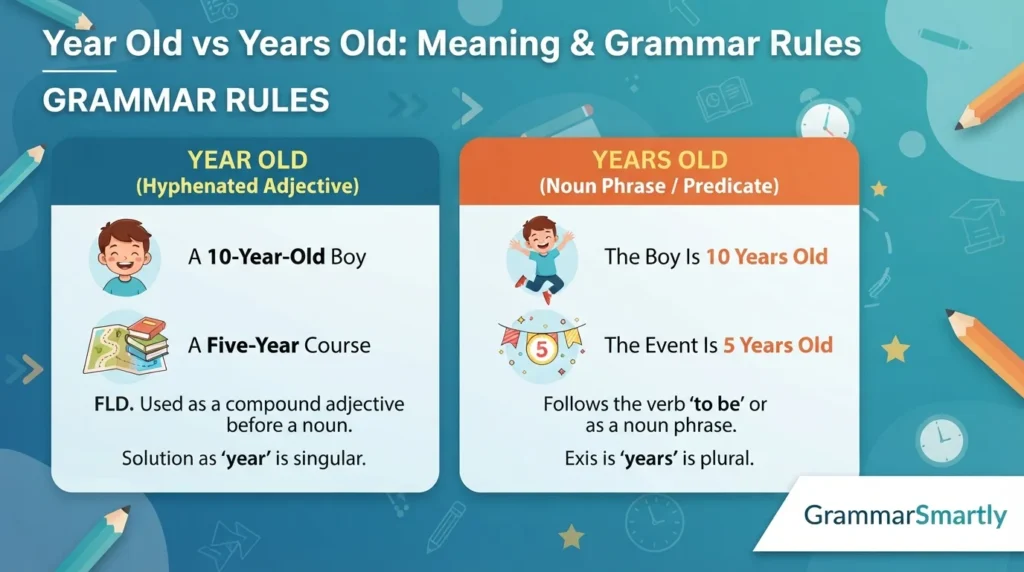
When talking about age, choosing between year old, years old, and year-old depends on how the phrase functions in a sentence. The difference is mainly grammatical rather than a difference in meaning. For example, we say, “My daughter is five years old,” but “My five-year-old daughter starts school today.” Cambridge explains that age expressions placed before a noun form a compound adjective, with the time unit remaining singular and the words hyphenated. Oxford likewise gives examples such as “fourteen years old” and “a twenty-year-old man.”
This guide explains when to use year old, years old, and year-old, how hyphenation works, what common mistakes to avoid, and how to remember the rule.
Quick Facts Table
| Feature | Details |
| Standard forms | year old, years old, and year-old, depending on sentence structure |
| Singular form | one year old |
| Plural form | two years old, ten years old, etc. |
| Compound adjective | one-year-old, ten-year-old, etc. |
| Word type | Age phrase or compound adjective |
| Main difference | Position and grammatical function |
| Hyphenation | Usually hyphenated when the age phrase comes before a noun |
| Common error | Writing five year old instead of five years old after a verb |
What Does “Year Old vs Years Old” Mean?
The phrase year old vs years old refers to the grammatical choice between singular and plural forms when describing age.
The basic distinction is:
- year old is used with one when the age expression follows a verb: The baby is one year old.
- years old is used with numbers greater than one when the age expression follows a verb: The baby is three years old.
- year-old is used as part of a compound adjective before a noun: a three-year-old baby.
- The word year stays singular in a compound age modifier, even when the number is greater than one.
So these are all grammatical:
- The child is one year old.
- The child is five years old.
- She has a one-year-old child.
- She has a five-year-old child.
The grammatical structure determines the form.
Understanding Unselect vs Deselect meaning and usage can help clarify which term fits different interface actions.
Is “Year Old” Correct?

Yes. Year old is correct when the age is one year and the expression normally comes after a verb.
Examples:
- My son is one year old.
- The puppy is one year old.
- The building is one year old.
The plural years is required when the number is greater than one:
- My son is two years old.
- The puppy is three years old.
- The building is ten years old.
Cambridge specifically gives examples such as “She’s five years old” and explains that age can be expressed with a number followed by years old.
Is “Years Old” Correct?
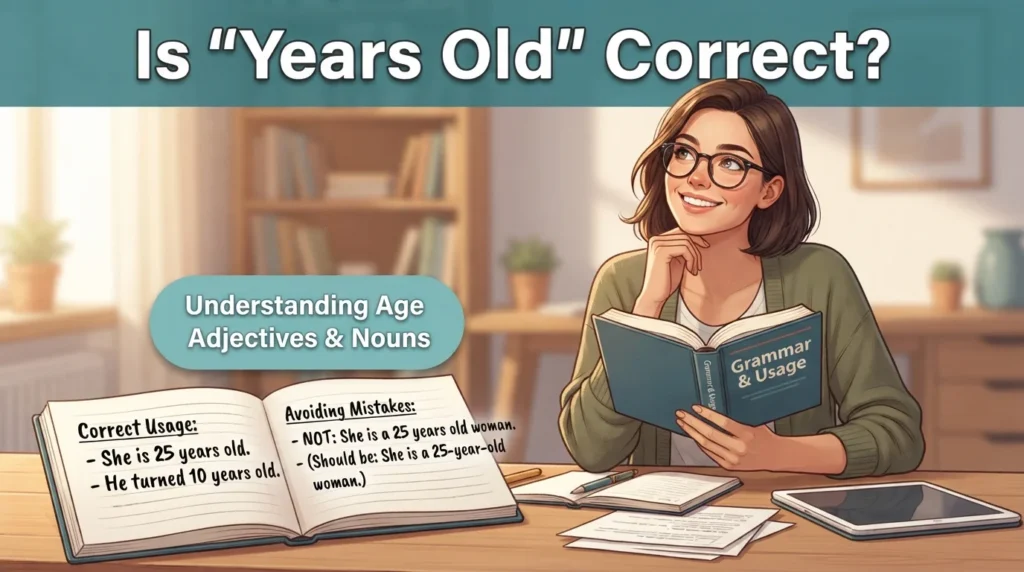
Examples include:
- She is six years old.
- He was twenty years old.
- The house is fifty years old.
- The painting is three hundred years old.
Oxford lists years old as an established expression for describing age and gives examples such as “He was 14 years old when it happened.”
With one, use the singular:
- Correct: She is one year old.
- Incorrect: She is one years old.
What Is the Correct Form?
The correct form depends on where the age expression appears.
| Sentence structure | Correct form | Example |
| After a verb, one year | one year old | He is one year old. |
| After a verb, more than one year | years old | He is seven years old. |
| Before a noun | year-old | He is a seven-year-old boy. |
| Used as a noun | year-old | The seven-year-old won the race. |
The most important rule is that year becomes singular inside a compound adjective:
a seven-year-old child
Not:
a seven-years-old child
Cambridge explicitly notes that time words such as year, month, and day remain singular when used in these compound modifiers.
Difference Between Year Old, Years Old, and Year-Old
| Feature | Year old | Years old | Year-old |
| Typical use | Age of one year | Age greater than one year | Compound age modifier |
| Number | Usually one | Usually two or more | Any specific age |
| Position | Usually after a verb | Usually after a verb | Before a noun or used substantively |
| Hyphens | No | No | Yes |
| Example | The baby is one year old. | The child is eight years old. | An eight-year-old child |
| Grammatical role | Age expression | Age expression | Compound adjective/noun |
The difference can be seen by comparing these sentences:
- The boy is ten years old.
- The ten-year-old boy is playing outside.
The first sentence states the boy’s age. The second uses the age as part of a description of the boy.
Oxford provides the same contrast with examples such as “He was 14 years old” and “a twenty-year-old man.”
Confusing Vicious vs Viscous meanings can lead to awkward word choices, especially when describing behavior or physical substances.
Meaning of “Years Old”
Years old describes the age of a person, animal, object, building, or other thing that can have an age.
Examples:
- The child is four years old.
- The dog is twelve years old.
- The bridge is more than one hundred years old.
- This computer is three years old.
The phrase normally follows a form of the verb be, such as is, are, was, or were.
Examples:
- She is nine years old.
- They are eighteen years old.
- He was twenty years old.
- The house was fifty years old.
Cambridge also notes that age can sometimes be expressed simply with a number for people, as in “I’m thirty,” while years old provides the fuller expression.
Common Contexts
You can use years old when discussing:
- someone’s current age
- someone’s age in the past
- the age of a pet
- the age of a building
- the age of an object
- the age of a work of art
- the age of a vehicle
- a particular age mentioned in a biography or story
Pronunciation
IPA Pronunciation
The relevant words have these pronunciations in standard dictionary entries:
- year: /jɪə(r)/ in Oxford’s British entry and /jɪr/ in its American entry
- old: /əʊld/ in British English and /oʊld/ in American English
Oxford lists the pronunciation of year as /jɪə(r)/ and /jɜː(r)/, with /jɪr/ for American English.
Syllable Breakdown
The main words are pronounced as follows:
- year: one syllable
- old: one syllable
- years: one syllable
The grammatical difference between year and years is therefore primarily a matter of number and sentence structure, not an additional syllable.
Pronunciation Tips
The word years ends with a consonant sound that is not present in singular year. In natural speech, the final sound can be less noticeable when followed by another word, so learners should pay attention to whether the sentence refers to one year or more than one.
Why Do People Make This Grammar Mistake?
Several features of age expressions can make them confusing.
The Same Age Can Appear in Different Structures
The age remains the same, but its grammatical form changes according to its position.
Compare:
- The child is six years old.
- The six-year-old child is sleeping.
The first uses an age expression after the verb. The second turns the age into a compound modifier before child.
The Number Can Be Misleading
Learners may naturally want to write the plural years whenever the number is greater than one. That is correct in:
She is seven years old.
But the compound adjective follows a different pattern:
She is a seven-year-old girl.
Cambridge specifically identifies this singular form as a feature of compound age expressions before nouns.
Hyphenation Adds Another Layer
Writers must decide not only between year and years, but also whether the phrase needs hyphens.
Compare:
- The child is five years old.
- She has a five-year-old child.
The first does not need hyphens. The second does.
Origin and Etymology
The distinction between year old, years old, and year-old is a grammatical development in English rather than a separate set of words with unrelated origins.
Year is an established English noun referring to a period of twelve months. Oxford lists it as a countable noun and gives age-related examples including “14 years old” and “a twenty-year-old man.”
The compound form year-old combines the age measurement with old to modify a noun. Modern English commonly uses this type of compound construction with other time measurements as well, including month-old and day-old. Cambridge gives examples such as “a three-month-old baby” and “a five-hundred-year-old violin.”
How to Remember the Correct Form
Use this simple three-part rule:
- One + after a verb: use one year old.
- More than one + after a verb: use years old.
- Age directly before a noun: use year-old.
For example:
- The car is one year old.
- The car is five years old.
- It is a five-year-old car.
Quick Memory Trick
Remember:
After the verb, count normally. Before the noun, make it a compound.
So:
- five years old
- five-year-old car
The second form keeps year singular because five-year-old functions as one compound modifier.
Word-Family Connection
The same pattern works with other time units:
- The baby is three months old.
- a three-month-old baby
- The chicks are two days old.
- two-day-old chicks
Cambridge confirms that these time words remain singular in compound modifiers before nouns.
Examples in Sentences
Age Expressions After a Verb
| No. | Example |
| 1 | My nephew is one year old today. |
| 2 | The puppy is two years old. |
| 3 | Her daughter is seven years old. |
| 4 | The museum is more than fifty years old. |
| 5 | That laptop is four years old. |
| 6 | He was nineteen years old when he started university. |
| 7 | The tree is nearly one hundred years old. |
| 8 | Their dog is eleven years old. |
| 9 | The painting is over two hundred years old. |
| 10 | She will be eighteen years old next month. |
| 11 | The company is twenty-five years old this year. |
| 12 | The building was only three years old when it was renovated. |
| 13 | Our car is six years old but still runs well. |
| 14 | The child was five years old when the family moved. |
| 15 | The bridge is more than a century old. |
Compound Age Modifiers
| No. | Example |
| 1 | My one-year-old nephew loves music. |
| 2 | They adopted a two-year-old dog. |
| 3 | She has a seven-year-old daughter. |
| 4 | We bought a four-year-old laptop. |
| 5 | A nineteen-year-old student won the scholarship. |
| 6 | The museum displays a two-hundred-year-old painting. |
| 7 | He drives a six-year-old car. |
| 8 | They rescued an eleven-year-old dog. |
| 9 | The story features a twelve-year-old protagonist. |
| 10 | A twenty-five-year-old company organized the event. |
| 11 | The renovation preserved the original fifty-year-old structure. |
| 12 | She interviewed a five-year-old child for the project. |
| 13 | They moved into a three-year-old apartment building. |
| 14 | The team recruited a nineteen-year-old goalkeeper. |
| 15 | The gallery acquired a century-old manuscript. |
Notice that year stays singular in compound modifiers, even when the number is large.
Common Mistakes to Avoid
- Wrong: She is five year old.
Correct: She is five years old. - Wrong: She is a five years old girl.
Correct: She is a five-year-old girl. - Wrong: He has a ten-years-old son.
Correct: He has a ten-year-old son. - Wrong: The building is twenty-year-old.
Correct: The building is twenty years old. - Wrong: My daughter is one years old.
Correct: My daughter is one year old. - Wrong: A three years old child was waiting outside.
Correct: A three-year-old child was waiting outside.
The main errors involve either incorrect pluralization or incorrect hyphenation.
Similar Commonly Confused Forms
| Common Error | Correct Form | Reason for Confusion |
| five year old | five years old | Missing plural s after the verb |
| five years old child | five-year-old child | Compound modifier needs singular year and hyphens |
| five-years-old child | five-year-old child | Compound age modifier does not pluralize year |
| one years old | one year old | One takes the singular noun |
| one-year old child | one-year-old child | Compound modifier needs both hyphens |
| ten-year-old | ten-year-old | Correct compound form |
| ten years old | ten years old | Correct post-verb age expression |
Related Words
Synonyms
There is no single synonym that can replace years old in every sentence. Depending on context, age can also be expressed with phrases such as:
- of age
- aged
- at the age of
- in his/her/their twenties
These expressions are not always interchangeable.
For example:
- She is twenty years old.
- She is twenty.
- She is a twenty-year-old student.
- At the age of twenty, she moved abroad.
The grammatical structures differ even though they can refer to the same age.
Antonyms
There is no direct grammatical antonym for years old. When discussing age, the contrasting concept may be expressed with terms such as young or younger, depending on the context.
Related Forms
Useful related constructions include:
- one year old
- five years old
- five-year-old
- five-year-olds
- of five years’ age
- at the age of five
- in her twenties
- aged five
Oxford and Cambridge both document several of these age-related constructions.
Grammar Tips
Use “Years Old” After a Linking Verb
When the age follows be, use the appropriate singular or plural form:
- He is one year old.
- He is six years old.
- They are six years old.
- She was twenty years old.
Use “Year-Old” Before a Noun
When the age directly modifies a noun, use the singular year and hyphens:
- a six-year-old child
- a twenty-year-old student
- a fifty-year-old building
Use “Year-Old” as a Noun
The compound can also stand on its own as a noun:
- The six-year-old won the competition.
- Two five-year-olds were playing nearby.
Do Not Pluralize “Year” Inside the Compound
Even though six refers to six years, the compound is:
a six-year-old child
not:
a six-years-old child
This singular form is a standard feature of compound age expressions.
Writing Tips
When writing essays, articles, emails, or professional documents, check the position of the age phrase before choosing its form.
Before a Noun
Use:
a twelve-year-old student
After a Verb
Use:
The student is twelve years old.
In Formal Writing
Both structures are standard. Choose whichever fits the sentence naturally.
For proofreading, look for the noun immediately after the age expression. If the age directly modifies that noun, the compound form usually needs singular year and hyphens.
Quick Spelling Checklist
| Check | Correct Form or Rule |
| Standard spelling | year, years, or year-old, depending on structure |
| Common misspelling | five year old when used after a verb |
| Meaning | Describes someone’s or something’s age |
| Pronunciation | year and years are distinct singular/plural forms |
| Word type | Age expression or compound modifier |
| Key spelling pattern | years old after a verb; year-old before a noun |
| Common usage | She is five years old / a five-year-old girl |
| Final proofreading check | Check number, position, singular/plural form, and hyphens |
Key Takeaways
- Year old is correct with one when stating an age after a verb: He is one year old.
- Years old is used with ages greater than one after a verb: He is five years old.
- Year-old is used in a compound modifier before a noun: a five-year-old boy.
- The word year remains singular inside the compound adjective.
- Age compounds are normally hyphenated before a noun.
- Do not write five-years-old child.
- Do not write five year old when the correct structure is five years old.
- The same principle applies to related expressions such as three-month-old and two-day-old.
Conclusion
The choice between year old, years old, and year-old depends on the grammatical structure of the sentence. When stating an age after a verb, use one year old for a one-year age and years old for ages greater than one. When the age directly describes a noun, use the compound form year-old, keeping year singular and connecting the words with hyphens. Thus, “The child is seven years old” and “the seven-year-old child” are both correct, but they perform different grammatical jobs. The easiest memory strategy is to check the position of the age phrase: after the verb, use the normal singular or plural form; before a noun, use singular year-old. This simple check prevents most age-expression errors.
Frequently Asked Questions
Is “year old” grammatically correct?
Yes, year old is correct when referring to an age of exactly one year in a construction such as “The baby is one year old.” The singular noun year agrees with the number one. However, when the age is greater than one, use years old, as in “The baby is three years old.”
Is it “one year old” or “one years old”?
The correct expression is one year old. Because one is singular, the noun year must also be singular. For example, “My daughter is one year old.” The plural form years is used with numbers greater than one, such as “My daughter is two years old.”
Is it “five year old” or “five years old”?
When the phrase follows a verb, the correct form is five years old: “My son is five years old.” If the age comes directly before a noun, use five-year-old: “My five-year-old son starts school today.” The position of the phrase determines both the plural form and the hyphenation.
Why is “five-year-old” singular?
In five-year-old, the entire expression functions as a compound modifier describing a noun. English keeps the measurement unit singular inside this type of compound. Therefore, we write “a five-year-old child,” not “a five-years-old child.” Cambridge specifically explains that time words remain singular when they form compound modifiers before nouns.
Should “year old” have a hyphen?
It depends on its grammatical position. Years old does not normally need hyphens when it follows a verb: “She is eight years old.” When an age expression directly modifies a noun, use hyphens: “She is an eight-year-old girl.” The hyphens show that the words work together as one compound modifier.
Is “ten-years-old” correct before a noun?
No. Before a noun, the standard form is ten-year-old, with year singular. For example, write “a ten-year-old student,” not “a ten-years-old student.” The plural years belongs in the separate age expression “The student is ten years old.”
Is “years old” always plural?
No. The expression years old specifically contains the plural noun years, so it is normally used with an age greater than one. For exactly one year, use one year old. The distinction is the same as with ordinary singular and plural nouns: one year versus two years.
Can “year-old” be used without a noun?
Yes. A compound age expression can function substantively, as in “The five-year-old won the race.” Here, five-year-old refers to a five-year-old person, with the noun understood from context. Oxford gives the related example five-year-olds for people of that age.
Which is correct: “a two-year-old” or “a two-years-old”?
The correct form is a two-year-old. The phrase is a compound modifier, so year remains singular and the components are hyphenated. For example, “They adopted a two-year-old dog.” By contrast, when the phrase follows the verb, write “The dog is two years old.”
Can I say “She is five”?
Yes. For people, English commonly allows a person’s age to be stated simply as a number, such as “She is five.” You can also say “She is five years old.” Cambridge notes that people can be described with a number alone, while years old provides the fuller age expression.
What is the easiest way to remember “year old” vs “years old”?
Ask where the age phrase appears. If it follows a verb, use the ordinary singular or plural form: “He is one year old” or “He is six years old.” If it comes immediately before a noun, use year-old: “a six-year-old boy.” This position-based rule handles most common cases.
Is “year old” different from “years old” in meaning?
They both describe age, so the basic meaning is the same. The difference is grammatical number and structure. One year old describes an age of one year, while years old is normally used for ages greater than one. Before a noun, both become the compound form year-old, regardless of the number.