
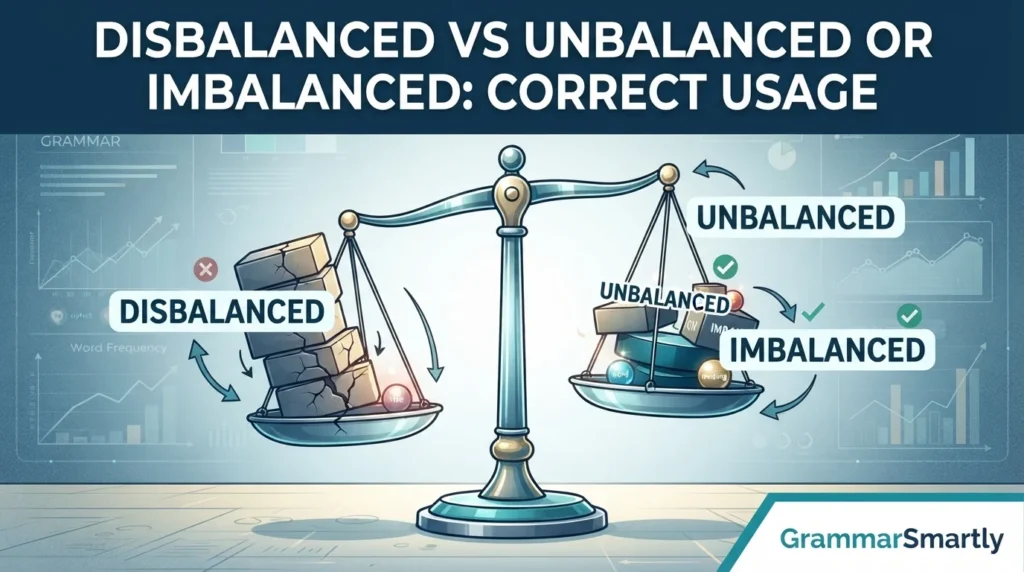
The confusion in disbalanced vs unbalanced or imbalanced comes from the fact that all three forms are found in English, but they do not have the same status or practical usefulness in modern writing. Unbalanced is the most established everyday choice for something that is not balanced, while imbalanced is also a standard adjective and is particularly useful when describing unequal or disproportionate arrangements. Disbalanced is a legitimate English form connected with the verb disbalance, but it is uncommon in contemporary general English. Major dictionaries clearly document unbalanced, imbalanced, and disbalance, although they differ in how prominently they treat the related forms.
This guide explains what each form means, when to use it, why disbalanced can sound unusual, how the words are pronounced, and which choice is safest in academic, professional, and everyday writing.
Quick Facts: Disbalanced vs Unbalanced vs Imbalanced
| Feature | Disbalanced | Unbalanced | Imbalanced |
| Standard status | Legitimate but uncommon | Standard modern English | Standard modern English |
| Word type | Adjective/past participle | Adjective | Adjective |
| Basic meaning | Made or left out of balance | Not balanced | Not balanced or disproportionately arranged |
| Commonness in general writing | Low | High | Moderate to high |
| Best general choice | Usually avoid unless context supports it | Usually the safest choice | Useful for unequal distributions or proportions |
| Common contexts | Specialized, historical, or uncommon usage | Physical balance, diets, reporting, accounts, systems | Distributions, systems, groups, proportions |
| Is it a spelling error? | No | No | No |
| Main issue | Uncommon and potentially distracting | Broad, established usage | Sometimes more specific in emphasis |
The important point is that disbalanced is not simply an incorrect spelling of unbalanced or imbalanced. It is associated with the verb disbalance, which Merriam-Webster records as a noun meaning a lack of balance. Broader lexical evidence also records disbalance as a verb meaning to cause something to become unbalanced, with disbalanced as its past form or participle.
Understanding Optimization vs Optimisation spelling differences can help you choose the correct form confidently.
What Does “Disbalanced vs Unbalanced Or Imbalanced” Mean?
The three words overlap semantically, but their usage patterns differ.
Disbalanced
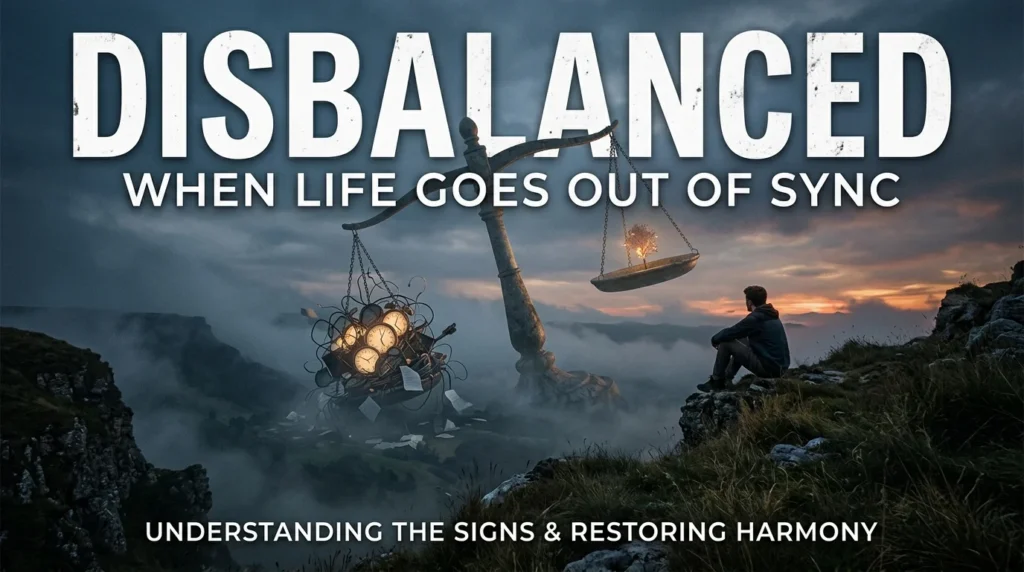
Disbalanced is the past-tense or past-participle form associated with disbalance. In lexical records, disbalance means to cause something to become unbalanced. Therefore, disbalanced can describe something that has been put out of balance.
For example:
- The uneven load disbalanced the machine.
- The structure became disbalanced after the support was removed.
However, this form is relatively uncommon in ordinary contemporary English. That means a reader may find it unusual even when it is understandable.
Unbalanced

It can describe something that is physically unstable, unequal, improperly arranged, or lacking equilibrium. Oxford gives examples involving an unbalanced article and an unbalanced diet, while Merriam-Webster includes physical equilibrium and financial accounts among its senses.
Examples include:
- The table is unbalanced.
- She follows an unbalanced diet.
- The article presents an unbalanced view.
- The accountant discovered an unbalanced account.
Understanding the Vicious vs Viscous meaning and usage can help prevent confusion when describing behavior or liquids.
Imbalanced
Imbalanced also means not balanced. It is particularly natural when the emphasis is on an unequal distribution, disproportion, or lack of symmetry between elements.
Merriam-Webster defines imbalanced as “not balanced” and gives a specialized example involving disproportionate representation. Collins likewise describes imbalanced situations as ones in which elements are not evenly or fairly arranged.
Examples include:
- The team has an imbalanced roster.
- The population has an imbalanced age distribution.
- The chemical mixture became imbalanced.
- The system has an imbalanced allocation of resources.
I will provide a URL. Read the URL, identify the primary keyword from its slug, and convert it into a properly capitalized, human-readable keyword. Then create 5 unique internal linking sentences that naturally fit at the end of an article introduction. For each sentence, create a different long-tail version of the extracted keyword by adding relevant, natural details based on the keyword’s meaning and search intent. Make every long-tail keyword unique, with no repeated anchor text across the 5 sentences, and keep each variation closely related to the original keyword without changing its meaning. Use the long-tail keyword as the exact anchor text and wrap only that keyword in this HTML format: Long-Tail Keyword. Do not link any other words or the entire sentence. Use a standard follow link and do not add nofollow, ugc, or sponsored. Keep each sentence between 12 and 22 words, make all 5 sentences completely different in structure and wording, and ensure they sound natural, human-written, engaging, and SEO-friendly. Make the long-tail anchor text descriptive and relevant by naturally adding details such as meaning, pronunciation, differences, examples, usage, spelling, or common mistakes when appropriate, but do not force the same modifiers or long-tail pattern into every anchor text. Do not mention any website name, brand name, or domain, and avoid generic or templated calls to action such as “Read more,” “Learn more,” “Click here,” “Explore more,” “Check out,” “Discover more,” or similar phrases. Return only the final output as 5 bullet points, with no headings, explanations, introductions, or additional text. URL:
Is “Disbalanced” Correct?
Yes, disbalanced is an attested English form, but it is uncommon.
This distinction matters. Calling disbalanced simply “wrong” would be too absolute. Lexical records document disbalance as an English noun and verb, and disbalanced as its past form and participle. Merriam-Webster specifically lists disbalance as a noun meaning a lack of balance or an imbalance.
At the same time, unbalanced is much more firmly established in major contemporary learner dictionaries. Oxford and Cambridge both provide substantial entries for unbalanced, and Merriam-Webster treats it as a standard adjective.
Therefore:
Disbalanced is possible English, but unbalanced is normally the better choice in ordinary modern writing.
If you are writing an essay, report, email, article, or examination answer, unbalanced or imbalanced will usually communicate your meaning more naturally.
Are “Unbalanced” and “Imbalanced” Both Correct?
Yes. Both are standard English adjectives.
They can sometimes be substituted for one another, but context determines which sounds more natural.
Use unbalanced when you mean:
- physically unstable
- not in equilibrium
- lacking proper balance
- giving disproportionate attention to one side
- nutritionally unequal
- financially not reconciled or adjusted
Use imbalanced when the emphasis is often on:
- unequal proportions
- unequal distribution
- disproportion
- unequal representation
- a system whose elements are not properly balanced
The distinction is not an absolute grammatical rule. There are contexts where either word works.
For example:
- The diet is unbalanced.
- The diet is imbalanced.
Both can communicate that the diet lacks an appropriate balance.
But:
- The chair is unbalanced.
is much more natural than:
- The chair is imbalanced.
Likewise, in discussions of distribution:
- The workforce is imbalanced.
can sound especially natural because the focus is on unequal representation or distribution.
What Is the Correct Spelling?
The three spellings are:
disbalanced
unbalanced
imbalanced
None should be “corrected” automatically into one of the others.
The spelling problem is therefore mainly a word-choice problem, not a simple spelling mistake.
The easiest way to approach the words is to recognize their bases:
- dis + balance + d = disbalanced
- un + balance + d = unbalanced
- im + balance + d = imbalanced
The spelling of the base balance remains important in all three forms.
A common mistake is to assume that because disbalanced looks unusual, it must be a typo. Its rarity explains why it may trigger doubt, but rarity and incorrectness are not the same thing.
Difference Between the Forms
| Feature | Disbalanced | Unbalanced | Imbalanced |
| Basic idea | Caused to become out of balance | Not balanced | Not balanced or disproportionately arranged |
| Part of speech | Adjective/past participle | Adjective | Adjective |
| Related verb | Disbalance | Unbalance | Imbalance |
| Everyday use | Uncommon | Very common | Common in appropriate contexts |
| Physical objects | Possible but unusual | Very natural | Less usual |
| Unequal distribution | Possible | Natural | Particularly natural |
| Biased presentation | Unusual | Natural | Possible but less typical |
| Financial accounts | Unusual | Natural | Possible depending on context |
| Recommended for general writing | Usually no | Yes | Yes, when context fits |
The simplest distinction
Think of the three forms this way:
Unbalanced is the broad everyday adjective.
Imbalanced emphasizes an imbalance, often involving unequal proportions, distribution, or representation.
Disbalanced emphasizes the result of something being put out of balance, but the word is uncommon enough that a more familiar alternative is usually preferable.
This does not mean that disbalanced has a completely separate meaning. The three forms overlap considerably.
Meaning of “Unbalanced”
Unbalanced has several established uses.
Physical Meaning
Something can be unbalanced when it is unstable or not properly distributed.
- The ladder felt unbalanced on the uneven ground.
- An unbalanced load can make the vehicle difficult to control.
Cambridge specifically includes the sense of something that is not firm and may suddenly fall or change position.
Strong descriptions of emotional isolation often rely on creative Similes for Loneliness and solitude to communicate feelings clearly.
Unequal or One-Sided Meaning
Unbalanced can describe an argument, report, article, or presentation that gives excessive importance to one side or aspect.
- The report provides an unbalanced account of the dispute.
- The documentary was criticized for presenting an unbalanced view.
Oxford explicitly records this use.
Dietary Meaning
An unbalanced diet lacks an appropriate combination of food types or amounts.
- Eating the same few foods every day can result in an unbalanced diet.
Cambridge records this dietary use.
Financial Meaning
An account can be described as unbalanced when its credits and debits do not correspond properly.
- The auditor found an unbalanced account during the review.
Merriam-Webster records this accounting sense.
Meaning of “Imbalanced”
Imbalanced describes something that is not balanced, especially where elements are unequal or disproportionately arranged.
Common contexts include:
Distribution
- The region has an imbalanced distribution of medical facilities.
Representation
- The committee has an imbalanced representation of different departments.
Systems
- The network became imbalanced after demand shifted sharply.
Proportions
- The experiment produced an imbalanced mixture.
Collins describes imbalanced in terms of elements that are not evenly or fairly arranged, while Merriam-Webster gives the broad definition “not balanced.”
Pronunciation
Unbalanced
Oxford gives the pronunciation:
UK: /ˌʌnˈbælənst/
US: /ˌʌnˈbælənst/
It can be thought of approximately as:
un-BAL-ənst
The main stress falls on BAL.
Imbalanced
Collins gives:
UK: /ɪmˈbælənst/
US: /ɪmˈbælənst/
Approximately:
im-BAL-ənst
Again, the strongest stress is on BAL.
Disbalanced
Because disbalanced is much less common, pronunciation information is less consistently presented in the major learner-dictionary sources consulted for this comparison. It follows the pronunciation pattern of disbalance plus the regular past-tense ending, but there is little practical reason for learners to memorize a special pronunciation when the word itself is uncommon.
Pronunciation Tip
Do not choose between unbalanced and imbalanced solely from sound.
Both contain the clearly recognizable element balanced, but their prefixes differ:
- un- → unbalanced
- im- → imbalanced
- dis- → disbalanced
The meaning and context should determine your choice.
Why Do People Confuse These Words?
The confusion is understandable because all three forms contain balance and all three can relate to a lack of balance.
Several factors contribute to the uncertainty.
The Shared Base Word
The common element is balance:
- balance
- balanced
- unbalanced
- imbalanced
- disbalance
- disbalanced
When several words share the same base but take different prefixes, writers may assume that the prefixes are interchangeable.
They are not always interchangeable in actual usage.
Prefix Similarity
English has several prefixes that can express negation, reversal, separation, or removal.
That can make combinations such as unbalanced, imbalanced, and disbalanced look equally plausible.
But English vocabulary is not built by freely attaching every possible prefix to every word. Established usage determines which forms are natural.
Rarity of “Disbalanced”
A reader who rarely encounters disbalanced may assume it is a spelling error.
That reaction is understandable, but it does not prove the form is incorrect. Lexical sources document disbalance and its related forms.
Overlap in Meaning
Both unbalanced and imbalanced can mean “not balanced.”
Because their meanings overlap, writers sometimes wonder whether one is technically wrong.
It is better to view them as legitimate overlapping choices with different patterns of use, rather than as a correct-versus-incorrect pair.
Origin and Etymology
The words are built around the English word balance.
Unbalanced
Unbalanced is formed from un- + balanced. Merriam-Webster lists unbalanced as a long-established English word and gives a first-known-use date of 1650.
Imbalanced
Merriam-Webster gives the etymology of imbalanced as in- + balanced. The prefix appears as im- before b, a form consistent with the spelling pattern seen in English words beginning with certain consonants.
Disbalanced
Disbalanced is related to disbalance, which Merriam-Webster analyzes as dis- + balance. Merriam-Webster defines disbalance as a lack of balance or imbalance when used as a noun. Broader lexical records also document the verb sense “to cause to be unbalanced.”
The important lesson is that these forms have genuine morphological structures. The unusual appearance of disbalanced does not by itself make it a spelling mistake.
How to Remember the Correct Choice
Instead of memorizing one “correct” word, connect each form with its typical context.
Memory Trick
Unbalanced = generally not balanced.
Imbalanced = unequal or disproportionate.
Disbalanced = put out of balance, but uncommon.
A useful mental shortcut is:
Use “unbalanced” by default, “imbalanced” when unequal distribution is the focus, and “disbalanced” only when you have a specific reason to use the less common form.
Word-Family Connection
| Base | Related Form | Example |
| balance | balanced | The scales are balanced. |
| balance | imbalance | There is an imbalance in resources. |
| balance | imbalanced | The distribution is imbalanced. |
| balance | unbalance | The movement may unbalance the rider. |
| balance | unbalanced | The bicycle is unbalanced. |
| balance | disbalance | The verb disbalance is documented but uncommon. |
| balance | disbalanced | The less common past form of disbalance. |
Oxford explicitly lists unbalance as a verb meaning to make something no longer balanced or to make someone or something unsteady.
Examples in Sentences
Because all three forms have different practical profiles, the examples below focus on real distinctions rather than treating disbalanced as a simple misspelling.
| Form | Example |
| Unbalanced | The uneven floor left the bookshelf unbalanced. |
| Unbalanced | The article gave an unbalanced account of the investigation. |
| Unbalanced | The athlete struggled after lifting an unbalanced load. |
| Unbalanced | The nutritionist warned that the meal plan was unbalanced. |
| Unbalanced | The financial statement remained unbalanced after the adjustment. |
| Unbalanced | The boat became unbalanced when several passengers moved to one side. |
| Unbalanced | The presentation seemed unbalanced because it ignored the strongest counterargument. |
| Unbalanced | The machine stopped because one component had become unbalanced. |
| Imbalanced | The survey revealed an imbalanced distribution of respondents. |
| Imbalanced | The organization had an imbalanced allocation of resources. |
| Imbalanced | The ecosystem became imbalanced after the introduction of a new species. |
| Imbalanced | The study examined an imbalanced sample of participants. |
| Imbalanced | The team’s imbalanced lineup left it vulnerable in defense. |
| Imbalanced | The region has an imbalanced distribution of healthcare services. |
| Imbalanced | The chemical process produced an imbalanced mixture. |
| Disbalanced | The historical account uses disbalanced to describe something that has been put out of equilibrium. |
| Disbalanced | The less common term disbalanced can function as the past form of disbalance. |
| Disbalanced | In specialized writing, a system may be described as disbalanced after an existing equilibrium has been disturbed. |
| Disbalanced | The researcher encountered the word disbalanced in older technical prose. |
| Disbalanced | Modern readers may prefer unbalanced to the uncommon disbalanced. |
These examples illustrate an important point: the fact that a word can be formed and understood does not mean it is equally natural in every context.
Common Mistakes to Avoid
- Do not automatically “correct” disbalanced to unbalanced without considering context.
- Do not assume that imbalanced is a misspelling of unbalanced.
- Do not use disbalanced simply because you want a more formal-sounding version of unbalanced.
- Do not treat the three prefixes as interchangeable.
- Do not assume that imbalanced must always replace unbalanced when discussing unequal proportions.
- Do not use unbalanced when the intended meaning is a completely different word such as unstable, biased, or unequal without checking the context.
- Avoid describing a person as unbalanced when a more precise and respectful description is available, especially when discussing mental health.
- Remember that unbalance is a verb, while unbalanced is commonly an adjective and also the past form of that verb. Oxford documents these grammatical forms.
Similar Commonly Misspelled or Confused Forms
The most useful comparisons are words built from balance and related prefixes.
| Common Error or Confusion | Correct Form | Reason for Confusion |
| unbalenced | unbalanced | The vowel pattern in balance can be misremembered. |
| imbalenced | imbalanced | Writers may alter the final vowel before adding -ed. |
| disbalenced | disbalanced | The same spelling uncertainty affects the base balanced. |
| inbalanced | imbalanced | The prefix is spelled im- before b. |
| unbalance | unbalanced | Writers may confuse the base verb with its adjective/past form. |
| imbalance | imbalanced | The noun and adjective have different endings. |
| disbalance | disbalanced | Writers may confuse the verb and past form. |
The especially important pair is inbalanced vs imbalanced. The standard adjective is imbalanced, not inbalanced, and Merriam-Webster gives its etymology as in- plus balanced.
Related Words
Synonyms
Depending on the intended meaning, useful alternatives include:
- uneven
- unequal
- disproportionate
- unstable
- lopsided
- biased
- asymmetrical
These are not interchangeable in every sentence.
For example:
- an unbalanced table can mean physically unstable.
- an uneven table may suggest an irregular surface or unequal legs.
- a biased report focuses on unfair preference for one side.
- an imbalanced distribution focuses on unequal allocation.
Choosing a synonym therefore requires attention to the specific meaning.
Antonym
The clearest general antonym is:
balanced
Depending on context, related opposites can include:
- even
- equal
- proportionate
- stable
- fair
Again, the exact opposite depends on the sense being discussed.
Related Forms
Important related words include:
- balance, noun and verb
- balanced, adjective and past form of balance
- imbalance, noun
- imbalanced, adjective
- unbalance, verb
- unbalanced, adjective and past form of unbalance
- disbalance, noun and verb
- disbalanced, past form/past participle associated with disbalance
Oxford confirms the verb forms of unbalance, including unbalanced as both past simple and past participle.
Grammar Tips
The grammatical role of the word matters.
“Unbalanced” as an Adjective
- The machine is unbalanced.
- She wrote an unbalanced report.
Here, unbalanced describes a noun or subject.
“Unbalanced” as a Verb Form
Because unbalance is a verb, unbalanced can also be its past tense or past participle.
- The sudden movement unbalanced the cyclist.
- The cyclist was unbalanced by the sudden movement.
Oxford lists these forms directly.
“Imbalance” vs “Imbalanced”
Do not confuse the noun with the adjective.
Noun: There is an imbalance in funding.
Adjective: The funding distribution is imbalanced.
The ending changes because the grammatical role changes.
“Balance” vs “Balanced”
Likewise:
- The machine needs balance.
- The machine is balanced.
The first uses the noun, while the second uses the adjective.
Writing Tips
For academic and professional writing, choose the most familiar established term that accurately expresses your meaning.
In Essays
Prefer unbalanced when discussing a one-sided argument or presentation:
The article provides an unbalanced interpretation of the evidence.
In Academic Research
Imbalanced can be appropriate when discussing unequal samples, distributions, representation, or proportions:
The researchers noted that the dataset was imbalanced across the categories.
In Professional Reports
Use unbalanced for ordinary physical, financial, or general situations:
The account remains unbalanced.
Use imbalanced when the focus is on unequal allocation:
The department has an imbalanced distribution of staff.
In Emails
Avoid disbalanced unless the context specifically calls for it. A familiar word is generally clearer:
The current workload is unbalanced across the team.
In Exams
If you are uncertain, unbalanced is usually the safest general choice when you simply mean “not balanced.” If the question concerns unequal proportions or distribution, imbalanced may be more precise.
Quick Spelling Checklist
| Check | Correct Form or Rule |
| Standard spelling | unbalanced / imbalanced |
| Less common legitimate form | disbalanced |
| Common spelling problem | Changing the ending of balanced or confusing prefixes |
| Basic meaning | Not balanced |
| Word type | Adjectives; some forms also function as verb forms |
| Key spelling pattern | un- + balanced, im- + balanced, dis- + balanced |
| Common usage | Unbalanced is the broadest everyday choice |
| Distribution/proportion | Imbalanced is often appropriate |
| Final proofreading check | Confirm both meaning and grammatical role |
Key Takeaways
- Unbalanced, imbalanced, and disbalanced are not simply three spellings of one word.
- Unbalanced is the most broadly established everyday adjective for something that is not balanced.
- Imbalanced is also a standard adjective and is especially useful for unequal or disproportionate arrangements.
- Disbalanced is an attested English form related to disbalance, but it is uncommon in contemporary general writing.
- Do not call disbalanced simply a nonexistent word.
- Use unbalanced when you want the safest general-purpose choice.
- Use imbalanced when unequal distribution or proportion is the central idea.
- Remember the forms by connecting each prefix with its typical usage rather than treating the prefixes as interchangeable.
Conclusion
The main lesson from disbalanced vs unbalanced or imbalanced is that spelling alone does not settle the question. All three forms have a documented relationship with balance, but their modern usefulness differs. Unbalanced is the safest general-purpose adjective and works naturally for physical instability, one-sided descriptions, diets, accounts, and many other contexts. Imbalanced is also standard and often fits especially well when discussing unequal distributions, proportions, or representation. Disbalanced is a legitimate but uncommon form associated with disbalance, so it should not automatically be labeled a spelling error.
For everyday, academic, and professional writing, the easiest memory strategy is simple: choose unbalanced when you mean generally “not balanced,” choose imbalanced when unequal arrangement is the focus, and use disbalanced only when its less common wording is genuinely appropriate.
Frequently Asked Questions
Is “disbalanced” a correct English word?
Yes. Disbalanced is an attested English form related to the verb disbalance. Lexical sources document disbalance and its past form disbalanced. However, it is uncommon in contemporary general English, so many writers will find unbalanced more natural.
Is “unbalanced” the safest word to use?
Usually, yes, when your intended meaning is simply “not balanced.” Oxford, Cambridge, and Merriam-Webster all document unbalanced as a standard adjective with several established meanings. It can describe physical instability, unequal emphasis, dietary composition, and other forms of imbalance.
Is “imbalanced” grammatically correct?
Yes. Imbalanced is a standard adjective. Merriam-Webster defines it as “not balanced,” while Collins uses it for situations in which elements are not evenly or fairly arranged. It is particularly useful when discussing unequal distributions, proportions, representation, or systems.
Should I use “unbalanced” or “imbalanced”?
Choose according to context. Unbalanced is broader and more natural in everyday English. Imbalanced often works particularly well when the focus is on unequal distribution or disproportion. In many contexts, both can be grammatically acceptable, so the choice is often one of meaning, emphasis, and natural usage rather than correctness.
Is “disbalanced” a misspelling of “unbalanced”?
No. It is not accurate to call disbalanced simply a misspelling. It is associated with the documented verb disbalance, although the form is uncommon today. The practical issue is therefore not basic spelling correctness but whether the unusual word is appropriate for the intended audience and context.
What is the difference between “imbalance” and “imbalanced”?
Imbalance is a noun, while imbalanced is an adjective. For example, There is an imbalance in the distribution uses the noun. The distribution is imbalanced uses the adjective. The two words belong to the same word family but serve different grammatical functions.
What is the difference between “unbalance” and “unbalanced”?
Unbalance is a verb meaning to make something no longer balanced or to make someone or something unsteady. Unbalanced can function as the adjective describing that condition and is also the past tense or past participle of unbalance. Oxford documents these verb forms.
How do you pronounce “unbalanced”?
Oxford gives both British and American pronunciation as /ˌʌnˈbælənst/. A beginner-friendly approximation is un-BAL-ənst, with the main stress on the first syllable of balanced.
How do you pronounce “imbalanced”?
Collins gives both British and American pronunciation as /ɪmˈbælənst/. An approximate learner-friendly pronunciation is im-BAL-ənst. The strongest stress falls on BAL.
Can I use “unbalanced” for a report or argument?
Yes. This is one of the established meanings of unbalanced. If a report, article, or argument gives disproportionate attention to one side or aspect, describing it as unbalanced is natural. Oxford specifically records this use, including examples involving articles and presentations of information.
Which word should I use in formal writing?
For most formal writing, unbalanced is the safest general choice when you mean “not balanced.” Use imbalanced when the context specifically concerns unequal distribution, proportions, or representation. Although disbalanced is attested, its relative rarity can make it distracting, so a familiar alternative is usually preferable unless the context specifically supports it.
What is the easiest way to remember these words?
Remember the three-way distinction: unbalanced means generally not balanced, imbalanced often highlights unequal distribution or proportion, and disbalanced is an uncommon form connected with something being put out of balance. When you simply need a normal everyday adjective, unbalanced is usually the safest choice.






1 thought on “Disbalanced vs Unbalanced Or Imbalanced: Correct Usage”