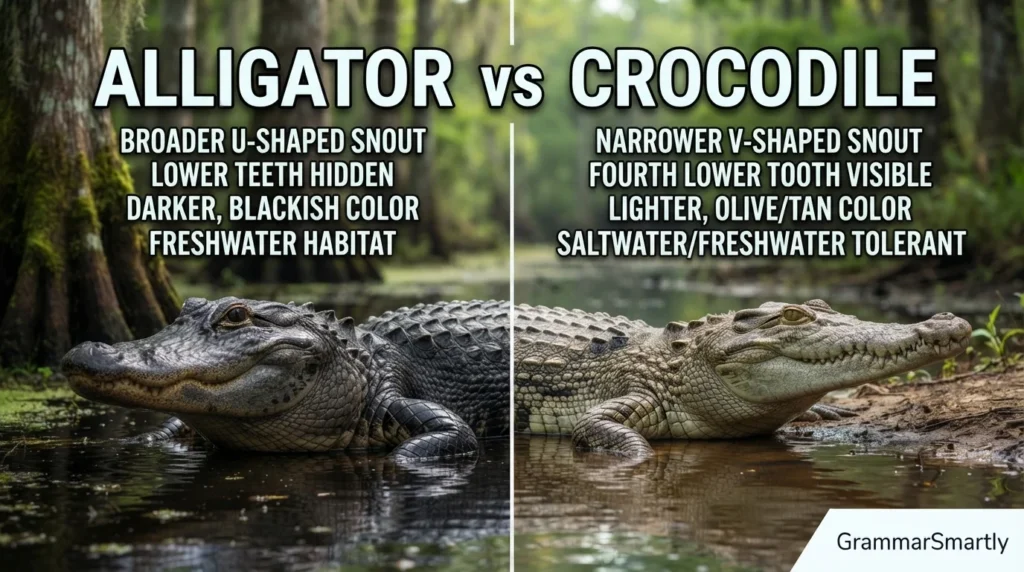
If you are comparing Alligator vs Crocodile, neither word is a misspelling. Both are standard English nouns for closely related reptiles, but they refer to different animal groups. The confusion comes from their similar appearance, shared aquatic lifestyle, and membership in the broader crocodilian group. An alligator generally has a broader, more rounded snout, while crocodiles typically have a longer, narrower snout. Their teeth also provide an important visual distinction when their mouths are closed.
This guide explains the meaning of alligator and crocodile, their pronunciation, biological differences, word origins, common usage, example sentences, and practical ways to remember which term to use.
Context becomes much clearer when you understand Vicious vs Viscous examples and correct word choice in different situations._
Quick Facts: Alligator vs Crocodile
| Feature | Details |
| Standard Form 1 | alligator |
| Standard Form 2 | crocodile |
| Word Type | Nouns |
| Meaning | Names for different groups of crocodilian reptiles |
| Alligator Snout | Generally broad, rounded, and U-shaped |
| Crocodile Snout | Generally longer, narrower, and more V-shaped |
| Main Difference | They belong to different taxonomic families and have recognizable physical differences |
| Usage Status | Both are standard modern English |
| Common Error | Using alligator and crocodile as though they were interchangeable |
What Does “Alligator vs Crocodile” Mean?
Alligator vs Crocodile is a comparison between two different but closely related reptiles.
What does “alligator” mean?
An alligator is a large crocodilian reptile. Modern alligators include the American alligator and the Chinese alligator. Cambridge describes an alligator as a large reptile found in and around rivers and lakes in warm parts of America and China, with a snout that is shorter and somewhat broader than that of a crocodile.
The word alligator can therefore refer specifically to an animal belonging to the alligator group rather than to any crocodilian.
For example:
- An alligator was resting beside the pond.
- The wildlife center cares for several alligators.
- The photograph shows an American alligator.
What does “crocodile” mean?
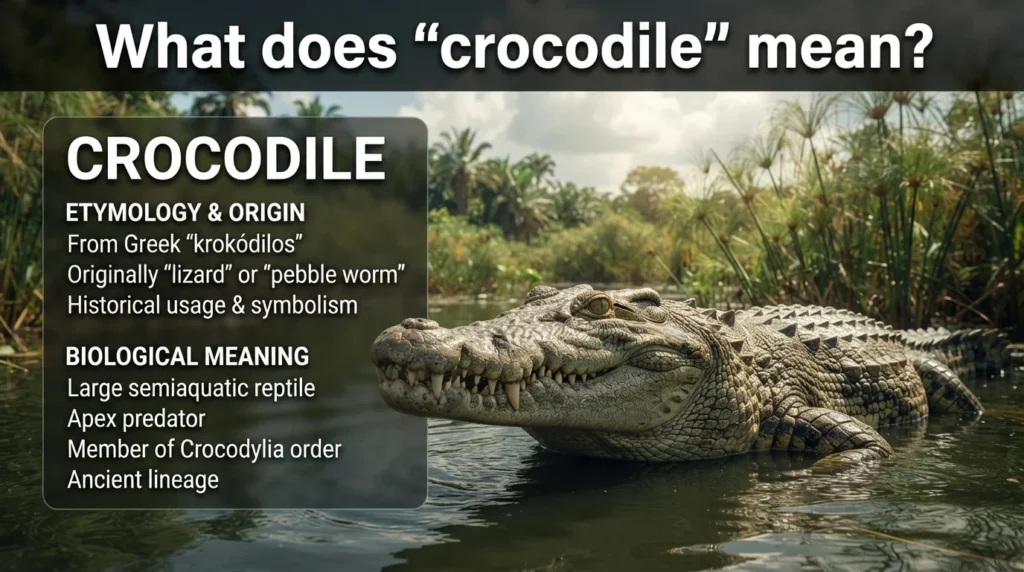
A crocodile is a reptile belonging to the crocodile group. Cambridge describes crocodiles as large, hard-skinned reptiles that live in and around rivers and lakes in warm regions and notes that they generally have longer, narrower noses than alligators.
For example:
- A crocodile moved quietly through the river.
- The documentary follows crocodiles in their natural habitat.
- The guide warned visitors not to approach the crocodile.
The basic distinction
The easiest starting point is this:
- Alligator = one group of crocodilian reptiles, especially associated with a broad, rounded snout.
- Crocodile = a different group of crocodilian reptiles, generally associated with a longer, narrower snout.
- Neither word is the misspelling of the other.
- Crocodilian is the broader zoological term that can include alligators and crocodiles.
Strong comparisons become easier to understand through Similes for Friendship with meanings and examples that capture genuine bonds.
Are Both “Alligator” and “Crocodile” Correct?
Yes. Both are correct English words.
This is not a case like receive versus recieve, where one spelling is standard and the other is a misspelling. Alligator and crocodile are both established nouns with different meanings.
The important issue is word choice, not spelling.
You should use alligator when referring to an animal in the alligator group and crocodile when referring to an animal in the crocodile group.
Correct
- The alligator has a broad, rounded snout.
- The crocodile has a longer, narrower snout.
Incorrect word choice
- The crocodile in Florida was actually an alligator.
This could be correct if the sentence means that someone initially called it a crocodile but later identified it as an alligator. - Every crocodilian is a crocodile.
This is too broad because crocodilian includes groups other than true crocodiles.
What Is the Correct Spelling?

The standard spellings are:
Correct: alligator
Correct: crocodile
There is no spelling correction required between these two forms.
The spelling alligator contains the sequence -igator, while crocodile contains croc- at the beginning and ends in -dile.
Because the words refer to different animals, changing one into the other does not correct a spelling mistake. It changes the meaning.
Difference Between Alligator and Crocodile
| Feature | Alligator | Crocodile |
| Status | Standard English word | Standard English word |
| Word Type | Noun | Noun |
| Animal Group | Alligator group | Crocodile group |
| Snout | Generally broad and rounded | Generally longer and narrower |
| Typical Snout Description | U-shaped | V-shaped or more pointed |
| Teeth With Mouth Closed | Lower fourth tooth is fitted into an upper-jaw socket and is not visible | A lower tooth can remain visible |
| Broader Category | Crocodilian | Crocodilian |
| Meaning | A particular crocodilian group | A particular crocodilian group |
| Common Informal Short Form | gator in U.S. English | croc in informal English |
The Smithsonian’s National Zoo notes that an alligator’s large fourth lower-jaw tooth fits into a socket in the upper jaw, so it is not visible when the mouth is closed. This provides a useful distinction from crocodiles.
PBS’s overview likewise identifies the broad, rounded snout of alligators and the narrower, more pointed snout of crocodiles as important distinguishing features.
Meaning of “Alligator”
The animal
The primary meaning of alligator is a crocodilian reptile belonging to the alligator group. Merriam-Webster identifies modern alligators as large aquatic crocodilian reptiles and specifically includes the American and Chinese alligators.
Alligators have armored bodies, muscular tails, short legs, and rounded snouts. The Smithsonian describes the American alligator as having a long, rounded snout and notes the distinctive arrangement of its fourth lower tooth.
Writers often encounter confusion when choosing between Inter vs Intra usage in English across different words and contexts.
Informal “gator”
In U.S. English, gator is an informal shortened form of alligator. Cambridge lists gator as an informal form.
For example:
The researchers observed a large gator near the marsh.
In formal writing, alligator is usually the safer choice unless the informal form is appropriate to the context.
Meaning of “Crocodile”
The animal
The primary meaning of crocodile is a large crocodilian reptile belonging to the crocodile group. Merriam-Webster describes crocodiles as large, aquatic reptiles of tropical and subtropical waters with long, tapered, V-shaped snouts.
For example:
The crocodile remained partly submerged near the riverbank.
“Croc” as an informal form
Croc is an informal shortened form of crocodile. Merriam-Webster records croc with the meaning “crocodile.”
For example:
The ranger spotted a croc near the water.
This informal form should not be confused with the name of the footwear brand or with other meanings that croc may have in particular contexts.
Pronunciation
The two words are pronounced quite differently.
Alligator
Cambridge gives these pronunciations:
- UK: /ˈæl.ɪ.ɡeɪ.tər/
- US: /ˈæl.ə.ɡeɪ.t̬ɚ/
A practical syllable division is:
al-li-ga-tor
The strongest stress falls on the first syllable.
Crocodile
Cambridge gives:
- UK: /ˈkrɒk.ə.daɪl/
- US: /ˈkrɑː.kə.daɪl/
A practical syllable division is:
croc-o-dile
The first syllable carries the main stress.
Pronunciation tip
Do not try to remember the words solely from their sounds. Their pronunciations are sufficiently different that the more important challenge is remembering which animal each word identifies.
Why Do People Confuse Alligator and Crocodile?
The confusion is primarily semantic rather than orthographic.
Several factors make the words easy to mix up:
- Both refer to large crocodilian reptiles.
- Both are associated with water.
- Both have armored bodies and powerful jaws.
- Their overall body shapes are similar.
- Everyday descriptions sometimes use the broader term crocodilian less frequently than the familiar words alligator and crocodile.
- A person who is unfamiliar with their physical differences may use one word for the other.
The two animals are close relatives, but they are not simply two spellings for the same animal. PBS notes that alligators belong to the family Alligatoridae, whereas crocodiles belong to Crocodylidae.
Alligator vs Crocodile: How to Tell Them Apart
If you are trying to identify the animal rather than merely choose the English word, look at several features.
1. Snout shape
The snout is one of the easiest clues.
Alligator: generally broad and rounded.
Crocodile: generally longer, narrower, and more pointed.
The Smithsonian specifically describes the American alligator’s snout as long and rounded.
2. Teeth
Teeth provide another useful distinction.
In an alligator, the large fourth tooth of the lower jaw fits into a socket in the upper jaw and is hidden when the mouth is closed.
Crocodiles have a different jaw arrangement, allowing a lower tooth to remain visible when the mouth is closed.
This is why photographs of crocodiles can sometimes appear to show teeth protruding from both jaws.
3. Habitat
Habitat can provide a clue, but it should not be treated as an absolute identification rule.
Alligators are associated especially with freshwater environments. Crocodiles occur in a wider range of aquatic environments, including freshwater and, for some species, saltwater or brackish environments.
Habitat alone is therefore not enough to identify an individual animal.
4. Geographic distribution
Alligators have a much more limited modern geographic distribution. Cambridge identifies the American and Chinese regions associated with alligators, while crocodiles occur across broader tropical and subtropical parts of the world.
Geography can help, but species-level identification should not be based on location alone.
Origin and Etymology
The two words have different histories.
Etymology of “alligator”
Merriam-Webster traces alligator through Spanish el lagarto, meaning “the lizard.” The history continues through earlier Romance and Latin forms. Merriam-Webster records 1591 as the first known use of alligator in the relevant sense.
The modern spelling therefore does not simply come from the English words all or gator. Treating alligator as though it were built from the ordinary English word all plus another word can be misleading.
Etymology of “crocodile”
Crocodile has a different and much older linguistic history. Merriam-Webster traces it through Middle English and Latin forms to Greek krokodilos, a word associated with a lizard or crocodile. The dictionary also records the development of the word through forms such as Medieval Latin cocodrillus and Middle English cocodrille.
The spelling history helps explain why crocodile does not look like a straightforward modern English formation. Its spelling reflects a long history of borrowing and alteration.
How to Remember the Difference
The best memory strategy is to connect each word to a physical feature.
Quick Memory Trick
Think:
Alligator = A for Almost rounded
This is only a memory aid, not an etymological rule. It reminds you that an alligator generally has the broader, more rounded snout.
For crocodile, remember:
Crocodile = C for Characteristically narrower snout
Again, this is a learning device rather than a spelling rule.
Visual memory
Picture the two animals side by side:
- Alligator: wider, rounded-looking muzzle.
- Crocodile: narrower, more pointed-looking muzzle.
Then connect the word to the picture rather than trying to memorize two dictionary definitions.
Word-family connection
Useful related terms include:
- alligator
- crocodile
- crocodilian
- crocodile-like
- alligator-like
- gator (informal)
- croc (informal)
The most important distinction is that crocodilian is the broader category term, while alligator and crocodile identify more specific groups.
Examples in Sentences
The following examples show the difference between the two words in natural contexts.
| # | Alligator Example | Crocodile Example |
| 1 | The alligator disappeared beneath the surface of the lake. | The crocodile rested beside the river. |
| 2 | A young alligator was spotted near the marsh. | A crocodile was photographed along the shoreline. |
| 3 | The guide explained how an alligator’s jaw is structured. | The guide explained how a crocodile’s jaws differ. |
| 4 | The researchers monitored the alligator from a safe distance. | The researchers tracked the crocodile’s movement. |
| 5 | The alligator’s broad snout was easy to recognize. | The crocodile’s narrow snout was clearly visible. |
| 6 | The wildlife center rescued an injured alligator. | The wildlife center treated a crocodile brought in by authorities. |
| 7 | The photograph shows an alligator lying in shallow water. | The photograph shows a crocodile swimming through the channel. |
| 8 | An alligator can remain surprisingly still while waiting for prey. | A crocodile can remain motionless near the water’s edge. |
| 9 | The child learned that an alligator is a crocodilian. | The student learned that a crocodile is also a crocodilian. |
| 10 | The ranger pointed out the alligator’s rounded snout. | The ranger pointed out the crocodile’s more pointed snout. |
| 11 | The alligator slipped quietly into the pond. | The crocodile moved slowly through the muddy water. |
| 12 | The documentary focused on the American alligator. | The documentary examined the behavior of Nile crocodiles. |
| 13 | The museum displayed an alligator skull. | The museum displayed a crocodile skull. |
| 14 | The photographer waited until the alligator moved away. | The photographer watched the crocodile from the opposite bank. |
| 15 | The article compares the alligator with other crocodilians. | The article compares the crocodile with other crocodilians. |
These examples demonstrate why replacing one word with the other can change the factual meaning of a sentence.
Common Mistakes to Avoid
- Do not treat the words as alternative spellings. They name different groups of animals.
- Do not assume every crocodilian is a crocodile. The broader term includes alligators as well.
- Do not use snout shape as an absolute rule for every individual. It is a useful general identification feature, not a substitute for species identification.
- Do not assume habitat alone identifies the animal. Different crocodilian species occupy different environments.
- Do not write alligater or alligatorr when you mean alligator.
- Do not write crocadile or crocodile interchangeably. The standard spelling is crocodile.
- Remember that gator is informal. Use alligator when a formal or neutral register is preferable.
- Remember that croc is informal. In formal educational writing, crocodile is usually clearer.
Similar Commonly Confused Animal Terms
Because alligator vs crocodile is not a spelling-error pair, the most useful related comparisons are other crocodilian terms.
| Common Confusion | Correct Distinction | Reason for Confusion |
| Alligator / Crocodile | Different crocodilian groups | Similar appearance and habitat |
| Alligator / Caiman | Different groups within Crocodilia | Caimans resemble alligators |
| Crocodile / Caiman | Different crocodilian groups | Similar body shape and aquatic lifestyle |
| Crocodile / Gharial | Different crocodilian groups | All have elongated bodies and powerful tails |
| Crocodilian / Crocodile | Crocodilian is broader; crocodile is more specific | Similar-looking terminology |
These terms should not be treated as interchangeable labels. The broad biological category and the specific animal group are different concepts.
Related Words
Synonyms and near-synonyms
There is no perfect everyday synonym for either alligator or crocodile when precise animal identification matters.
Some related terms include:
- crocodilian: a broader zoological term covering crocodilians, including alligators and crocodiles.
- gator: informal shortened form of alligator in U.S. English.
- croc: informal shortened form of crocodile.
- reptile: a much broader category that includes alligators and crocodiles.
Calling an alligator a reptile is broadly correct, but calling it a crocodile is not necessarily correct because the two terms identify different groups.
Antonyms
Neither alligator nor crocodile has a meaningful direct antonym. They are animal names, not words describing an opposing quality or action.
Related forms
Useful related forms and compounds include:
- alligator
- alligators
- alligator’s
- alligator-like
- crocodile
- crocodiles
- crocodile’s
- crocodile-like
- crocodilian
- crocodilians
- crocodilian-like
- gator
- croc
Use only forms that fit the intended grammatical and lexical context.
Grammar Tips
Both alligator and crocodile are nouns.
Singular
- The alligator is resting.
- The crocodile is swimming.
Plural
- The alligators moved toward the water.
- The crocodiles disappeared into the river.
With articles
Use the normal English articles:
- an alligator
- a crocodile
- the alligator
- the crocodile
Notice the difference in the indefinite article:
an alligator because alligator begins with a vowel sound.
a crocodile because crocodile begins with a consonant sound.
As modifiers
Both nouns can modify another noun:
- alligator habitat
- alligator skin
- crocodile habitat
- crocodile teeth
- crocodile conservation
The modifier identifies the relevant animal or material.
Writing Tips
When writing an essay, article, report, or educational explanation, choose the word based on the animal you mean.
For professional or academic writing:
- Use alligator when the subject is an alligator.
- Use crocodile when the subject is a crocodile.
- Use crocodilian when discussing the broader group.
- Avoid switching between the terms simply to prevent repetition.
- If identification matters, provide a physical or scientific clue rather than relying on the reader to infer the species.
- Use gator and croc only when the register permits informal language.
For example, instead of writing:
The crocodile was a large reptile, and later the alligator moved toward the same pond.
make sure each animal has actually been identified before using the two different terms.
Quick Spelling and Usage Checklist
| Check | Correct Form or Rule |
| Standard spelling | alligator / crocodile |
| Common misspelling | Neither is a misspelling of the other |
| Meaning | Different crocodilian groups |
| Pronunciation | Different pronunciations |
| Word type | Both are nouns |
| Key distinction | Snout, teeth, classification, and other biological features |
| Informal alligator form | gator |
| Informal crocodile form | croc |
| Broader category | crocodilian |
| Final proofreading check | Confirm that the animal named matches the intended meaning |
Key Takeaways
- Alligator and crocodile are both correctly spelled English words.
- They are not alternative spellings of the same word.
- An alligator generally has a broader, more rounded snout.
- A crocodile generally has a longer and narrower snout.
- Their jaw and tooth arrangements also provide useful identifying differences.
- Both belong to the broader crocodilian group.
- Gator is an informal form of alligator in U.S. English.
- Croc is an informal form of crocodile.
- The safest memory strategy is to connect each word with the animal’s characteristic appearance.
Conclusion
The key to Alligator vs Crocodile is recognizing that this is a vocabulary distinction, not a spelling correction. Both words are standard English nouns, but they identify different crocodilian groups. An alligator is generally recognized by its broader, rounded snout and distinctive jaw arrangement, while a crocodile typically has a longer, narrower snout and a different tooth arrangement.
For everyday writing, the simplest approach is to remember the animals rather than their spellings alone. Associate alligator with the broader, rounded muzzle and crocodile with the narrower, more pointed one. When you need a broader term covering both groups, crocodilian is more appropriate. With that distinction in mind, you can choose the correct word confidently in conversation, schoolwork, professional writing, and educational content.
Frequently Asked Questions
Is “alligator” the correct spelling?
Yes. Alligator is the standard modern English spelling of the word referring to animals in the alligator group. It is not an alternative spelling of crocodile. Merriam-Webster traces the English word through Spanish el lagarto, meaning “the lizard.”
Is “crocodile” the correct spelling?
Yes. Crocodile is the standard English spelling. It refers to reptiles in the crocodile group. The word has a long history involving Greek, Latin, French, and Middle English forms, which helps explain its distinctive spelling.
Are alligators and crocodiles the same animal?
No. They are closely related crocodilians, but they are different groups. Alligators belong to the family Alligatoridae, while crocodiles belong to Crocodylidae. Their snouts and jaw structures also provide useful physical differences.
Which has a wider snout, an alligator or a crocodile?
An alligator generally has the wider, more rounded snout. Crocodiles typically have a longer and narrower snout. This is one of the easiest general physical clues for distinguishing the two animals, although precise identification may require more information.
Can you see an alligator’s lower teeth when its mouth is closed?
The large fourth tooth of an alligator’s lower jaw fits into a socket in the upper jaw and is not visible when the mouth is closed. This differs from crocodiles, whose jaw arrangement can leave a lower tooth visible.
What is the difference between a crocodilian and a crocodile?
Crocodilian is the broader term. It can refer to members of the crocodilian group, including alligators and crocodiles. Crocodile is more specific and refers to animals in the crocodile group. Therefore, an alligator can be described as a crocodilian without being called a crocodile.
Is “gator” another spelling of “alligator”?
No. Gator is an informal shortened form of alligator, particularly in U.S. English. It is not a spelling mistake for alligator. In formal writing, alligator is generally the clearer and more neutral choice.
Is “croc” another spelling of “crocodile”?
No. Croc is an informal shortened form meaning crocodile. It is a legitimate informal word, not a misspelling. For formal or educational writing, however, the full form crocodile is usually preferable.
How do you pronounce “alligator”?
Cambridge gives /ˈæl.ɪ.ɡeɪ.tər/ for UK English and /ˈæl.ə.ɡeɪ.t̬ɚ/ for US English. The main stress is on the first syllable.
How do you pronounce “crocodile”?
Cambridge gives /ˈkrɒk.ə.daɪl/ for UK English and /ˈkrɑː.kə.daɪl/ for US English. The first syllable receives the main stress.
What is the easiest way to remember alligator vs crocodile?
Use the animals’ appearance as your memory aid. Associate alligator with the generally broader, rounded snout and crocodile with the generally longer, narrower snout. You can also remember that gator is an informal shortening of alligator, while croc is an informal shortening of crocodile.

3 thoughts on “Alligator vs Crocodile: Meaning & Key Differences”