
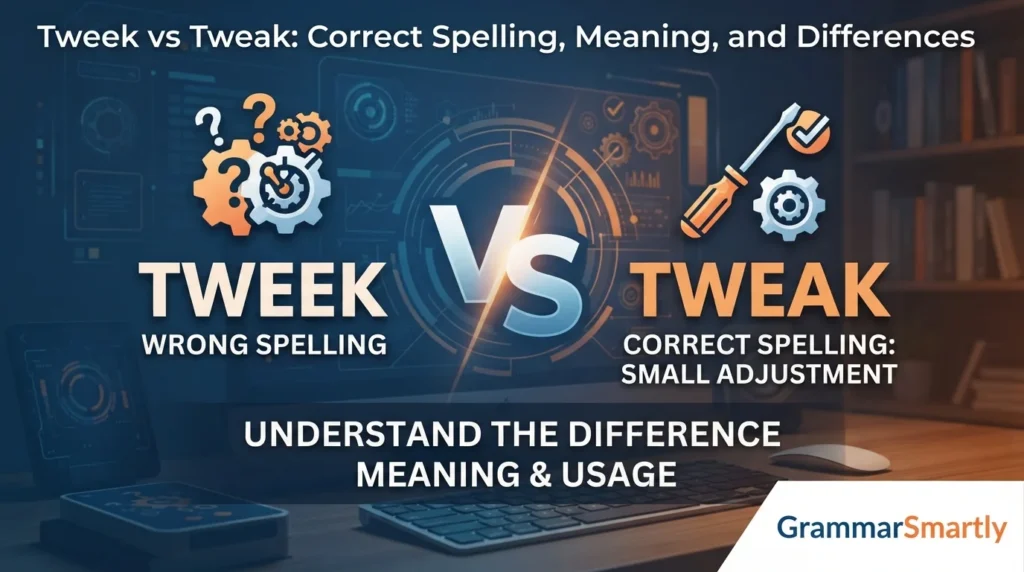
If you’re wondering whether tweek or tweak is correct, the answer is simple: tweak is the standard English spelling. Tweek is a common misspelling that appears frequently in online searches, social media posts, and spelling error lists, but it is not recognized as a standard English word in major dictionaries.
This pair falls into category (a): Pure misspelling, no real alternate meaning.
Why “tweek” Is Such a Common Mistake
The misspelling tweek is well documented in search queries and online writing. It likely happens because English speakers associate the long ee sound with spellings like week, cheek, and seek. However, tweak follows a different spelling pattern, using ea to produce the same long vowel sound.
Major dictionaries, including Merriam-Webster, Cambridge, and Oxford, list tweak but do not recognize tweek as a standard spelling.
What Does “Tweak” Mean?
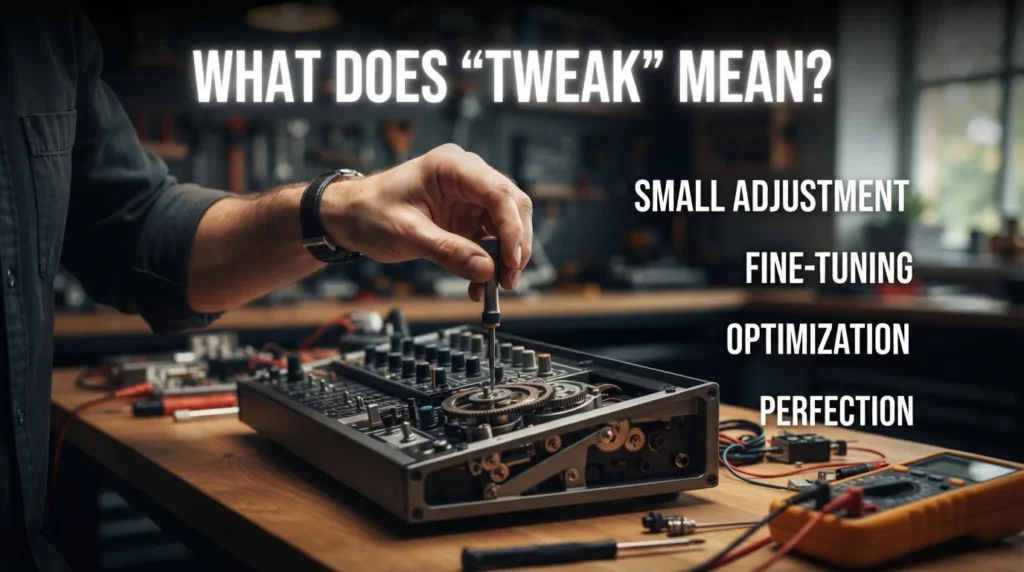
As a verb, tweak means to make a small adjustment or improvement.
Examples:
- She tweaked the presentation before sending it to the client.
- The engineer tweaked the software to improve performance.
- I only needed to tweak the recipe by adding a little more salt.
As a noun, tweak refers to a minor adjustment.
Example:
- The final tweak made the design much easier to use.
The word is especially common in technology, engineering, design, photography, music production, and everyday conversation because these fields often involve making small refinements rather than major changes.
Understanding alligator vs crocodile differences can help readers identify these reptiles more accurately.
Why Is It Spelled “Tweak”?

Unlike many spelling mistakes that come from confusing similar prefixes or suffixes, tweak has an older history.
The word first appeared in English in the early modern period with the meaning to pinch, pull sharply, or twist suddenly, such as tweaking someone’s nose or ear. Over time, its meaning broadened from a physical tug to the figurative idea of making a slight adjustment or fine-tuning something.
That historical development explains why today’s meaning of “make a small improvement” evolved naturally from the original idea of giving something a small pull or twist.
Tweek vs. Tweak at a Glance
| Word | Standard English? | Meaning |
| tweak | Yes | A small adjustment or to make a slight improvement |
| tweek | No | Common misspelling of tweak |
Similar Spelling Patterns
English contains several words where the expected ee spelling is incorrect because the standard form uses ea instead.
| Correct | Common Misspelling | Mechanism |
| tweak | tweek | Long “ee” sound spelled ea |
| speak | speek | Long “ee” sound spelled ea |
| break | breek | Incorrect attempt to regularize spelling |
These are analogous because the confusion comes from English spelling patterns rather than differences in meaning.
How to Remember the Correct Spelling
A useful memory trick is to connect tweak with weak.
Both words contain ea, even though they are pronounced differently. Once you remember that tweak is spelled with ea, the incorrect form becomes much easier to spot.
Another way to remember it is that many people tweak computer settings, photo edits, or recipes, and software menus, manuals, and dictionaries consistently use the spelling tweak.
Frequently Asked Questions
Is “tweek” ever a correct English word?
No. It is not accepted as a standard English spelling in major dictionaries. In ordinary writing, tweek should be corrected to tweak.
Why do so many people write “tweek”?
Because the long ee sound is often spelled ee in English words like week and green. Writers naturally apply that familiar pattern to tweak, even though English spelling is not fully regular.
Can “tweak” be both a noun and a verb?
Yes. It functions as both.
Verb: She tweaked the report.
Noun: The last tweak improved the design.
Is “tweak” only used in technology?
No. Although it is very common in computing and engineering, it is also used for recipes, writing, business plans, sports techniques, photography, and many other situations involving small improvements.
Students often encounter confusion when learning concave vs convex definitions and applying them to geometric figures.
Summary
Tweak is the only standard English spelling and is recognized by major dictionaries. Tweek is a frequent misspelling caused by the expectation that the long ee sound should always be written with ee. The word’s history, beginning with the sense of giving something a small pinch or pull, also explains why it now refers to making a minor adjustment or refinement.






4 thoughts on “Tweek vs Tweak: Correct Spelling, Meaning, and Differences ”