
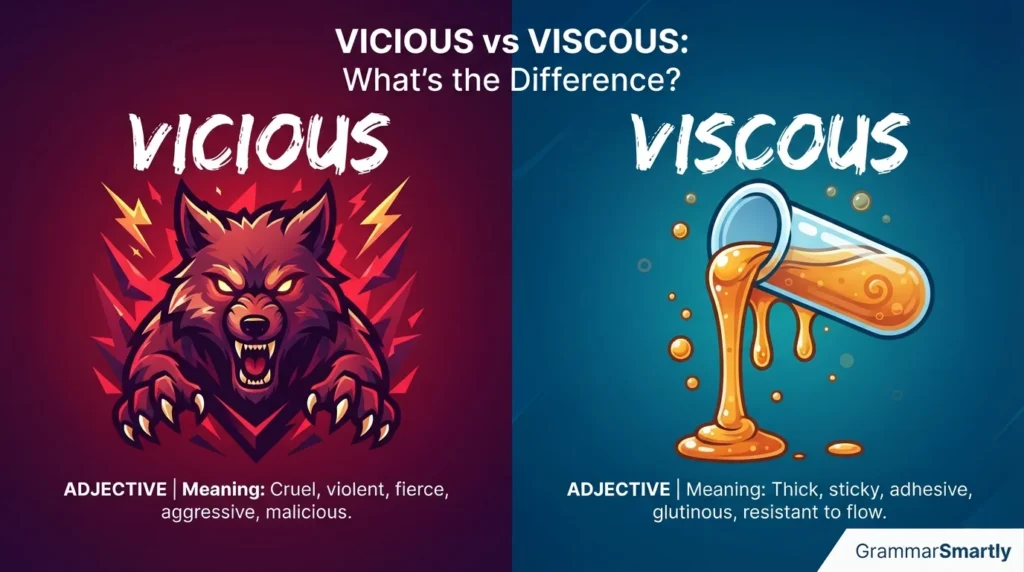
Vicious and viscous are two completely different English words that are genuinely confused because they look and sound somewhat similar. Vicious describes something cruel, violent, or severe, while viscous describes a thick, sticky liquid that resists flowing.
Although neither word is a misspelling of the other, they frequently appear in search queries, proofreading guides, and documented lists of commonly confused words. This pair belongs to category (d): unrelated look-alike words with different meanings and origins, not a simple spelling mistake.
Confusing these terms becomes easier to avoid with clear Tweek and Tweak spelling differences and practical examples.
Vicious Meaning
Vicious is an adjective that describes someone or something that is deliberately cruel, violent, harmful, or extremely severe.
Examples:
- The dog became vicious when threatened.
- They faced a vicious storm that damaged hundreds of homes.
- The article criticized the company in a vicious attack.
The word can describe physical violence, harsh criticism, destructive behavior, or intense conditions.
Viscous Meaning

Viscous is an adjective used mainly in science, engineering, medicine, and everyday descriptions of liquids. It means thick and resistant to flowing easily.
Examples:
- Honey is more viscous than water.
- The mechanic replaced the engine oil with a more viscous lubricant.
- Lava becomes less viscous as its temperature increases.
A highly viscous liquid flows slowly because it has greater internal resistance.
Side-by-Side Comparison
| Vicious | Viscous |
| Means cruel, violent, or severe | Means thick and slow-flowing |
| Describes people, animals, behavior, attacks, storms | Describes liquids and fluids |
| Related to aggression or harm | Related to physical properties of materials |
| Pronounced approximately VISH-us | Pronounced approximately VIS-kuhs |
Why People Mix Them Up
The confusion comes from their similar spelling.
Both words:
- begin with vi-
- contain the letters -cious- or -cous-
- have similar pronunciation patterns
- are adjectives
However, their meanings are completely unrelated.
The easiest way to remember the difference is that viscous contains the root visc-, which is also found in words such as viscosity, the scientific term for a liquid’s resistance to flow. Once you associate viscous with viscosity, the distinction becomes much easier to remember.
Different Origins Explain the Difference
Although the spellings look similar, the words come from different Latin roots.
Vicious comes from the Latin vitiosus, meaning “full of faults, corrupt, or defective.” It entered English through Old French and gradually developed the meanings of cruel, immoral, and violent.
Viscous comes from the Latin viscum, meaning “birdlime,” a naturally sticky substance once used to trap birds. That origin explains why the word has always been associated with stickiness and thickness.
Their different histories reflect their completely unrelated meanings.
Writers often confuse these terms, making Disbalanced, Unbalanced, and Imbalanced usage useful for avoiding awkward word choices.
Examples in Context
Correct:
- The hikers survived a vicious snowstorm.
- Maple syrup is more viscous than milk.
- The boxer suffered a vicious knockout.
- The laboratory measured the viscous properties of the new chemical.
Incorrect:
- The syrup was vicious and difficult to pour.
- The viscous dog attacked the mail carrier.
Similar Word Pairs
If you often confuse vicious and viscous, you may also find these pairs worth learning because they involve similar look-alike words with unrelated meanings:
- stationary vs. stationery
- principal vs. principle
- complement vs. compliment
- eminent vs. imminent
- berth vs. birth
Unlike vicious and viscous, some of these pairs are pronounced differently, while others are true homophones.
Frequently Asked Questions
Is viscous a spelling of vicious?
No. Both are standard English words with different meanings.
Can a person be described as viscous?
Normally, no. Viscous describes liquids or substances. Calling a person viscous would usually be incorrect unless used in a highly unusual figurative sense.
Can a storm be viscous?
Not in ordinary English. Storms are often described as vicious, meaning extremely violent or destructive.
What is viscosity?
Viscosity is the scientific measurement of how much a fluid resists flowing. The higher the viscosity, the more viscous the liquid.
Summary
Vicious refers to cruelty, violence, or extreme severity, while viscous refers to the thickness and flow of liquids. Although their spellings are similar enough to cause genuine confusion, they have different meanings, different origins, and are used in entirely different contexts. Remembering the connection between viscous and viscosity is one of the easiest ways to keep them separate.











3 thoughts on “Vicious vs Viscous: Definition, Meaning & Difference?”