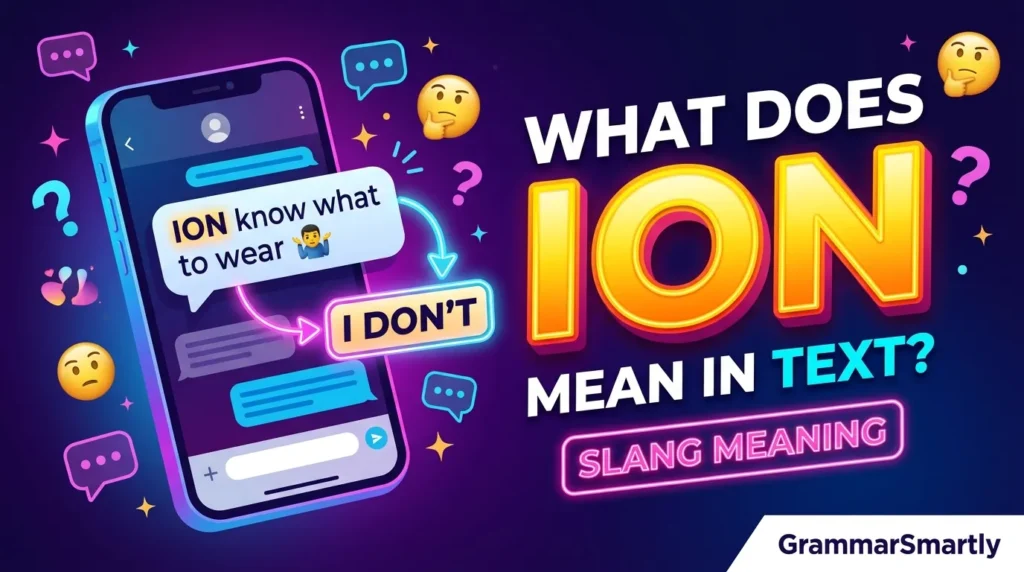
If someone sends you a message containing “ion,” they are probably saying “I don’t.” This informal expression is commonly used in text messages, social media comments, and online conversations. For example, “ion know” means “I don’t know,” and “ion care” means “I don’t care.”
However, ION can also stand for “In Other News,” particularly when someone wants to change the subject. Understanding the surrounding conversation is the easiest way to identify its intended meaning. Let’s explore both meanings, how people use ION online, and some examples to help you understand it.
What Does ION Mean in Text?
In texting and online conversations, ion usually means “I don’t.” It is an informal, phonetic spelling that represents how the words “I don’t” can sound when spoken quickly.
People use it to express disagreement, disinterest, uncertainty, or a negative response without typing the complete phrase.
Here are some common examples:
- ION know: I don’t know.
- ION care: I don’t care.
- ION want to go: I don’t want to go.
- ION think so: I don’t think so.
- ION like it: I don’t like it.
For example:
Person 1: Are you coming to the party tonight?
Person 2: Ion think so. I’m too tired.
In this conversation, the second person means, “I don’t think so. I’m too tired.”
Although ION is sometimes described as an abbreviation, it is more accurately understood as a phonetic spelling of “I don’t.” It reflects informal speech rather than the first letters of a longer expression.
What Does ION Stand for?
ION has two important meanings in digital communication:
- I Don’t: A casual, phonetic spelling commonly used in informal conversations.
- In Other News: An initialism used to introduce a new subject or shift the conversation.
The intended meaning depends on the sentence and conversational context.
| Expression | Meaning | Example |
| ion | I don’t | Ion like that. |
| ION | In Other News | ION, did you hear the announcement? |
Capitalization can provide a clue, but it is not a reliable rule because people frequently type these expressions without consistent capitalization.
The words surrounding ION are usually the best way to determine its meaning.
What Does ION Mean on Snapchat?
On Snapchat, ion usually means “I don’t.” People use it in private messages, group chats, and replies to communicate casually.
Examples:
- “Ion remember sending that snap.” = I don’t remember sending that snap.
- “Ion wanna go out.” = I don’t want to go out.
- “Ion know who that is.” = I don’t know who that is.
- “Ion have any streaks left.” = I don’t have any streaks left.
For example:
Friend 1: Did you save that picture?
Friend 2: Ion think I did.
The second friend means they don’t think they saved the picture.
What Does ION Mean on TikTok?
On TikTok, ion generally means “I don’t.” It frequently appears in video comments, captions, replies, and casual conversations.
Users may write it when expressing opinions, reacting to videos, or responding to something they disagree with.
Examples:
- “Ion understand this trend.” = I don’t understand this trend.
- “Ion see why everyone likes this.” = I don’t see why everyone likes this.
- “Ion think this video is funny.” = I don’t think this video is funny.
- “Ion even know what is happening.” = I don’t even know what is happening.
The meaning does not change specifically because someone uses TikTok. It is the same informal expression found in ordinary text messages.
What Does ION Mean on Instagram?
On Instagram, ion is commonly used in direct messages, comments, captions, and story replies.
It helps people express themselves in a relaxed, conversational way.
Examples:
- “Ion like that outfit.” = I don’t like that outfit.
- “Ion follow random people.” = I don’t follow random people.
- “Ion know why you posted that.” = I don’t know why you posted that.
- “Ion wanna argue with anyone.” = I don’t want to argue with anyone.
When you encounter ion in an Instagram conversation, look at the words that follow it to understand the intended message.
What Does ION Mean in Other News?
ION can also stand for “In Other News.” This is a separate meaning from the slang expression “I don’t.”
People use it to introduce another subject, share unrelated information, or move a conversation in a different direction.
It works similarly to expressions such as “anyway,” “by the way,” and “on another note.”
Examples:
Example 1:
“We had a long day at school. ION, are you watching the game tonight?”
Here, ION introduces a new topic.
Example 2:
“That meeting was exhausting. ION, I finally booked my vacation!”
Here, the speaker moves away from discussing the meeting and shares something different.
Example 3:
“ION, did you hear that Sarah got a new job?”
Here, ION signals that the speaker wants to introduce another piece of information.
This meaning is especially important because someone reading ION as “I don’t” could misunderstand the message.
How to Tell the Difference Between ION Meanings
The easiest way to identify the correct meaning is to examine the sentence structure.
| Context | Meaning | Example |
| Before a verb | I don’t | Ion understand. |
| Before a negative statement | I don’t | Ion want that. |
| Before an unrelated topic | In Other News | ION, guess what happened! |
| In a chemistry discussion | Electrically charged particle | The ion carries a positive charge. |
Remember that capitalization is not enough to determine the meaning. Someone might write “Ion know” at the beginning of a sentence because their phone automatically capitalizes the first word.
Always consider the surrounding words and conversation.
Where Does ION Come From?
The slang spelling ion comes from African American Vernacular English (AAVE), also known as African American English.
It represents a casual pronunciation of “I don’t,” in which the sounds of the two words blend together. The spelling reflects spoken language rather than a traditional abbreviation.
The written form appeared in internet communication during the 2000s. It later became more visible through online communities, music, social media, and texting.
Although it is now used by people from different backgrounds, its connection to Black English is an important part of its linguistic history.
It is also worth understanding that this is not simply a random spelling mistake. It represents a recognizable pronunciation pattern in a particular variety of English.
Wiktionary, the free dictionary+2
Is ION an Acronym or an Abbreviation?
When ion means “I don’t,” it is not technically a conventional acronym.
An acronym is generally formed from the initial letters of a group of words, such as NASA. An initialism is formed similarly but pronounced as individual letters, such as IDK.
The slang spelling ion works differently. It represents the pronunciation of “I don’t” in informal speech.
However, when ION means “In Other News,” it functions as an initialism because each letter represents part of the phrase.
This distinction explains why the same three letters can have two different meanings.
Is ION the Same as IDK?
No. ION and IDK are related in meaning, but they are not interchangeable in every sentence.
- ION: Means “I don’t.”
- IDK: Means “I don’t know.”
For example:
- “Ion want to leave.” = I don’t want to leave.
- “IDK what to do.” = I don’t know what to do.
- “Ion understand the question.” = I don’t understand the question.
- “IDK the answer.” = I don’t know the answer.
The main difference is that ION can be followed by different verbs, while IDK specifically communicates uncertainty or a lack of knowledge.
Is ION Formal or Informal?
ION is an informal expression best suited to casual communication.
You can use it when chatting with friends, responding to social media posts, or participating in relaxed online conversations.
However, avoid using it in:
- Professional emails
- Academic assignments
- Business reports
- Formal applications
- Official documents
- Workplace communication
In these situations, write “I don’t” instead.
For example:
- Informal: “Ion think this is a good idea.”
- Formal: “I don’t think this is a good idea.”
The standard version is clearer and more appropriate for professional readers.
Examples of ION in Everyday Conversations
Here are additional examples showing how people use ion naturally in text messages and online conversations.
| Text message | Meaning in standard English |
| Ion know what happened. | I don’t know what happened. |
| Ion feel like eating. | I don’t feel like eating. |
| Ion wanna talk right now. | I don’t want to talk right now. |
| Ion believe you. | I don’t believe you. |
| Ion have time today. | I don’t have time today. |
| Ion see the problem. | I don’t see the problem. |
| Ion remember his name. | I don’t remember his name. |
| Ion think it’s worth it. | I don’t think it’s worth it. |
| Ion need anything. | I don’t need anything. |
| Ion agree with that. | I don’t agree with that. |
These examples demonstrate that ion is flexible. It can appear before different verbs to express a negative statement.
Frequently Asked Questions About ION
Does ION mean I don’t in texting?
Yes. In most casual texting situations, ion means “I don’t.” For example, “ion know” means “I don’t know.” It is an informal spelling based on pronunciation.
Does ION mean the same thing as ION in other news?
No. These are two different meanings. Lowercase ion commonly represents “I don’t,” while uppercase ION can stand for “In Other News.” The surrounding conversation helps identify the intended meaning.
Is ION rude or disrespectful?
No. ION is not inherently rude or disrespectful. However, expressions such as “ion care” can sound dismissive depending on the conversation, relationship, and tone.
Does ION mean I don’t know?
Not by itself. ION means “I don’t.” When someone writes “ion know,” the complete expression means “I don’t know.”
What does ION mean from a girl or a boy?
The meaning does not change based on whether a girl or boy uses it. In casual messages, both can use ion to mean “I don’t.” The rest of the message determines the tone and intention.
Is ION a Gen Z slang word?
ION is commonly associated with Gen Z texting and internet slang today, but its written use dates back to the 2000s. It has linguistic roots in African American English and did not originate with Gen Z or TikTok.
Is ION the same as ion in chemistry?
No. In texting, ion is an informal spelling of “I don’t.” In chemistry, an ion is an atom or molecule with an electrical charge because it has gained or lost electrons.
Can I use ION in professional messages?
It is better to avoid it in professional communication. Use the standard expression “I don’t” instead to make your message clear and appropriate.
How should I reply when someone texts ION?
Your response depends on the complete message. If someone says “ion know,” you can ask a follow-up question. If they say “ion wanna go,” you can acknowledge their response or suggest another activity.
Is ION a spelling mistake?
Not necessarily. When used to represent “I don’t,” ion is an intentional phonetic spelling found in informal online communication. However, it is not appropriate as a replacement for “I don’t” in standard formal writing.
Conclusion
ION usually means “I don’t” in text messages, social media comments, and online conversations. It is an informal phonetic spelling that reflects how the phrase sounds when spoken quickly.
However, ION can also mean “In Other News” when someone wants to introduce a different topic. The surrounding sentence is the best way to distinguish between these meanings.
Now that you understand both interpretations, you can recognize ION more easily and respond appropriately when it appears in a message.