
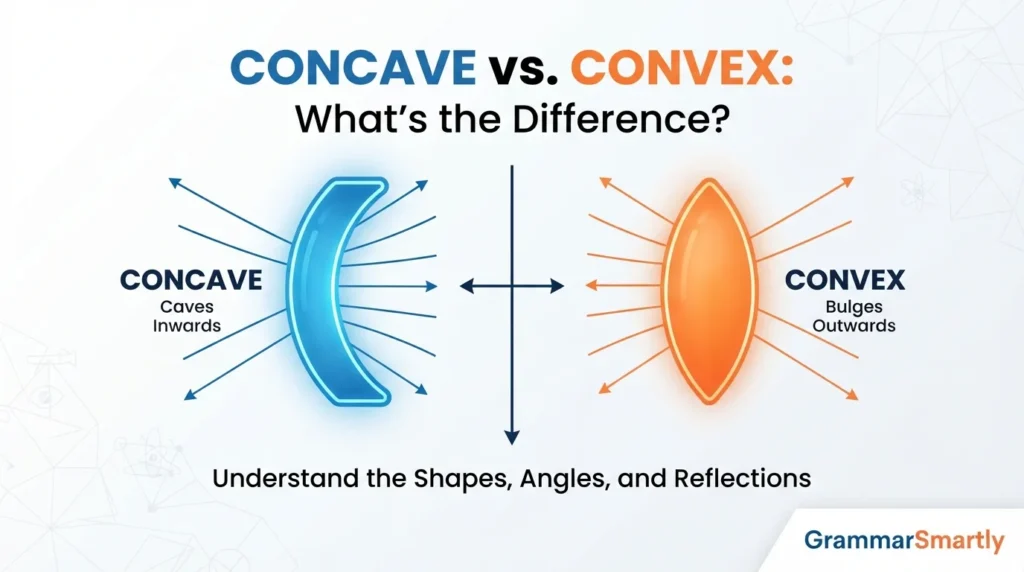
Concave and convex are both correct English words, but they describe opposite shapes. They are frequently confused because they look and sound similar, often appear together in mathematics, geometry, optics, engineering, and everyday descriptions, and differ by only a few letters.
This is not a spelling mistake or an incorrect variant. It belongs to category (h): true near-opposites with a real semantic distinction. Both words are standard English and have distinct meanings.
How Concave and Convex Differ
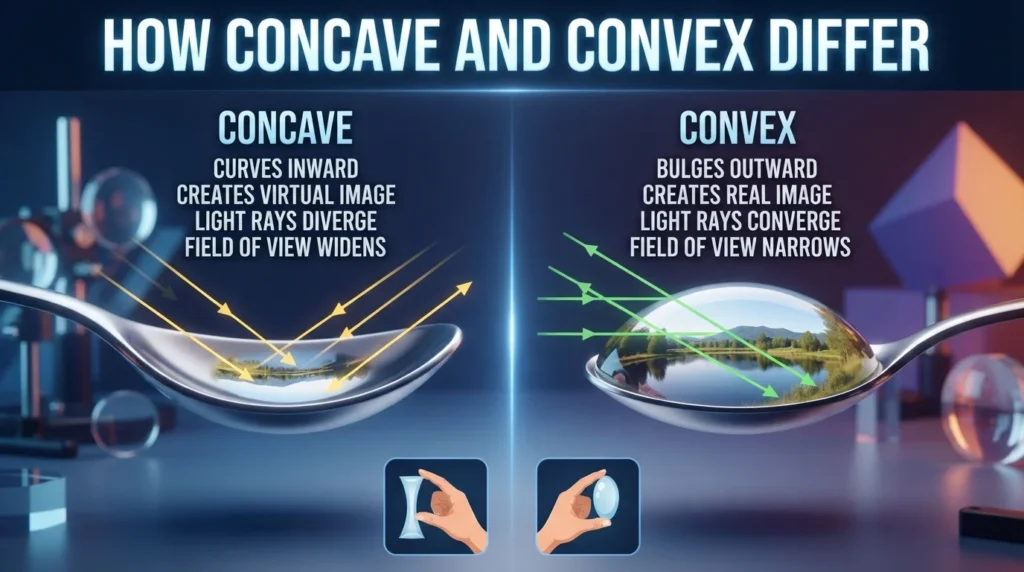
The easiest way to remember the distinction is by the direction of the curve.
| Word | Meaning | Visual idea |
| Concave | Curves inward | Like the inside of a bowl |
| Convex | Curves outward | Like the outside of a ball |
A concave surface has a depression or hollow.
A convex surface bulges outward.
Because the two words describe opposite geometric properties, choosing the wrong one completely changes the meaning.
For practical comparisons, single and double-decker cooler features reveal how these designs differ in capacity and organization.
Why These Words Are So Often Confused
Unlike many commonly mixed-up words, neither concave nor convex is incorrect. The confusion comes from several factors:
- Both begin with con-.
- Both end with -cave/-vex, which many learners do not recognize as meaningful parts.
- They are commonly introduced together in school.
- They describe opposite concepts that are easy to reverse in memory.
Search engines, educational forums, and dictionaries frequently receive queries asking which term describes an inward or outward curve, making this a well-documented point of confusion.
The Meaning of Concave
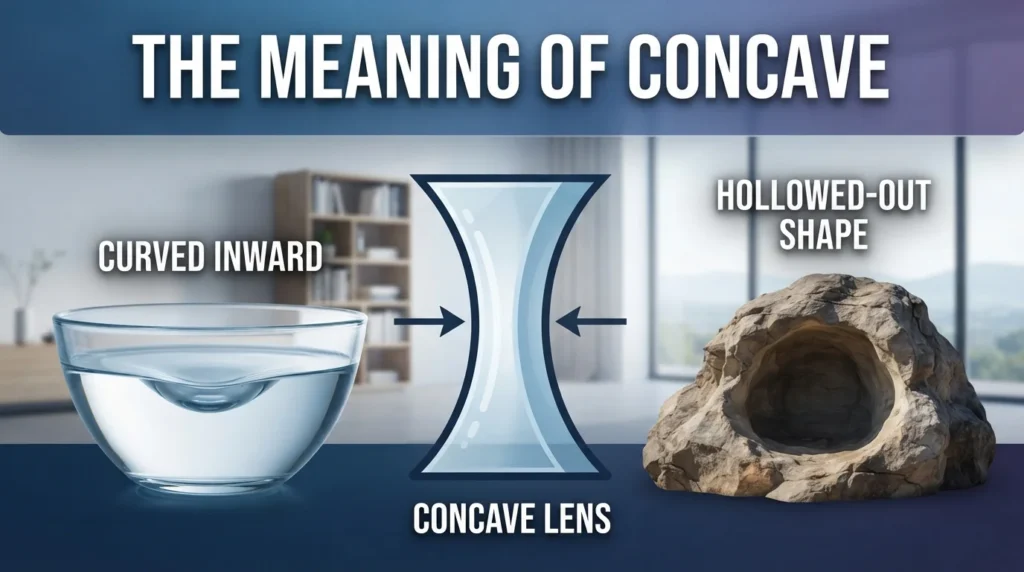
A concave object curves inward, creating a hollow or cavity.
Examples include:
- A spoon’s inner surface is concave.
- Some cave ceilings have concave sections.
- A concave mirror bends inward toward its reflective surface.
Example sentence:
The dentist used a small concave mirror to examine the back of the tooth.
The Meaning of Convex
A convex object curves outward.
Common examples include:
- The outside of a basketball.
- A dome.
- A convex traffic mirror at road intersections.
Example sentence:
The convex mirror gave the driver a wider field of view.
Understanding Unselect vs Deselect differences can make your writing more precise when discussing choices, options, and interface actions.
The Scientific Meaning Behind the Difference
The distinction is especially important in science because the two shapes behave differently.
Concave Mirrors
A concave mirror reflects light inward toward a focal point. Because of this, it can magnify nearby objects or concentrate light.
Examples include:
- Makeup mirrors
- Shaving mirrors
- Reflecting telescopes
- Satellite dishes (which are concave in shape)
Convex Mirrors
A convex mirror spreads reflected light outward.
This produces:
- A wider viewing angle
- Smaller reflected images
- Better visibility around corners
They are commonly used in:
- Vehicle side mirrors
- Security mirrors in stores
- Road safety mirrors
This practical difference is one reason the distinction matters far beyond vocabulary.
A Helpful Memory Trick
Many students remember the words using simple visual cues.
Concave
Think of a cave. A cave goes inward into the ground, just as a concave surface curves inward. While the historical origin of concave is not actually related to the English word cave, the resemblance makes a useful memory aid.
Convex
Think of a surface that bulges outward, like the outside of a ball. Some learners remember the x in convex as representing expansion outward, although this is simply a mnemonic rather than an etymological fact.
Where the Words Come From
The meanings become clearer when you look at their Latin origins.
Concave comes from the Latin concavus, meaning “hollow” or “arched inward.”
Convex comes from the Latin convexus, meaning “vaulted,” “arched,” or “curved outward.”
The opposite meanings have existed since these Latin forms entered English, which explains why the words have always been paired as opposites rather than as spelling variants.
Similar Opposite Pairs
These pairs are often learned alongside concave and convex because they describe opposing physical properties.
| Pair | Difference |
| Inward / Outward | Direction of movement or shape |
| Hollow / Bulging | Shape of a surface |
| Compress / Expand | Size decreases vs. increases |
| Converge / Diverge | Come together vs. move apart |
Unlike these examples, however, concave and convex specifically describe curvature.
Frequently Asked Questions
Is convex the opposite of concave?
Yes. A concave surface curves inward, while a convex surface curves outward.
Can a mirror be both concave and convex?
No. A single reflective surface is typically one or the other, although different sides of an object may have different shapes.
Which is used in car mirrors?
Most passenger-side and security mirrors are convex because they provide a wider field of view.
Is a bowl concave or convex?
The inside of a bowl is concave, while the outside surface is generally convex.
Are concave and convex only mathematical terms?
No. Although they are important in geometry, they are also widely used in physics, engineering, medicine, architecture, and everyday descriptions of shape.
Summary
Concave and convex are both correct words that describe opposite kinds of curvature. A concave surface curves inward, while a convex surface curves outward. Because they are common in science, mathematics, and everyday descriptions, learning the distinction helps avoid mistakes in both academic and practical contexts.