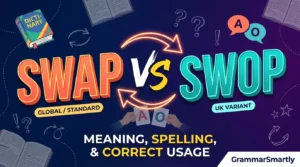
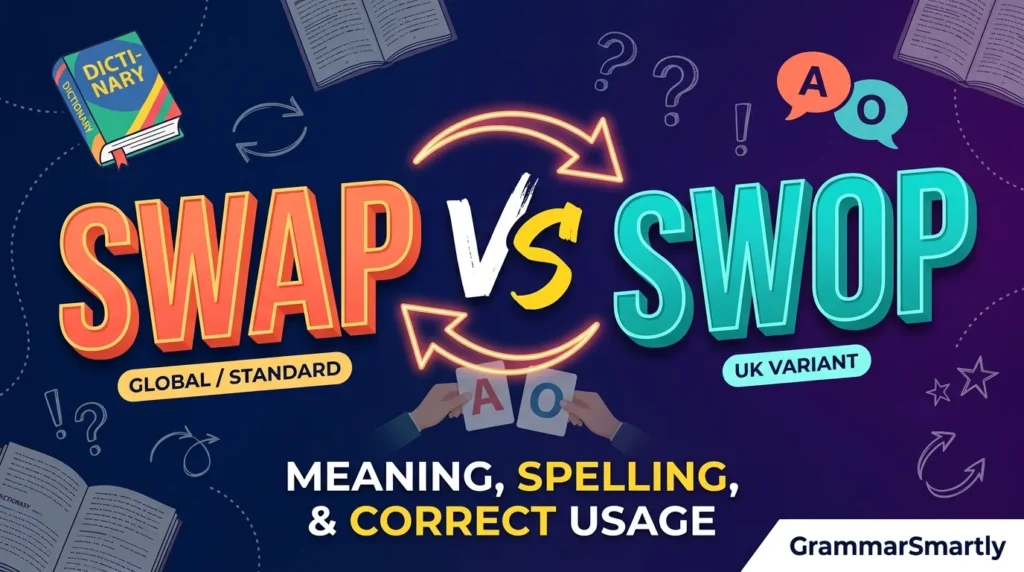
The difference between swap vs swop is not a difference in meaning. Both are legitimate English spellings of a word that means to exchange one thing for another, trade items, switch positions, or share something with another person. The important distinction is their usage: swap is the more widely useful standard choice, while swop is a recognized alternative used especially in British English.
Because the two forms have the same basic meaning, it would be inaccurate to label swop as a simple spelling mistake. However, choosing the most suitable form depends on your audience, region, and writing style. This guide explains the meaning of both spellings, their pronunciation, grammatical forms, origins, and usage in everyday and professional English. You will also find examples, memory tips, common mistakes, and answers to frequently asked questions.
Quick Facts: Swap vs Swop
| Feature | Details |
| Standard form | Swap |
| Alternative form | Swop |
| Word type | Verb and noun |
| Meaning | To exchange, trade, or switch |
| Pronunciation | Generally the same within a given accent |
| Main difference | Swap is the safer general-purpose spelling; swop is especially associated with British English |
| Usage status | Both are recognized English spellings |
| Common error | Assuming that swop is always incorrect |
| Verb forms | Swap, swaps, swapped, swapping; swop, swops, swopped, swopping |
What Does Swap vs Swop Mean?
What Does Swap Mean?

Swap is a verb meaning to exchange one thing for another. It can also be a noun referring to an exchange or something exchanged.
The word applies to physical objects, responsibilities, positions, arrangements, ideas, and other things that people can exchange or switch.
Examples:
- We decided to swap books after finishing them.
- Could you swap seats with me?
- The two colleagues arranged a shift swap.
- During lunch, the students swapped stories about their holidays.
The word can describe a direct exchange, a replacement, or a change from one arrangement to another.
Understanding the difference between Eventhough and Even Though in English helps you avoid common spelling mistakes and write more accurately.
What Does Swop Mean?
Swop is a recognized alternative spelling of swap. It has the same principal meaning and can function as either a verb or a noun.
Examples:
- The children agreed to swop their trading cards.
- We arranged a swop of weekend duties.
- She swopped her green jacket for a blue one.
- The players spent the afternoon swopping stories.
The spelling is particularly associated with British English. It is not necessary to learn a separate definition for swop, because its meaning is essentially the same as that of swap.
What Is the Difference Between Swap and Swop?
The difference is mainly orthographic, meaning that it concerns how the word is written rather than what it means.
- Swap: The broadly established spelling and the best default for most general-purpose writing.
- Swop: A legitimate alternative spelling, especially in British English.
- Meaning: Both forms can describe the same exchange or switch.
- Grammar: Both forms can be used as nouns and verbs.
- Practical choice: Use swap when you want the most widely recognizable spelling across international audiences.
For example, We swapped our books and We swopped our books express the same basic idea. The choice of spelling does not change the nature of the exchange.
Are Both Swap and Swop Correct?
Yes. Both spellings are recognized in English dictionaries, although they do not have the same degree of general usefulness across all audiences.
Swap is the recommended default for most readers. It is the form to choose when writing for an international audience, preparing schoolwork, or aiming for consistency in general English.
Swop is also correct, particularly in British English usage. It can appear in ordinary conversation and writing, including sentences about exchanging objects, changing duties, or switching positions.
The important distinction is between an alternative spelling and a misspelling. A misspelling fails to follow the accepted spelling of the intended word. A recognized alternative, by contrast, is a valid form even when another spelling is more widely preferred.
Consider these examples:
- Correct: Would you swap your seat with mine?
- Also correct: Would you swop your seat with mine?
- Incorrect for the intended word: Would you swapp your seat with mine?
The third example adds an unnecessary letter and is not a standard spelling of the intended word.
What Is the Correct Spelling?
The two accepted spellings are swap and swop. If you need one form to use consistently, choose swap.
The spelling swap contains four letters: S, W, A, and P. The alternative swop replaces the letter A with O.
This single-letter difference does not produce a different meaning in ordinary use.
Why Swap Is a Useful Default
Choose swap when:
- Writing an academic assignment or examination answer.
- Preparing a business email for an international audience.
- Writing website content intended for readers from different English-speaking regions.
- Following a style guide that specifies swap.
- Using related expressions such as swap places, swap ideas, and swap information.
If you choose swop for a British audience, use it consistently within the same document.
Spelling Patterns and Word Forms
The verb swap has these common forms:
| Grammatical form | Spelling | Example |
| Base form | swap | We swap books. |
| Third-person singular | swaps | She swaps shifts. |
| Past tense | swapped | They swapped tickets. |
| Past participle | swapped | The items have been swapped. |
| Present participle | swapping | He is swapping seats. |
| Noun, plural | swaps | The swaps were arranged yesterday. |
The alternative spelling follows a corresponding pattern:
| Grammatical form | Spelling | Example |
| Base form | swop | We swop books. |
| Third-person singular | swops | She swops shifts. |
| Past tense | swopped | They swopped tickets. |
| Past participle | swopped | The items have been swopped. |
| Present participle | swopping | He is swopping seats. |
| Noun, plural | swops | The swops were arranged yesterday. |
The spelling changes in the past and present participle forms are important. Standard forms include swapped and swapping, or swopped and swopping. Avoid mixing the two patterns within a single word.
Difference Between Swap and Swop
| Feature | Swap | Swop |
| Status | Standard English spelling | Recognized alternative spelling |
| Meaning | Exchange, trade, or switch | Exchange, trade, or switch |
| Word type | Verb and noun | Verb and noun |
| Pronunciation | Accent-dependent pronunciation | Generally the same pronunciation as swap in the same accent |
| Usage | Broadly useful across English varieties | Especially associated with British English |
| Past tense | Swapped | Swopped |
| Present participle | Swapping | Swopping |
| Modern writing | Recommended general-purpose choice | Suitable where the alternative is accepted and consistent |
The key point is that the spelling difference does not create a semantic distinction. If someone writes swop rather than swap, the reader should generally understand the same exchange or change.
Nevertheless, spelling conventions matter in edited writing. A document that uses swap in one paragraph and swop in another may look inconsistent unless there is a deliberate reason for the variation.
Discovering how to use Entwined and Intertwined correctly in sentences makes your English writing clearer and more precise.
Meaning of Swap and Swop
Literal Meaning
In their literal sense, both words describe exchanging one item, person, or position for another.
Examples include exchanging clothes, trading collectible cards, changing seats, or arranging for two people to exchange duties.
- The hikers swapped their packed lunches.
- The children swopped stickers during the break.
- We swapped the damaged component for a working one.
The exchange may be mutual, but it does not always have to involve objects of equal value.
Figurative Meaning
Both words can also describe changes that are not limited to physical objects.
For example, people can swap roles, exchange ideas, change responsibilities, or replace one arrangement with another.
- The managers swapped responsibilities for the afternoon.
- The speakers swapped opinions after the debate.
- The company swapped its old booking process for a digital system.
These examples describe changes in roles, information, or arrangements rather than simple exchanges of physical goods.
Common Contexts
Both forms can appear in several everyday situations:
- Clothing and possessions: swapping jackets, books, toys, or accessories.
- Work schedules: arranging a shift swap or exchanging duties.
- Travel: swapping seats or changing travel arrangements.
- Education: swapping notes, books, or study materials.
- Conversation: swapping stories, ideas, or opinions.
- Technology: swapping components or replacing one item with another.
- Sports: exchanging players or changing positions.
- Everyday decisions: swapping one activity or arrangement for another.
In all these contexts, swap is the straightforward general-purpose spelling.
Pronunciation of Swap and Swop
IPA Pronunciation
The exact pronunciation varies with accent. Common dictionary transcriptions include:
| English variety | Swap | Swop |
| British English | /swɒp/ | /swɒp/ |
| American English | /swɑːp/ or /swɑp/, depending on the transcription system | /swɑːp/ or /swɑp/, depending on the transcription system |
The symbol /ɒ/ represents the vowel heard in many British pronunciations of hot. The symbol /ɑː/ or /ɑ/ represents a more open back vowel, as heard in many American pronunciations of father.
Pronunciation varies among individual speakers, so these transcriptions are useful guides rather than a complete description of every accent.
Syllable Breakdown
Both swap and swop are one-syllable words.
- Swap: one syllable.
- Swop: one syllable.
Neither word needs to be divided into smaller spoken syllables for ordinary pronunciation practice.
Pronunciation Tips
To pronounce either spelling:
- Begin with the /s/ sound, as in sun.
- Move directly into the /w/ sound, as in win.
- Pronounce the vowel used in your accent.
- Finish with the /p/ sound, as in map.
The main difference between the written forms is the vowel letter, A or O. That difference does not necessarily create a pronunciation contrast between the two words within the same accent.
Why Do People Confuse Swap and Swop?
The Words Have the Same Meaning
The most important reason for confusion is that both spellings are accepted for the same basic word. Readers may encounter one form in a text and the other elsewhere, then assume that one must be a mistake.
In reality, the distinction is one of spelling convention and regional preference, not a difference between two unrelated meanings.
The Vowel Letters Look Like an Alternative Spelling
The letters A and O distinguish the written forms, but the difference can be easy to overlook during proofreading. Someone may also remember seeing swop in British writing without knowing that it is a recognized variant.
Regional Usage Influences Familiarity
Readers tend to become familiar with the spellings they encounter most often in their own reading and writing environments. Someone accustomed to swap may regard swop as an error, while a reader familiar with British usage may recognize it as an alternative.
Familiarity, however, is not the same as a universal spelling rule.
Inconsistent Word Forms Create Additional Errors
Writers sometimes combine the base form of one spelling with the inflections of the other.
Examples include:
- swopped paired with swapping in a document that otherwise uses swop.
- swopping used when the intended form is swapping.
- swaped, which omits one of the letters required in the standard past-tense spelling swapped.
The solution is to learn the word family as a complete set rather than memorizing only the base form.
Origin and Etymology of Swap and Swop
The history of swap helps explain why the word has a spelling variation.
The verb has roots in Middle English. Its earlier sense was associated with striking or throwing forcefully, and its development into the modern idea of exchanging something is linked to the older practice of striking hands to confirm a bargain. The precise origin has been described as probably imitative, rather than established with absolute certainty.
Swop is recognized as a variant spelling of swap. It is therefore unnecessary to invent a separate origin or meaning for the alternative form.
The modern distinction is best understood through spelling usage: both forms refer to exchanging or switching, while swap is the safer general-purpose choice for contemporary international writing.
How to Remember the Correct Spelling
Quick Memory Trick
Remember this simple rule:
When in doubt, choose SWAP.
Think of the A in swap as your automatic choice for general writing. You can still recognize swop when you encounter it, but you do not need to use the alternative yourself.
This is a practical writing preference, not a claim that the O spelling is incorrect.
Word-Family Connection
Learn the related forms together:
- Swap
- Swaps
- Swapped
- Swapping
- Swapable is not the standard form; use swappable when you mean capable of being swapped.
- Swop
- Swops
- Swopped
- Swopping
The spelling swappable retains the double P before the suffix. The spelling swopping likewise retains the double P in the alternative word family.
Visual Pattern
Compare the two sets:
- SWAP, SWAPPED, SWAPPING
- SWOP, SWOPPED, SWOPPING
The matching patterns make it easier to avoid mixing forms. Once you select a base spelling, keep the same vowel in the related verb forms.
Examples in Sentences
Both spellings can be used to express the same idea. The examples below demonstrate their use as verbs and nouns, including exchanges of objects, changes of position, and exchanges of information.
| Swap Example | Swop Example |
| 1. Maya agreed to swap her paperback novel for a cookbook. | 1. Maya agreed to swop her paperback novel for a cookbook. |
| 2. Could we swap seats so that my grandmother can sit near the aisle? | 2. Could we swop seats so that my grandmother can sit near the aisle? |
| 3. The neighbours arranged a swap of gardening tools. | 3. The neighbours arranged a swop of gardening tools. |
| 4. Two teachers swapped classroom duties for the afternoon. | 4. Two teachers swopped classroom duties for the afternoon. |
| 5. The children are swapping football cards after school. | 5. The children are swopping football cards after school. |
| 6. I would swap my early shift for your late shift if that helps. | 6. I would swop my early shift for your late shift if that helps. |
| 7. We swapped contact details before leaving the conference. | 7. We swopped contact details before leaving the conference. |
| 8. The mechanic swapped the faulty cable for a new one. | 8. The mechanic swopped the faulty cable for a new one. |
| 9. The cousins decided to swap rooms during the family visit. | 9. The cousins decided to swop rooms during the family visit. |
| 10. The students swapped revision notes before the examination. | 10. The students swopped revision notes before the examination. |
| 11. After the meeting, the two researchers swapped ideas about the project. | 11. After the meeting, the two researchers swopped ideas about the project. |
| 12. We made a fair swap: my desk lamp for his bookcase. | 12. We made a fair swop: my desk lamp for his bookcase. |
| 13. The coach swapped two players to strengthen the defence. | 13. The coach swopped two players to strengthen the defence. |
| 14. They swapped their usual weekend plans to attend the ceremony together. | 14. They swopped their usual weekend plans to attend the ceremony together. |
| 15. The two departments agreed to swap equipment for a month. | 15. The two departments agreed to swop equipment for a month. |
These paired examples show that the two spellings can be interchangeable in meaning. They do not imply that every publication or style guide will prefer them equally.
Common Mistakes to Avoid
- Calling swop a misspelling in every context: It is a recognized alternative, especially in British English.
- Assuming the words have different definitions: Both normally mean to exchange, trade, or switch.
- Mixing verb forms: Use swapped and swapping, or swopped and swopping.
- Writing swaped: The usual past-tense spelling is swapped, with two Ps.
- Writing swappping: The standard present participle is swapping, with two Ps, not three.
- Confusing swap with stop: These are different words with different meanings.
- Using swop in a document that requires a specified spelling convention: Follow the publication’s style guide.
- Assuming pronunciation always determines spelling: The two spellings may sound alike in the same accent, so sound alone may not identify the written form.
Similar Commonly Misspelled Words
The following examples illustrate spelling variations and letter-pattern issues that can cause uncertainty. They are not all examples of the same linguistic phenomenon as swap and swop.
| Common Error or Confusion | Correct Form or Distinction | Reason for Confusion |
| Swapp | Swap | An unnecessary final consonant is added. |
| Swaped | Swapped | The past-tense spelling requires a doubled P. |
| Swaping | Swapping | The final consonant is doubled before -ing. |
| Swopping vs. swapping | Both are valid forms in their respective spelling patterns. | The alternative base spelling changes the inflected form. |
| Advice vs. advise | Advice is a noun; advise is a verb. | The final sound and spelling differ. |
| Affect vs. effect | Usually a verb and a noun, respectively, in common uses. | Similar pronunciation and related meanings in some contexts. |
| Practice vs. practise | Usage depends on English variety and grammatical role. | British and American spelling conventions differ. |
| Travelled vs. traveled | Both are accepted in different English spelling conventions. | British and American spelling preferences differ. |
The broader lesson is to check whether a disputed form is an actual error or an accepted alternative before correcting it.
Related Words
Synonyms
Several words can replace swap in appropriate contexts, although none fits every sentence equally well.
- Exchange: A broad term for giving one thing and receiving another.
- Trade: Often emphasizes exchanging goods, services, or assets.
- Switch: Usually emphasizes changing from one option, position, or arrangement to another.
- Interchange: Emphasizes exchanging positions or using things in place of one another.
- Barter: Refers to exchanging goods or services without using money as the medium of exchange.
- Replace: Means putting one thing in the place of another. Unlike swap, it does not necessarily imply a mutual exchange.
- Trade places: Means exchanging positions or, figuratively, experiencing another person’s situation.
For instance, you can swap books or exchange books. You can also replace a broken part, but that does not necessarily mean that you exchange it with another person.
Antonyms
There is no single universal antonym for swap, because its meaning varies with context. Depending on the intended contrast, useful opposites may include:
- Keep: Retain something rather than exchange it.
- Retain: Continue to possess or maintain something.
- Hold on to: Avoid giving something away or exchanging it.
- Keep unchanged: Preserve the existing arrangement rather than switch it.
These are contextual opposites, not exact replacements in every sentence.
Related Forms
| Word | Part of Speech | Meaning or Use |
| Swap | Verb and noun | Exchange, trade, or an exchange |
| Swop | Verb and noun | Alternative spelling of swap |
| Swapped | Past tense and past participle | Exchanged or switched |
| Swapping | Present participle and gerund | Exchanging or switching |
| Swopped | Past tense and past participle | Alternative form of swapped |
| Swopping | Present participle and gerund | Alternative form of swapping |
| Swappable | Adjective | Capable of being swapped |
| Swapper | Noun | A person who swaps something |
Use the word forms that match the spelling convention you have selected.
Grammar Tips
Swap as a Verb
The verb commonly appears in several useful patterns.
Swap something with someone
This pattern identifies the other person involved in the exchange.
Example: I swapped my notes with a classmate.
Swap something for something else
This pattern identifies what is received in exchange.
Example: She swapped her old backpack for a smaller one.
Swap places with someone
This means to exchange positions or, in some contexts, to imagine being in another person’s situation.
Example: I would not swap places with the referee during that difficult match.
Swap ideas, stories, or information
This describes people sharing information with each other.
Example: The delegates swapped ideas during the workshop.
Swap as a Noun
The noun can refer to the act of exchanging or to the arrangement itself.
Examples:
- The shift swap was approved by the supervisor.
- We arranged a book swap for the end of term.
- That was a fair swap for both collectors.
Correct Verb Forms
Remember these grammatical patterns:
- Present: I swap.
- Third-person singular: He swaps.
- Past: They swapped.
- Present perfect: We have swapped.
- Continuous: She is swapping.
For the alternative spelling, the corresponding forms include swop, swops, swopped, and swopping.
Noun and Verb Agreement
When swap is a verb, its form changes according to the subject and tense. When it is a noun, it can be singular or plural.
- Singular noun: The swap was completed yesterday.
- Plural noun: Several swaps took place at the event.
- Singular verb: He swaps books with his brother.
- Plural-subject verb: They swap books every month.
Writing Tips
Academic Writing and Exams
In schoolwork, university assignments, and examinations, use swap unless your teacher, course materials, or prescribed style guide specifies another accepted convention. It is a clear and widely recognizable choice.
Do not mark swop as universally incorrect if you are evaluating English usage. Instead, distinguish between a legitimate variant and a spelling that does not belong to the accepted word family.
Professional Emails
In workplace communication, clarity and consistency are more important than using an alternative spelling simply for variety.
Examples:
- Could we swap our meeting times next week?
- Please let me know whether a shift swap is possible.
- We can swap the two files if necessary.
These sentences use the broadly suitable spelling.
Website and Blog Writing
For online content intended for a mixed international audience, swap is a sensible default. It also works naturally in headings and search phrases such as swap vs swop, swap meaning, and how to swap items.
If your website follows a British English house style that permits swop, apply that choice consistently and avoid treating the variant as a typographical error.
Proofreading and Editing
When proofreading, check the following:
- Does the sentence require a verb or a noun?
- Is the intended meaning exchange, replacement, or switching?
- Is the spelling consistent with the document’s style?
- Are the past-tense and -ing forms written correctly?
- Has an accidental extra or missing letter changed the word?
A spelling checker may flag or overlook a variant depending on its language settings. A dictionary and the relevant style guide can help resolve the question.
Quick Spelling Checklist
| Check | Correct Form or Rule |
| Standard spelling | Swap |
| Alternative spelling | Swop |
| Common incorrect form | Swaped |
| Meaning | Exchange, trade, or switch |
| Pronunciation | Accent-dependent; the forms generally share a pronunciation within the same accent |
| Word type | Verb and noun |
| Key spelling pattern | Swap, swapped, swapping |
| Alternative word family | Swop, swopped, swopping |
| Common usage | Use swap as the general-purpose default |
| Final proofreading check | Keep spelling and inflected forms consistent |
Key Takeaways
- Swap and swop are both recognized English spellings.
- Both words have the same principal meaning: to exchange, trade, or switch.
- Swap is the most practical default for general-purpose and international writing.
- Swop is particularly associated with British English.
- The spelling difference does not normally change pronunciation or meaning within the same accent.
- Use swapped and swapping with swap.
- Use swopped and swopping with swop.
- Check the intended style and audience before correcting an alternative spelling.
Conclusion
The choice between swap and swop becomes straightforward once you understand that both are legitimate spellings rather than words with different definitions. They can describe exchanging possessions, changing positions, trading responsibilities, or sharing information. The principal distinction is usage preference, with swap serving as the more widely useful default and swop remaining a recognized alternative, especially in British English.
For school assignments, professional communication, and content written for readers around the world, choosing swap is a practical way to maintain broad recognition and consistency. If you use swop, remember to carry its spelling through the related forms swopped and swopping. A useful memory aid is to treat swap, swapped, and swapping as one spelling family. Most importantly, distinguish an actual spelling mistake from an accepted variant. This approach will help you write accurately without incorrectly rejecting legitimate English usage.
Frequently Asked Questions
Is swap or swop the correct spelling?
Both are correct. Swap is the more widely useful general-purpose spelling, while swop is a recognized alternative used especially in British English. They share the same basic meaning, so the choice is primarily a matter of spelling preference and consistency rather than meaning.
Is swop a real English word?
Yes. Swop is a recognized English word and an alternative spelling of swap. It can function as both a noun and a verb. For example, They swopped books describes the same basic action as They swapped books. Its recognition means that it should not automatically be treated as a misspelling.
Does swap mean something different from swop?
No, not in their ordinary use as alternative spellings. Both can refer to exchanging objects, switching positions, or trading responsibilities. The distinction is primarily orthographic and related to usage preferences. If you want one spelling that works well for a broad international audience, swap is a sensible choice.
Is swop British English?
Swop is particularly associated with British English and is recognized as an alternative spelling of swap. That does not mean every British writer must use it, or that it is limited to one country. Writers can use swap in British English as well. The best choice depends on personal preference and the relevant style guide.
How do you pronounce swap and swop?
The words generally have the same pronunciation within a given accent. Many British pronunciations use /swɒp/, while many American pronunciations use a vowel represented as /ɑ/ or /ɑː/ in dictionary transcription. Individual accents vary, so the written difference between A and O does not necessarily indicate a difference in spoken sound.
What is the past tense of swap?
The standard past tense of swap is swapped. For example, We swapped our seats before the performance began. The spelling doubles the final P. The corresponding past-tense form of the alternative spelling swop is swopped. Keep the form consistent with the base spelling you choose.
Is it swapping or swopping?
Both swapping and swopping are accepted forms. Swapping comes from swap, while swopping comes from swop. Each form uses a doubled P before the -ing ending. Choose the version that matches your selected spelling convention, and avoid mixing the two patterns in the same word.
Can I use swop in formal writing?
You can use swop when it fits your audience and the applicable style guide. However, swap is generally the safer choice for formal documents intended for international readers. If a publisher, employer, or educational institution specifies a preferred spelling, follow that requirement rather than assuming that every accepted variant is equally suitable in every context.
What does swap mean as a noun?
As a noun, swap can refer to an exchange or to something exchanged. In a sentence such as The book swap attracted dozens of readers, the word names an exchange activity. In That was a fair swap, it refers to the exchange itself. The alternative noun spelling is swop.
What is the difference between swapped and swopped?
Swapped is the past tense and past participle of swap. Swopped is the corresponding form of swop. Both can describe an exchange that has already taken place. For consistency, write swap, swapped, swapping or swop, swopped, swopping, rather than combining forms from the two spelling patterns.
How can I remember whether to write swap or swop?
Use swap as your default spelling for general English writing. Remember the sequence swap, swapped, swapping, and learn the alternative sequence swop, swopped, swopping for recognition. This simple grouping prevents mistakes in the related forms and helps you identify swop as an accepted variant rather than automatically treating it as an error.
Should I use swap or swop in an English examination?
Unless the examination instructions or prescribed style guide indicate otherwise, swap is the safest general-purpose choice. It is widely recognizable and straightforward to use in standard writing. If you encounter swop in a reading passage, understand it as a recognized alternative spelling, not necessarily as evidence of a spelling mistake.